
Loading, please wait...
LOT 1863
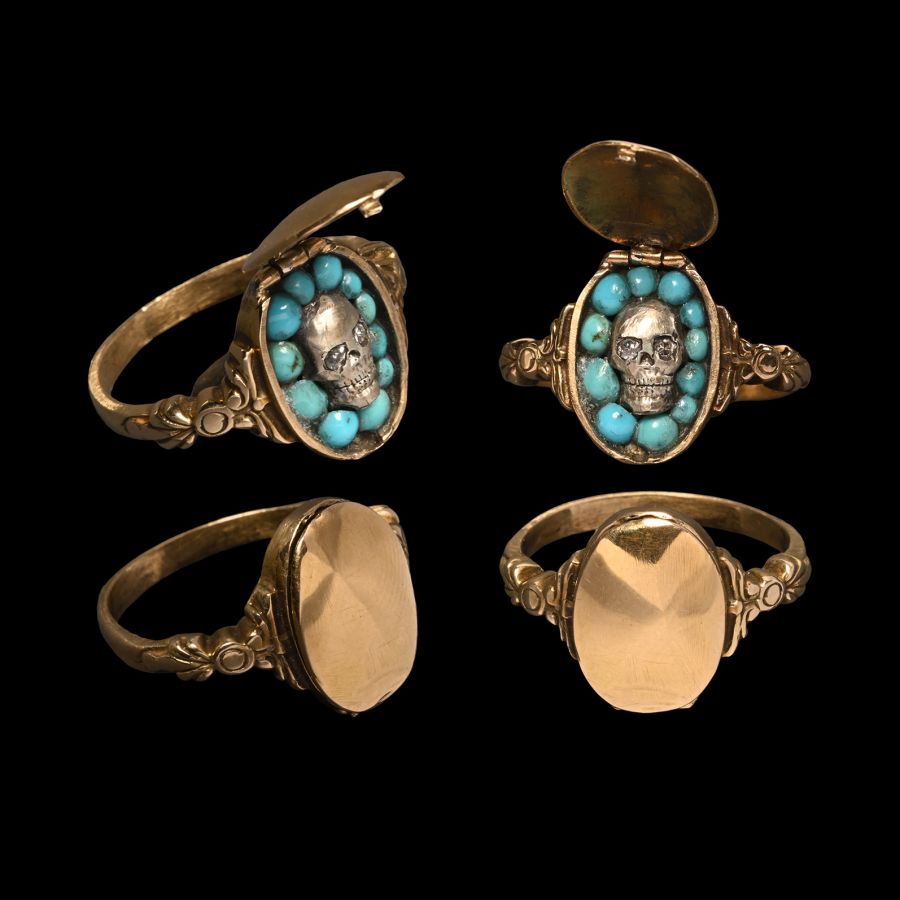
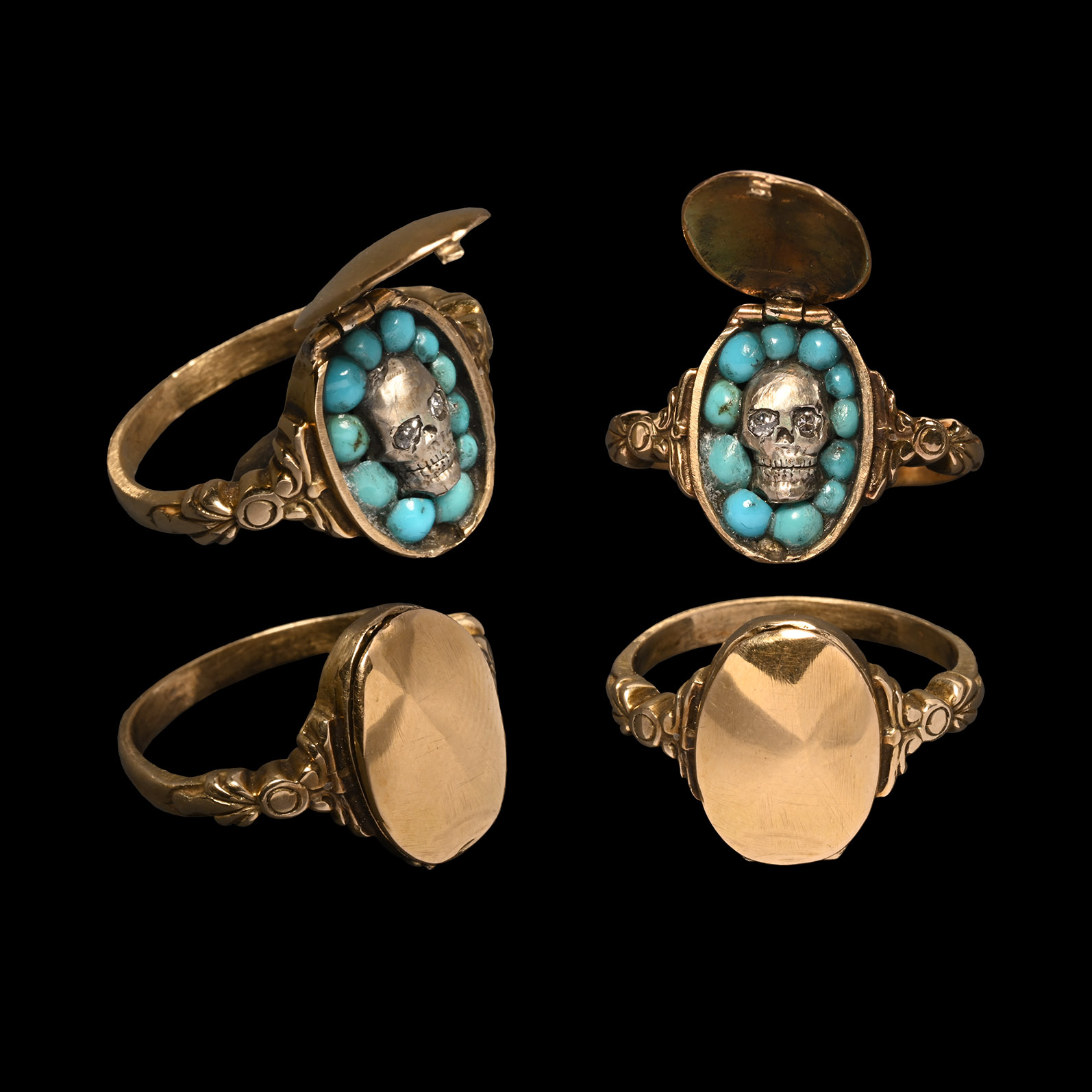
Georgian Gold Locket Ring with Skull
CIRCA 1800 A.D.
3/4 in. (3.95 grams, 20.00 mm overall, 16.20 mm internal diameter (approximate size British J, USA 4 3/4, Europe 8.69, Japan 8)).
Comprising a slender hoop with shell-shaped shoulders, hinged oval bezel with secret compartment revealing a silvered skull framed by turquoise cabochons, the eyes set with diamonds or other stones; accompanied by a ring box.
ProvenanceAcquired from Berganza, Hatton Garden, London, 2016.
Property of an East Sussex collector.
Accompanied by a copy of the Berganza invoice.
This lot has been checked against the Interpol Database of stolen works of art and is accompanied by search certificate no.11666-197585.
Cf. Oman, C.C., British Rings 800-1914, London, 1974, plate 90(D), for ring with compartment in which to place a lock of hair, etc.
FootnotesLikely a ring of the memento mori genre.
CONDITIONTimeLine Auctions follows a vetting process to ensure the authenticity and legality of all items, reinforcing our commitment to integrity and responsible trading. Each antiquity, antique, and coin lot undergoes thorough examination by a vetting committee of at least ten external specialists, professional trade association members, scientists, and archaeologists: Our Vetting Process
AUCTIONS:
TimeLine is a leading auction house specialising in antiquities, ancient art, collectables, natural history, coins, medals, and books. Our auctions offer museums, collectors, historians, and enthusiasts the opportunity to acquire unique and historically significant pieces.
-
.jpg)
Eastern Greek Style Lapis Lazuli and Gold Bead Necklace
20th century A.D.Sold for (Inc. bp): £780
Composed of graduated mainly tubular lapis lazuli beads with later gold openwork spacer beads, gold biconvex and waisted cage beads; restrung. 28.68 grams, 42 cm long
Fine condition.
Acquired in the late 1980s-early 1990s. Property of a West London gentleman. Ex private collection on Dr H.B., Sussex, UK. -
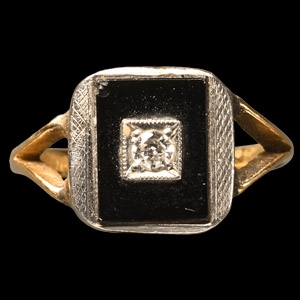
Post Medieval Gold Memorial Ring with Diamond
Late 19th-20th century A.D.Sold for (Inc. bp): £156
Featuring openwork shoulders and rectangular bezel set with a platinum-mounted diamond against a black background; stamped '18 ct & pt' to reverse. 3.35 grams, 19.05 mm overall, 14.94 mm internal diameter (approximate size British F, USA 2 3/4, Europe 3.67, Japan 3)
Acquired 1990s-early 2000s. East Anglian private collection. -
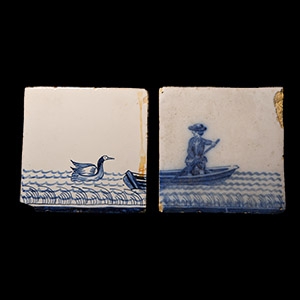
Post Medieval Glazed Ceramic Tile Set with Boating Scene
Circa 18th century A.D.Sold for (Inc. bp): £46
A duck or swan shown on the water; tiles of different thicknesses. 454 grams total, 13 x 13 cm each
Acquired 1990s-early 2000s. East Anglian private collection.
