
Loading, please wait...
_900x900.jpg "French WWII 'Donkey Ears' Trench Periscope")
_200x200.jpg "French WWII 'Donkey Ears' Trench Periscope")
.jpg "French WWII 'Donkey Ears' Trench Periscope")
LOT 1103
French WWII 'Donkey Ears' Trench Periscope
1940S A.D.
11 5/8 in. (1.69 kg, 29.5 cm).
Aluminium bodied binocular trench periscope with green finish, fitted with folding handle and leather neck strap; with original leather case fitted with shoulder strap and belt/webbing loop.
ProvenanceThe Kusmirek Collection, UK.
CONDITIONTimeLine Auctions follows a vetting process to ensure the authenticity and legality of all items, reinforcing our commitment to integrity and responsible trading. Each antiquity, antique, and coin lot undergoes thorough examination by a vetting committee of at least ten external specialists, professional trade association members, scientists, and archaeologists: Our Vetting Process
AUCTIONS:
TimeLine is a leading auction house specialising in antiquities, ancient art, collectables, natural history, coins, medals, and books. Our auctions offer museums, collectors, historians, and enthusiasts the opportunity to acquire unique and historically significant pieces.
-
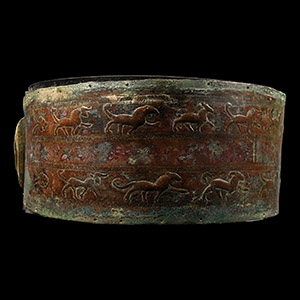
Urartian Bronze Cuirass Belt with Animals
8th-7th century B.C.Sold for (Inc. bp): £4,160
Displaying two repoussé registers of animals including lions, antelope and birds processing right between geometric borders, stylised flower heads to one terminal; attachment perforations to upper and lower edges; one rounded terminal, one terminating with a narrow arm and D-shaped lug; mounted on an adjustable custom-made display stand. 6.4 kg total, 35 cm high including stand
some restoration.
UK private collection before 2000. UK art market. Property of a London gentleman. Accompanied by an academic report by Raffaele D'Amato. This lot has been checked against the Interpol Database of stolen works of art and is accompanied by search certificate number no.11745-202242.
Protective belts were very popular in the Caucasus, especially among the Urartians, decorated with geometric motifs, or with images of warriors, animals, hunting and mythological tales. They were regarded as a personal item and eventually buried with the warrior. -
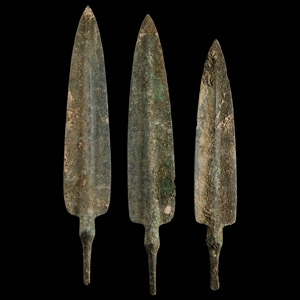
Western Asiatic Bronze Arrowhead Group
1st millennium B.C.Sold for (Inc. bp): £117
The tanged trio with leaf-shaped heads and raised midrib to both faces. 112 grams total, 13.7-15.3 cm
Ex private collection, 1980s. Acquired on the UK art market in the 1990s. -
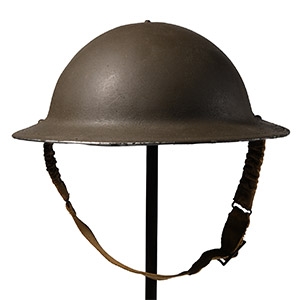
British WWII 'Tommy's' Helmet
1939-1945 A.D.Sold for (Inc. bp): £130
Standard issue steel helmet with leather liner and fabric chin-strap, finished green. 1.14 kg, 31 wide
The Kusmirek Collection, UK.
