
Loading, please wait...
_900x900.jpg "French Stone Age Mousterian Flint Racloir")
_200x200.jpg "French Stone Age Mousterian Flint Racloir")
_900x900.jpg "French Stone Age Mousterian Flint Racloir")
_200x200.jpg "French Stone Age Mousterian Flint Racloir")
.jpg "French Stone Age Mousterian Flint Racloir")
.jpg "French Stone Age Mousterian Flint Racloir")
LOT 1539
French Stone Age Mousterian Flint Racloir
MIDDLE PALAEOLITHIC PERIOD, MOUSTERIAN CIRCA 150,000- 60,000 B.P
3 3/4 in. (59 grams, 97 mm).
Very well formed example with neat retouch, some cortex, inked legend 'Plazac / Dord'. [No Reserve]
ProvenanceFound in the Dordogne, France.
Acquired on the European art market.
From the private collection of an East Anglian, UK, specialist collector.
This lot is accompanied by an illustrated lot declaration signed by the Head of the Antiquities Department, Dr Raffaele D'Amato.
Made by Neanderthals.
CONDITIONTimeLine Auctions follows a vetting process to ensure the authenticity and legality of all items, reinforcing our commitment to integrity and responsible trading. Each antiquity, antique, and coin lot undergoes thorough examination by a vetting committee of at least ten external specialists, professional trade association members, scientists, and archaeologists: Our Vetting Process
AUCTIONS:
TimeLine is a leading auction house specialising in antiquities, ancient art, collectables, natural history, coins, medals, and books. Our auctions offer museums, collectors, historians, and enthusiasts the opportunity to acquire unique and historically significant pieces.
-
.jpg)
French Stone Age Mousterian Flint Racloir Drill
Middle Palaeolithic Period, Mousterian circa 150,000-60,000 B.PSold for (Inc. bp): £59
Very well formed example with neat retouch leading to a sharp point to form a drill/piercer; with old label 'Grattoir Percoir'. 86 grams, 84 mm
Found Mainxe, France, 1 April 1968. From the private collection of famous UK musician and amateur archaeologist, Victor Brox (1941-2023). From the private collection of an East Anglian, UK, specialist collector. This lot is accompanied by an illustrated lot declaration signed by the Head of the Antiquities Department, Dr Raffaele D'Amato.
Made by Neanderthals. -
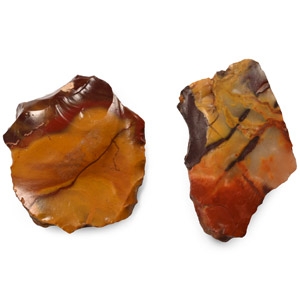
Stone Age Fontmaure Jasper Neanderthal Levellious Tool Group
Middle Palaeolithic Period, Mousterian, circa 150,000-60,000 B.PSold for (Inc. bp): £130
Cordate and irregular scraper group with fine retouch on each piece. 41 grams total, 46-51 mm
From Fontmaure, Vienne department, France. From the private collection of famous UK musician and amateur archaeologist, Victor Brox (1941-2023). Acquired on the UK art market. From the private collection of an East Anglian, UK, specialist collector. This lot is accompanied by an illustrated lot declaration signed by the Head of the Antiquities Department, Dr Raffaele D'Amato.
From the well regarded area of Fontmaure, the jasper has vibrant colours and traces of chalcedony running through it. -
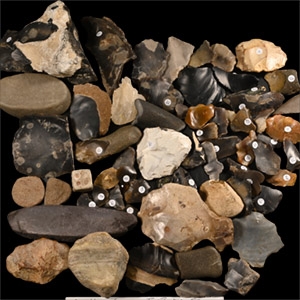
Stone Age Collection of Excavation and Field-Walking Finds From Clacton
Palaeolithic-Neolithic Period, circa 200,000-4,000 B.P.Sold for (Inc. bp): £52
Including various worked tools with cutting edges, debitage and a polished smoothing stone; most with a collector's numeric label. 3.36 kg total, 1.9-15.5 cm
Found West Clacton, Essex. Collected in the 1970s when the finder was a building inspector with Clacton & District Council. Property of a Little Oakley gentleman, Harwich, UK. This lot is accompanied by an illustrated lot declaration signed by the Head of the Antiquities Department, Dr Raffaele D'Amato.
