
Loading, please wait...
_900x900.jpg "French Stone Age Mousterian Flint Convergent Tool")
_200x200.jpg "French Stone Age Mousterian Flint Convergent Tool")
_900x900.jpg "French Stone Age Mousterian Flint Convergent Tool")
_200x200.jpg "French Stone Age Mousterian Flint Convergent Tool")
.jpg "French Stone Age Mousterian Flint Convergent Tool")
.jpg "French Stone Age Mousterian Flint Convergent Tool")
LOT 1526
French Stone Age Mousterian Flint Convergent Tool
MIDDLE PALAEOLITHIC PERIOD, MOUSTERIAN, CIRCA 150,000- 60,000 B.P
3 1/2 in. (65 grams, 89 mm).
Very well formed example with neat retouch leading to a sharp point; milky light blue and cream patina; inked legend to flat face 'MG / Georgean / CM'. [No Reserve]
ProvenanceFound in the Dordogne, France.
Ex M.G. Georgeon collection.
Acquired on the European art market.
From the private collection of an East Anglian, UK, specialist collector.
This lot is accompanied by an illustrated lot declaration signed by the Head of the Antiquities Department, Dr Raffaele D'Amato.
Made by Neanderthals.
CONDITIONTimeLine Auctions follows a vetting process to ensure the authenticity and legality of all items, reinforcing our commitment to integrity and responsible trading. Each antiquity, antique, and coin lot undergoes thorough examination by a vetting committee of at least ten external specialists, professional trade association members, scientists, and archaeologists: Our Vetting Process
AUCTIONS:
TimeLine is a leading auction house specialising in antiquities, ancient art, collectables, natural history, coins, medals, and books. Our auctions offer museums, collectors, historians, and enthusiasts the opportunity to acquire unique and historically significant pieces.
-
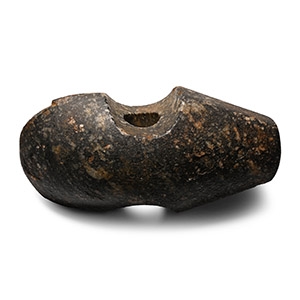
Stone Age Scandinavian Pierced Battle Axehead
Neolithic Period, 6th-4th millennium B.C.Sold for (Inc. bp): £780
Finely formed axehead in a dark diorite with asymmetric convex cutting edge, with pronounced 'seam' to upper surface; rounded 'hammer' butt, pierced to receive handle with projecting socket to underside. 814 grams, 15 cm
From the private collection of a London gentleman, from his grandfather's collection formed before the early 1970s. This lot is accompanied by an illustrated lot declaration signed by the Head of the Antiquities Department, Dr Raffaele D'Amato. -
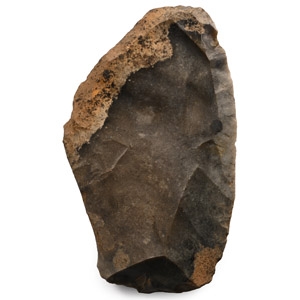
French Stone Age Mousterian Flint Racloir
Middle Palaeolithic Period, Mousterian circa 150,000- 60,000 B.PSold for (Inc. bp): £78
Very well formed example with neat retouch, cortex to trailing edge; inked legend 'Plazac / Dord)'. 66 grams, 94 mm
Found in the Dordogne, France. Acquired on the European art market. From the private collection of an East Anglian, UK, specialist collector. This lot is accompanied by an illustrated lot declaration signed by the Head of the Antiquities Department, Dr Raffaele D'Amato.
Made by Neanderthals. -
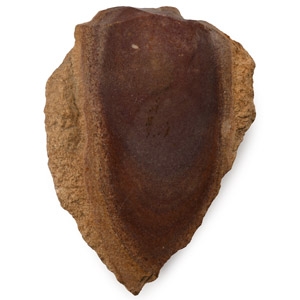
French Stone Age Neanderthal Levallois Point
Middle Palaeolithic Period, Mousterian, circa 150,000-60,000 B.P.Sold for (Inc. bp): £104
Triangular point with cortex; in old collector's sleeve with inked notation 'Mousterion . pink / a 8 kms north of Bergerac (Dordogne) around campsegret / [.] - 100,000 years old'. 82 grams, 86 mm
Found 8km North of Bergerac, near Campsegret, Dordogne France. Acquired on the European art market. From the private collection of an East Anglian, UK, specialist collector. Accompanied by a copy of the relevant book pages where this handaxe is published. This lot is accompanied by an illustrated lot declaration signed by the Head of the Antiquities Department, Dr Raffaele D'Amato.
