
Loading, please wait...
_900x900.jpg "Frankish Silver-Gilt S-Shaped Bird Brooch with Garnets")
_200x200.jpg "Frankish Silver-Gilt S-Shaped Bird Brooch with Garnets")
.jpg "Frankish Silver-Gilt S-Shaped Bird Brooch with Garnets")
LOT 0349
Frankish Silver-Gilt S-Shaped Bird Brooch with Garnets
5TH-6TH CENTURY A.D.
1 1/4 in. (7.58 grams, 30 mm).
S-shaped plate brooch formed with a profile bird-head finial at each end with inset garnet cabochon eye, hatched panels and inlaid garnet cloisons; pin-lugs and catch to reverse. [No Reserve]
ProvenancePrivate collection formed in Europe in the 1980s.
Westminster collection, central London, UK.
This lot has been cleared against the Art Loss Register database, and is accompanied by an illustrated lot declaration signed by the Head of the Antiquities Department, Dr Raffaele D'Amato.
Cf. Beck, H. et al., Fibel und Fibeltracht, Berlin, 2000, item 468; similar brooches from the Frankish cemetery at Monceau-le-Neuf-et-Faucouzy, deptn Aisne, France in Menghin, W., The Merovingian Period. Europe Without Borders, item VII.23.2; and the S-fibula from Schwarz-Rheindorf, Westphalia, in Menghin, W., The Merovingian Period. Europe Without Borders, item VII.48.27.
FootnotesDuring the mid-sixth century the S-brooch, along with the disc brooch, became popular. These were made primarily of gilded silver embellished with garnet inlays or in garnet cloisonné. Early forms of S-shaped brooches appear in graves in Scandinavia throughout the fifth century and in Europe during the first decades of the sixth century, and reached the height of their popularity during the latter half of that time. They were widespread across Europe and are found in central and western Europe, Italy, Scandinavia and Anglo-Saxon England. They generally take the form of an S-shaped body with heads at either end facing in opposite directions. The heads are generally depicted as birds but examples are known of unidentified animals with splayed open jaws, possibly dragons or wolves. The use of the head imagery is consistent with the aesthetic tendencies associated with the northern, Pagan Germanic world.
CONDITIONTimeLine Auctions follows a vetting process to ensure the authenticity and legality of all items, reinforcing our commitment to integrity and responsible trading. Each antiquity, antique, and coin lot undergoes thorough examination by a vetting committee of at least ten external specialists, professional trade association members, scientists, and archaeologists: Our Vetting Process
AUCTIONS:
TimeLine is a leading auction house specialising in antiquities, ancient art, collectables, natural history, coins, medals, and books. Our auctions offer museums, collectors, historians, and enthusiasts the opportunity to acquire unique and historically significant pieces.
LOT 0349
Frankish Silver-Gilt S-Shaped Bird Brooch with Garnets
Sold for (Inc. bp): £3,120
-
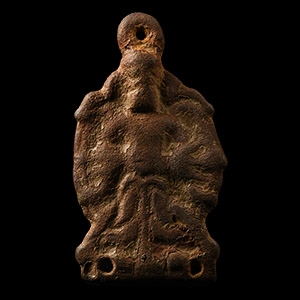
Anglo-Scandinavian Viking Bronze Stirrup Apex Mount with Odin Bound by Serpents
11th century A.D.Sold for (Inc. bp): £624
An excessively rare example of Williams Class A, Type 3 showing a standing nude man with beard and long moustache, an animal-like form around the man's waist extending towards the flanking serpents on each side, the serpents' tails wrapped around the man's legs and their open jaws gape on either side of the man's head. 26.6 grams, 54 mm
Found Sutton Fields, Sutton on the Forest, Yorkshire, UK, on 21 November 1999. From the private collection of Robin Sykes, Yorkshire, UK, formed since the late 1990s. Accompanied by an illustrated record sheet by Jim Halliday dated 22 November 1999, and various off-prints. This lot is accompanied by an illustrated lot declaration signed by the Head of the Antiquities Department, Dr Raffaele D'Amato. -
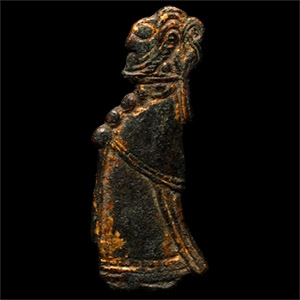
Scandinavian Viking Gilt Bronze 'Valkyrie' Plaque
9th-11th century A.D.Sold for (Inc. bp): £1,170
Profile image of a female in floor-length robe with shawl to her shoulders, stylised headdress and long plaited band of hair to the rear, shoes at the lower edge; pierced lug to the reverse. 9.16 grams, 48 mm
Private collection formed in Europe in the 1980s. Westminster collection, central London, UK. This lot is accompanied by an illustrated lot declaration signed by the Head of the Antiquities Department, Dr Raffaele D'Amato. -
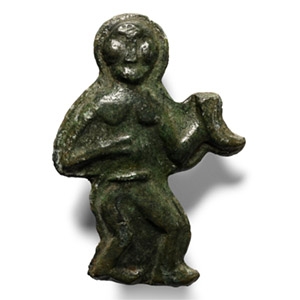
Scandinavian Pre-Viking Bronze Patrix Die with God and Drinking Horn
4th-5th century A.D.Estimate: £1,500 - 2,000 (+bp*)
Opening Bid: £500
Modelled in the half-round, advancing figure with bent legs and holding a drinking horn. 7.62 grams, 37 mm
From the private collection of a London gentleman, from his grandfather's collection formed before the early 1970s. This lot has been cleared against the Art Loss Register database, and is accompanied by an illustrated lot declaration signed by the Head of the Antiquities Department, Dr Raffaele D'Amato.
