
Loading, please wait...
LOT 0073
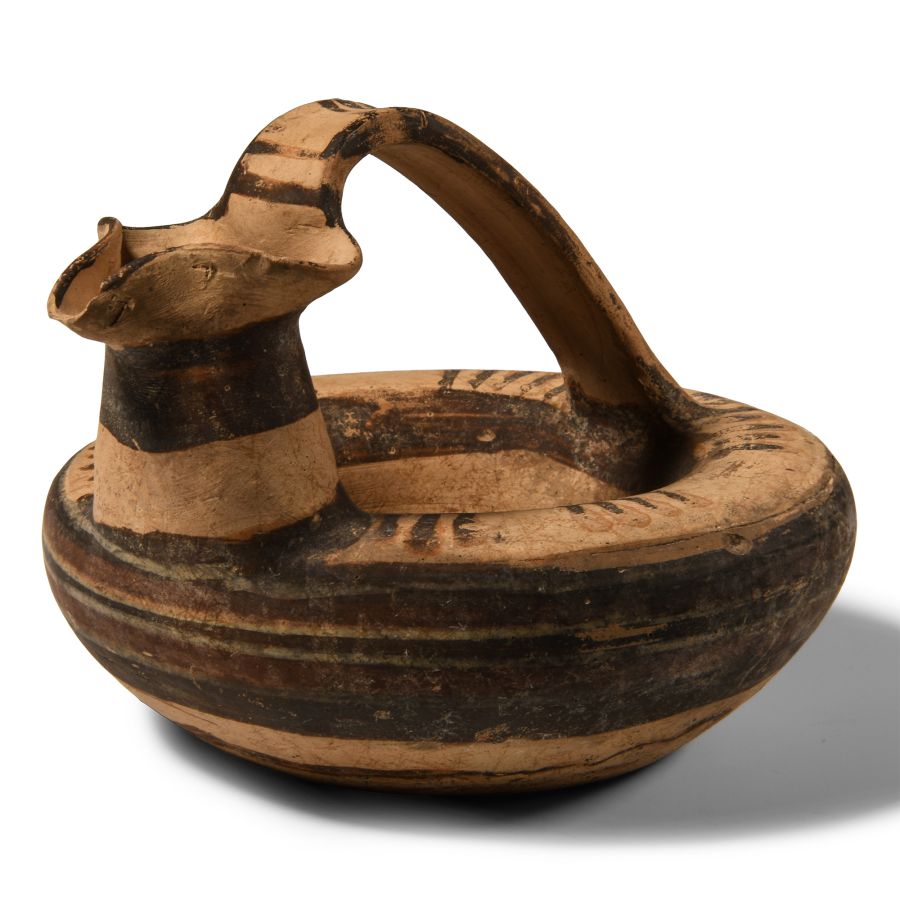
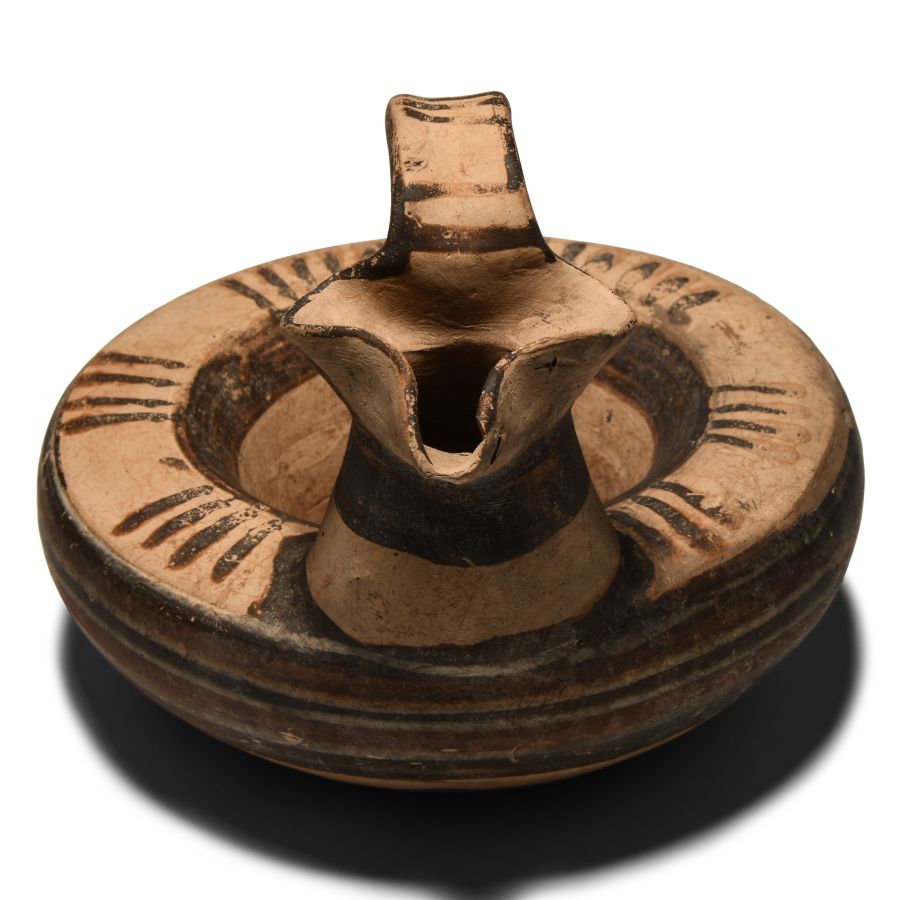
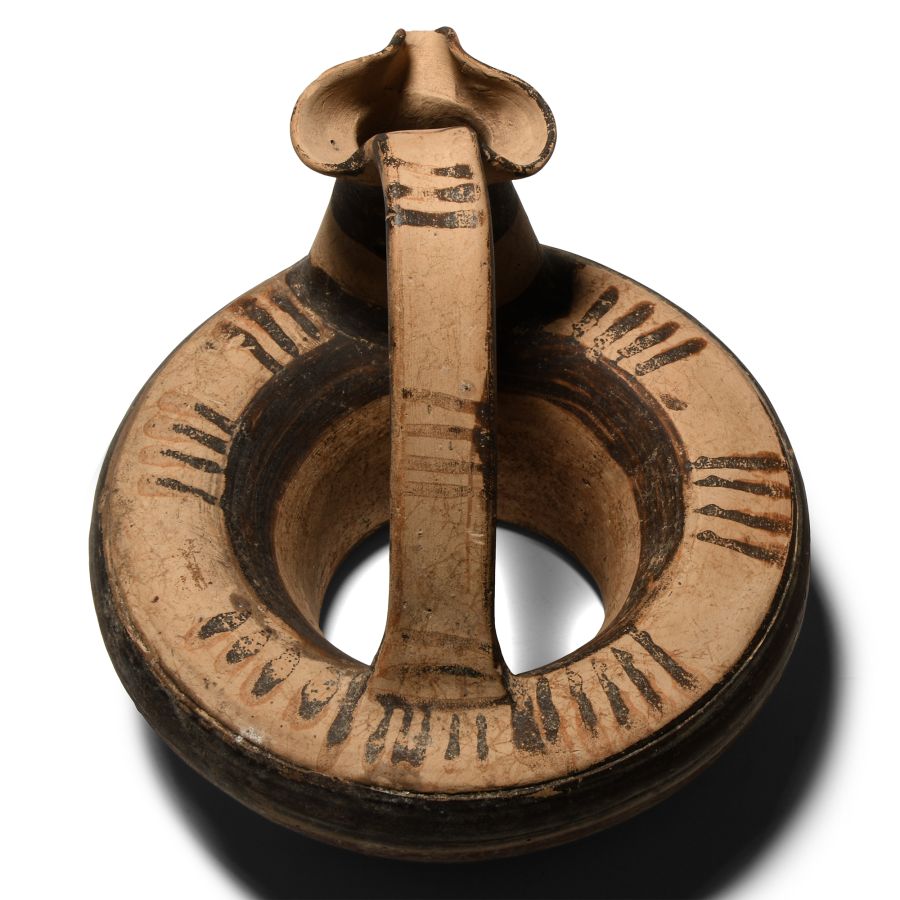
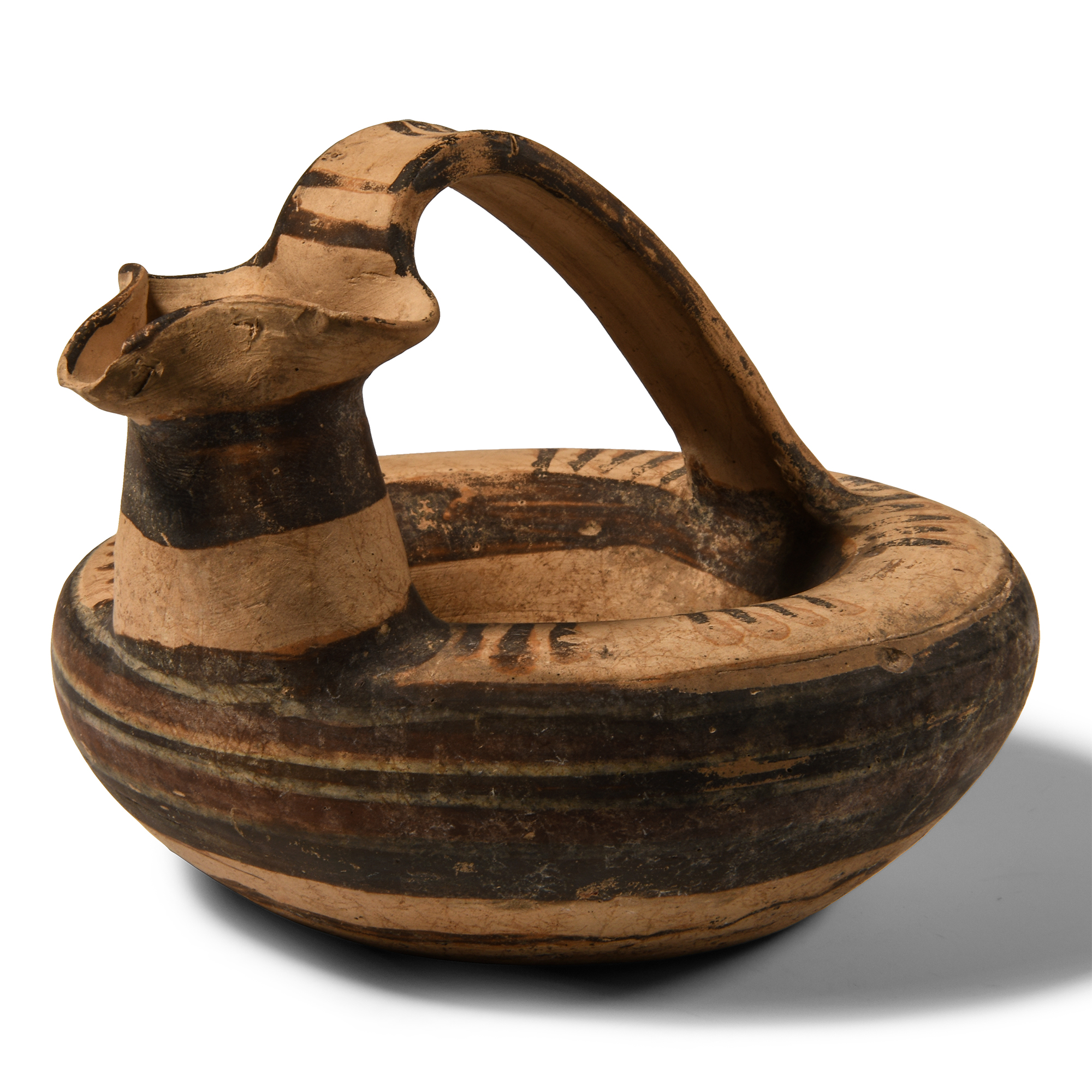
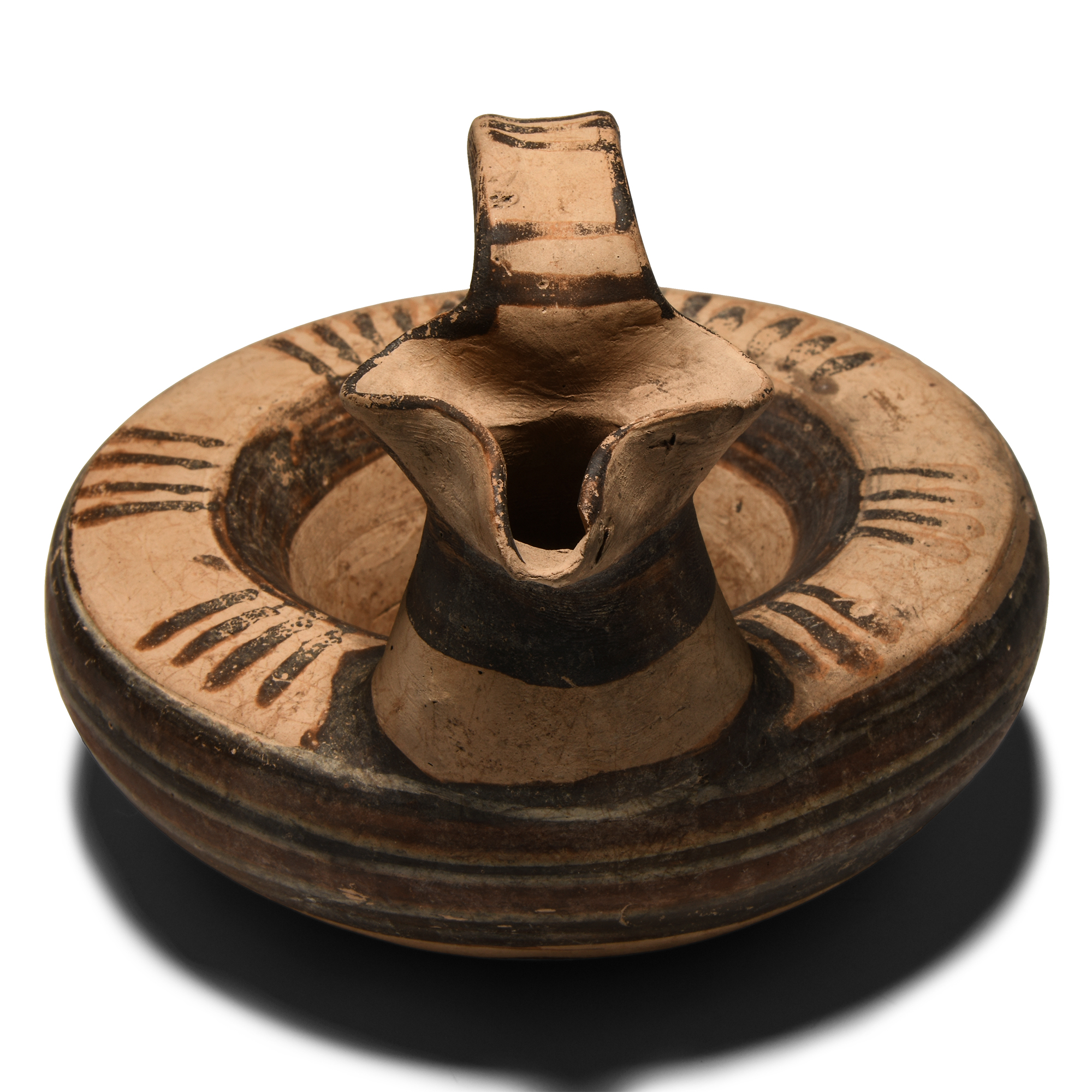
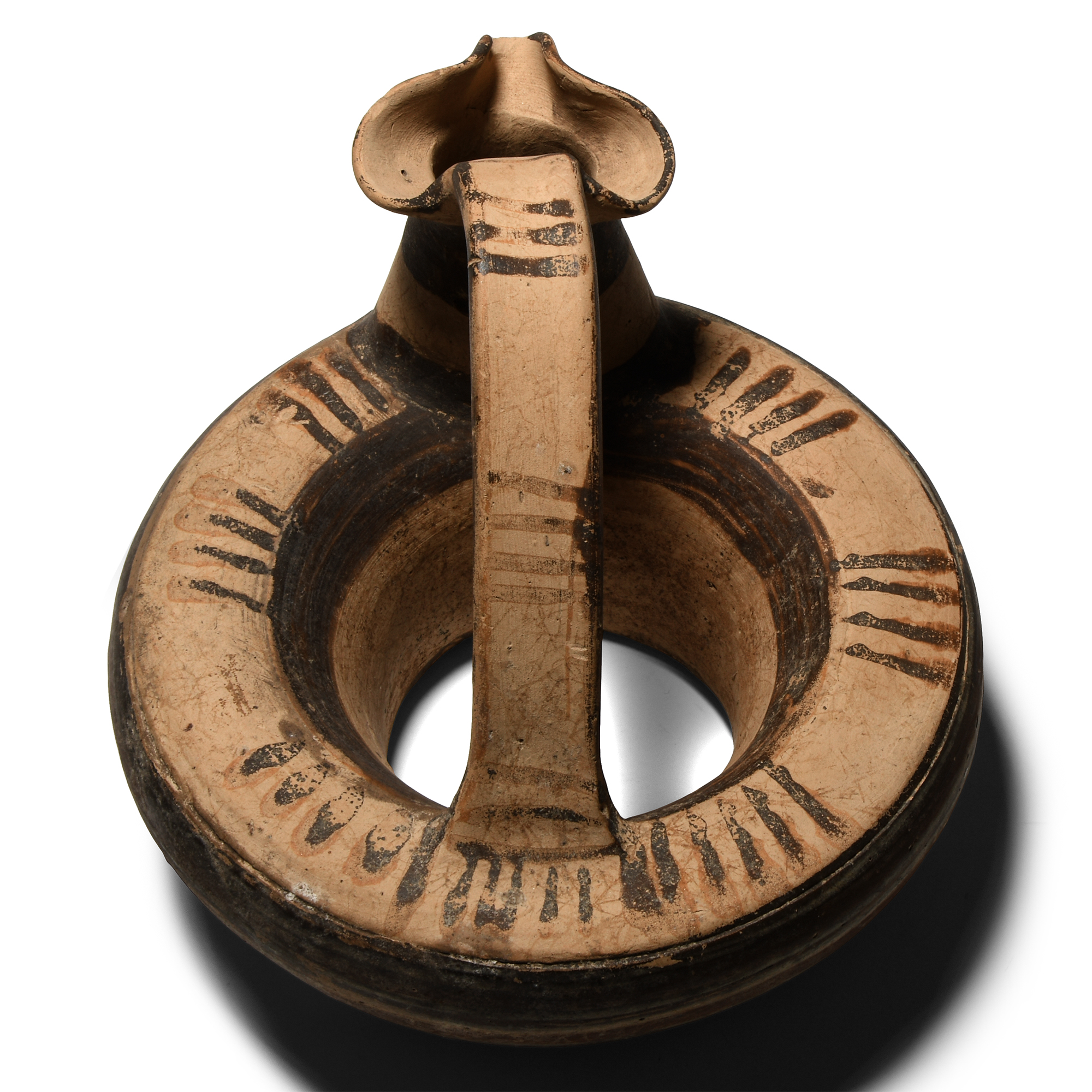
Etrusco-Corinthian Ring Askos
CIRCA 575 B.C.
6 1/2 in. (349 grams, 16.5 cm).
With strap handle positioned over the central hole; black-figure decoration with fired umber (reddish-brown) consisting of a broad band heightened with crimson and white round the upper part of the wall, and a wavy band on the reversed area below; broad band of black (fired umber) inside the ring and around the neck below the spout; groups of transverse lines with faded petals around the top, horizontal lines across the handle; intact.
ProvenanceAcquired from Charles Ede Gallery, London, in 1982.
Prominent Palm Springs, California, USA, collection.
with Artemis Gallery, Colorado, USA, 14 July 2012, lot 30 (US$2,500-3,000).
Property of a South Australian private collector, with collection reference 14.08.
Accompanied by detailed collector's catalogue pages including description and photograph.
Charles Ede Gallery Etruscan Pottery Catalogue VI in 1982, item 22.
LiteratureSee Reusser, C., Etruskische Kunst: Antikenmuseum Basel und Sammlung Ludwig, p. 24.
FootnotesEtrusco-Corinthian pottery is a local imitation of Corinthian pottery, made from the late seventh to the mid-sixth century B.C., with production concentrated on the southern Etruscan cities of Caere, Veii and Vulci. The forms predominately employed include various forms of jug (olpai, oinochoe) and unguent containers (aryballoi and alabastra) as well as amphorae and craters. The askos is the name given in modern parlance to a type of Greek pottery vessel used to pour small quantities of liquids such as oil. It is recognisable from its flat shape and a spout at one or both ends that could also be used as a handle; they were usually painted decoratively like vases and were mainly used for storing oil and refilling oil lamps. They were extensively traded in and around the Mediterranean, and local types emerge in Italy from the early Iron Age in Italy (cf. CVA Taranto – Museo Nazionale I, pl. 1.1 (Inv. 2400) – refer photo at 14.08 – 3); also CVA British Museum 7, pl. 4.4). The original meaning of ἀσκός is “wineskin” which can be seen in the shapes of early askoi.
This askos has unique painted decoration for which a parallel has not been found to date. For an earlier variant of this type, see CVA Tarquinia – Museo Archeologico Nazionale III, pl. 27.7-8 (Inv. RC. 1892). Described as 'Italo- Geometric' and dated to third quarter of the seventh century; askos is 10.2cm high, 11.5cm diameter; dark brown paint. Neck is longer than on Inv.14.08, and different decorations, but otherwise an early parallel (refer photos at 14.08 – 4 & 5). Another variant of this type can be seen in CVA Museo Civico d’Archeologia Ligure di Genova, I, pl. 1.2-3 (Inv. 1101). Described as Italo-Corinthian but undated, askos is 11.0cm high 11.5cm diameter; neck is longer than on Inv.14.06, with handle not curving, and different decorations (see photos 14.08 – 6; 7). The groups of horizontal line decoration can be seen on earlier types, cf. late eighth to early seventh century footed cup in the Museo Archeologico della Maremma (CVA Grosetto Museo Archeologico I, pl. 26.3 (Inv. 24294)). See askos at the Museo Nazionale di Villa Giulia from the Polledrara necropolis at Vulci, dated to 625–600BC (refer photo at 14.08 – 8).
TimeLine Auctions follows a vetting process to ensure the authenticity and legality of all items, reinforcing our commitment to integrity and responsible trading. Each antiquity, antique, and coin lot undergoes thorough examination by a vetting committee of at least ten external specialists, professional trade association members, scientists, and archaeologists: Our Vetting Process
AUCTIONS:
TimeLine is a leading auction house specialising in antiquities, ancient art, collectables, natural history, coins, medals, and books. Our auctions offer museums, collectors, historians, and enthusiasts the opportunity to acquire unique and historically significant pieces.
LOT 0073
Etrusco-Corinthian Ring Askos
Estimate £1,000 - 1,400€1,160 - 1,620 (for guidance only)$1,350 - 1,890 (for guidance only)
-
Cypriot Brown Burnished Ware 'Bilbil' Vessel
Late Bronze Age II, 1400-1200 B.C.Sold for (Inc. bp): £260
Unglazed tall juglet (bilbil) with flared foot, piriform body, tapering neck and flared mouth. strap handle; bands of bilinear ornament to the shoulder and neck. 103 grams, 13.7 cm
From a collection acquired on the UK art market from various auction houses and collections mostly before 2000. From an important Cambridgeshire estate; thence by descent. -
.jpg)
Monumental Greek Apulian Red-Figure Calyx-Krater
Late 4th century B.C.Estimate: £18,000 - 24,000 (‡+bp*)
Opening Bid: £10,000
With elegant fluted body, drum foot and elaborate up-swung handles, displaying polychrome panels on both sides, between a laurel wreath below the rim and a band of Greek meander motif; Side A: the hero Bellerophon riding Pegasus, wearing a Thessalian hat (petasos), depicted nude except for a cloak fastened at the centre of the neck by a round clasp, the hero towering above the other two mythological characters beneath him: Princess Filinoe, on the left, crowned and dressed in a long chiton, and King Iobates of Lycia, dressed in Persian fashion with a long sleeved red tunic worn under a long dress, the field with a representation of an altar, two palm branches over a volute krater, a shield, a javelin, a lotus flower, and above the hero a hanging shield and two clamydes; Side B: figure of a young beardless man, wrapped in a large cloak and holding a staff, with windows and floral scrolls on the background. 7.6 kg, 56 cm high
Acquired in the mid 1980s-1990s. From the family collection of Mr S.A., Switzerland, thence by descent. Private collection since the late 1990s. Accompanied by an academic report by Dr Raffaele D’Amato. This lot has been checked against the Interpol Database of stolen works of art and is accompanied by a search certificate number no.12068-218200.
The decoration is very different on the two sides: on the main one, the painter has created a large mythological scene as if it was a summary. The scene comprising the famous hero Bellerophon riding Pegasus, the winged horse, flying above Iobates and his daughter (who will become the hero's wife). The king sent Bellerophon to perform impossible mission, among which the best known is the fight against the Chimera (monster with the body of a lion and a goat, with a snake's tail and two heads, one of a lion and the other of a goat). -
Cypriot Terracotta Jar
6th-3rd century B.C.Sold for (Inc. bp): £65
Bulbous in profile with rounded underside, broad rounded rim to the mouth. 1.6 kg, 21 cm high
Acquired 1980-2015. Ex Abelita family collection.
