
Loading, please wait...
LOT 0074
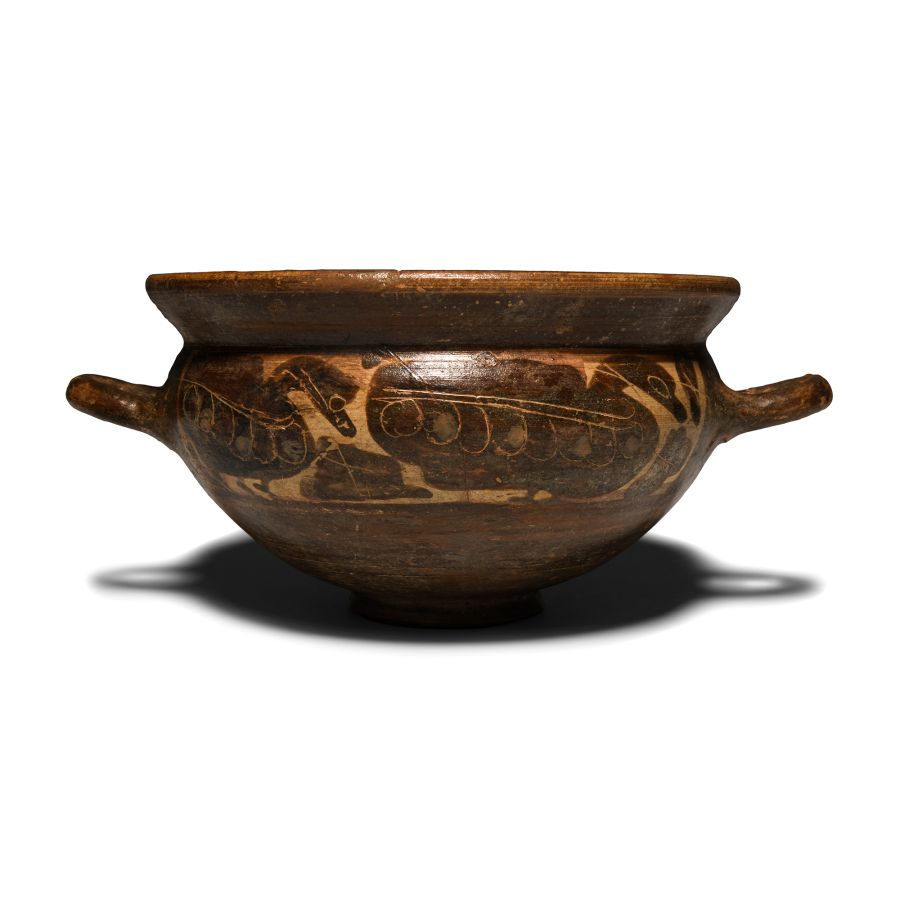
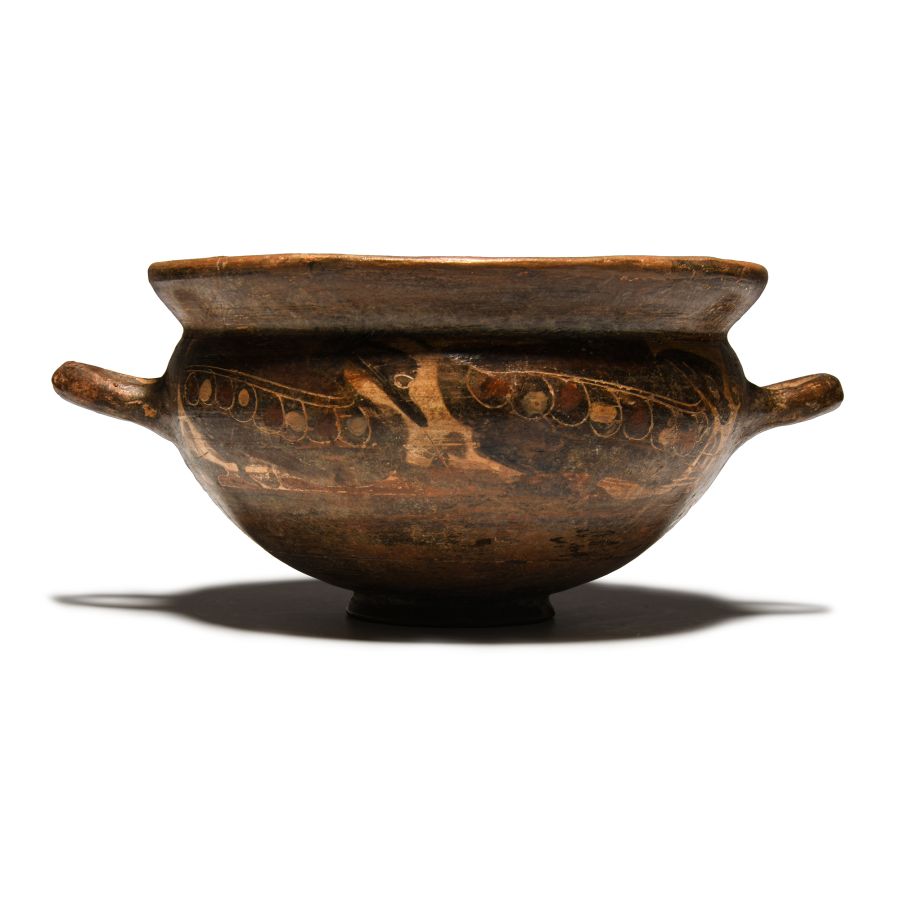
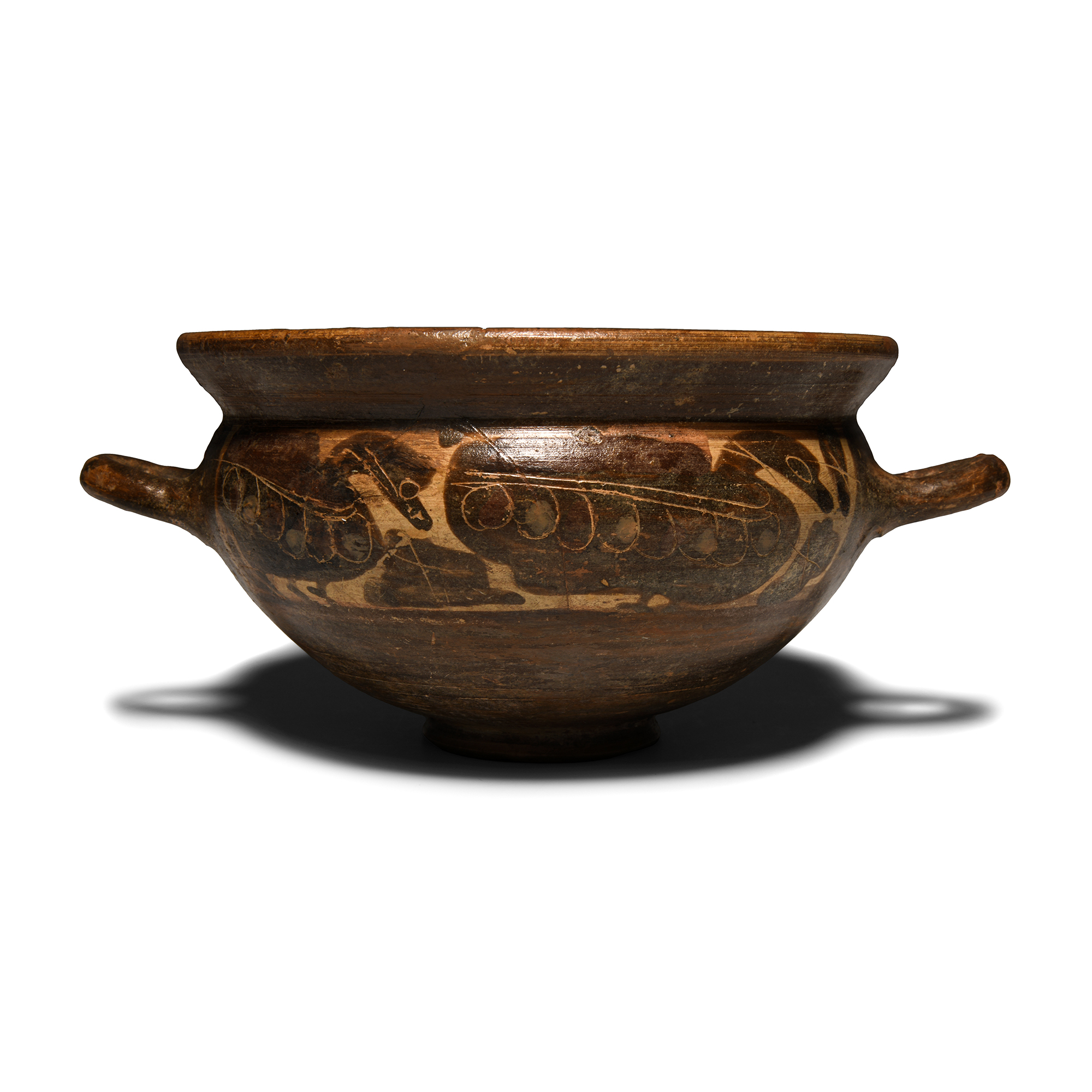
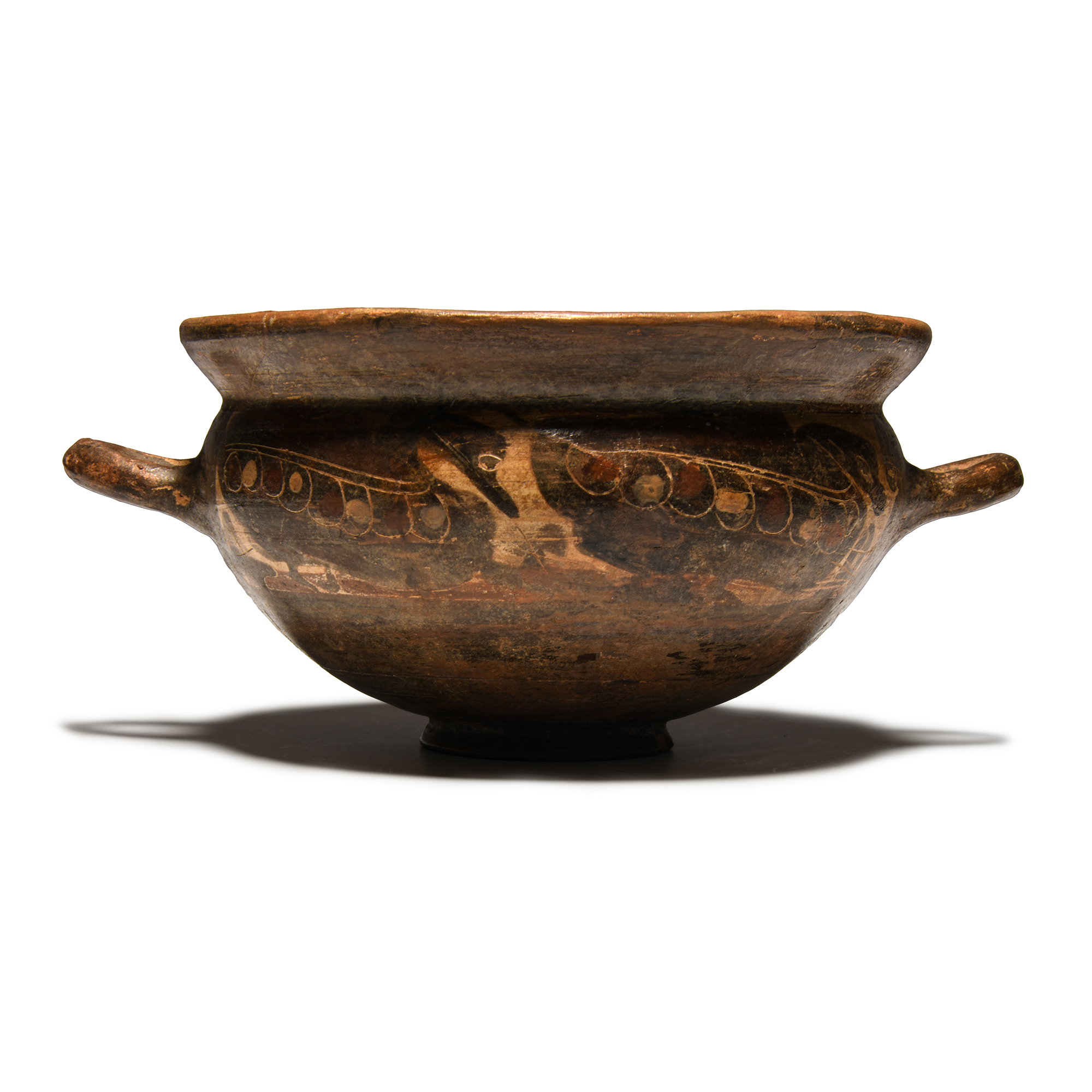
Etrusco-Corinthian Bowl with Painted Ducks
575-550 B.C.
7 1/8 in. (257 grams, 18 cm wide).
Squat skyphos on a low, pared conical base; two small horizontal handles round in section, short flaring everted rim; painted in dark brown with decoration limited to two window-like areas between the handles; on either side of the bowl two large ducks moving to the right with incision and overpaint clarifying the mass of the bodies, wings indicated with two quick horizontal strokes and a row of pendant arcs or scallops with dots of red and white overpaint for a rich, feathered effect; rosettes filling the space around the ducks.
ProvenanceIn the collection of Mr Ulfert Wilke, founding Director of the University of Iowa Museum of Art.
Acquired from Ulfert Wilke on 29 May 1968.
From the collection of Dr Howard Sirak, Columbus, Ohio, USA.
Ex I.M. Chait Gallery, Los Angeles, USA, 14 December 2020, lot 212.
Property of a South Australian private collector, with collection reference 20.34.
Accompanied by detailed collector's catalogue pages including description and photograph.
De Puma, Etruscan and Villanovan Pottery: A Catalogue of Italian Ceramics from Midwestern Collections, no. 45.
FootnotesThe catalogue cites this piece as no. 3.10 from the Wilke Collection and the original sticker is on the base. The catalogue was for the exhibition at the University of Iowa Museum of Art from 17 March to 30 April 1971.
CONDITIONTimeLine Auctions follows a vetting process to ensure the authenticity and legality of all items, reinforcing our commitment to integrity and responsible trading. Each antiquity, antique, and coin lot undergoes thorough examination by a vetting committee of at least ten external specialists, professional trade association members, scientists, and archaeologists: Our Vetting Process
AUCTIONS:
TimeLine is a leading auction house specialising in antiquities, ancient art, collectables, natural history, coins, medals, and books. Our auctions offer museums, collectors, historians, and enthusiasts the opportunity to acquire unique and historically significant pieces.
-
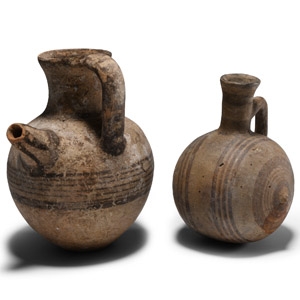
Cypriot Painted Geometric Vessel Group
Early Iron Age, circa 950-850 B.C.Sold for (Inc. bp): £260
Comprising: a spherical vessel with trumpet-shaped mouth and strap handle, painted concentric circles; similar, larger with lateral spout. 222 grams total, 9.5-11.2 cm
From a collection acquired on the UK art market from various auction houses and collections mostly before 2000. From an important Cambridgeshire estate; thence by descent. -
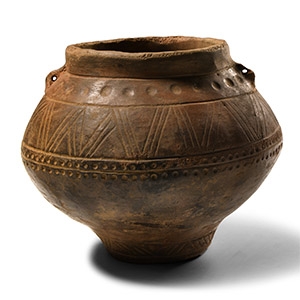
Cypriot Brown Burnished Ware Decorated Jar
Late Bronze Age II, 1400-1200 B.C.Sold for (Inc. bp): £221
Biconvex in profile with dimpled base and broad mouth, band of linear chevron ornament to the base and similar to the shoulder, pelletted band to the equator, impressed pellets below the rim, two pierced lug handles. 467 grams, 14.2 cm wide
From a collection acquired on the UK art market from various auction houses and collections mostly before 2000. From an important Cambridgeshire estate; thence by descent. -
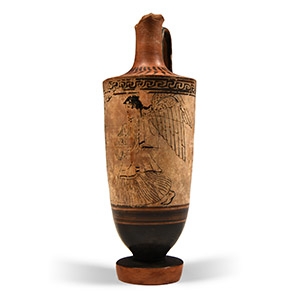
Greek 'Lord Elgin's' Attic White-Ground and Black-Figure Lekythos, Circle of the Aischines Painter
Circa 450 century B.C.Sold for (Inc. bp): £2,860
Attic white-ground and black-figure cylindrical lekythos; circle of the Aischines Painter; on the body an outlined figure of Nike with torch; above, a maeander, and on the shoulder two circles of rays; mouth missing, foot replaced; small hole behind the head filled up, the colour partially rubbed. 173 grams, 17 cm
From the collection of Lord Elgin (BAPD 12703). Ex Coins and Medals, Attic Red-Figure Vases, Basel, Special List N, May 1971, no.48. Ex Imhof collection, Germany. Acquired Bonhams & Brooks, London, 26 April 2001, no.37. From the C.K. private collection, Graz. with Gorny & Mosch, Munich, 30 June 2017, no.15. Property of a North London collector. Accompanied by copies of the relevant Bonhams & Brooks and Gorny & Mosch catalogue pages, and the original Bonhams & Brooks lot tag.
Once in the collection of Lord Elgin. With the corresponding pages of the M&M and Bonhams catalogues (copies).
