Loading, please wait...

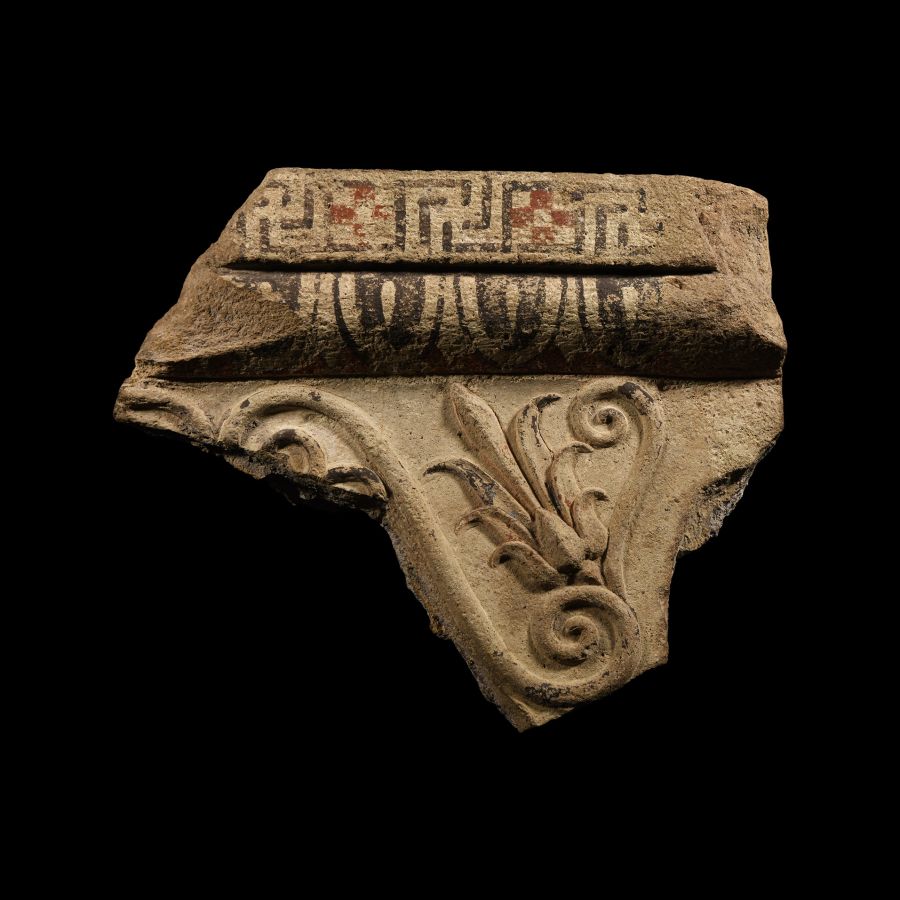
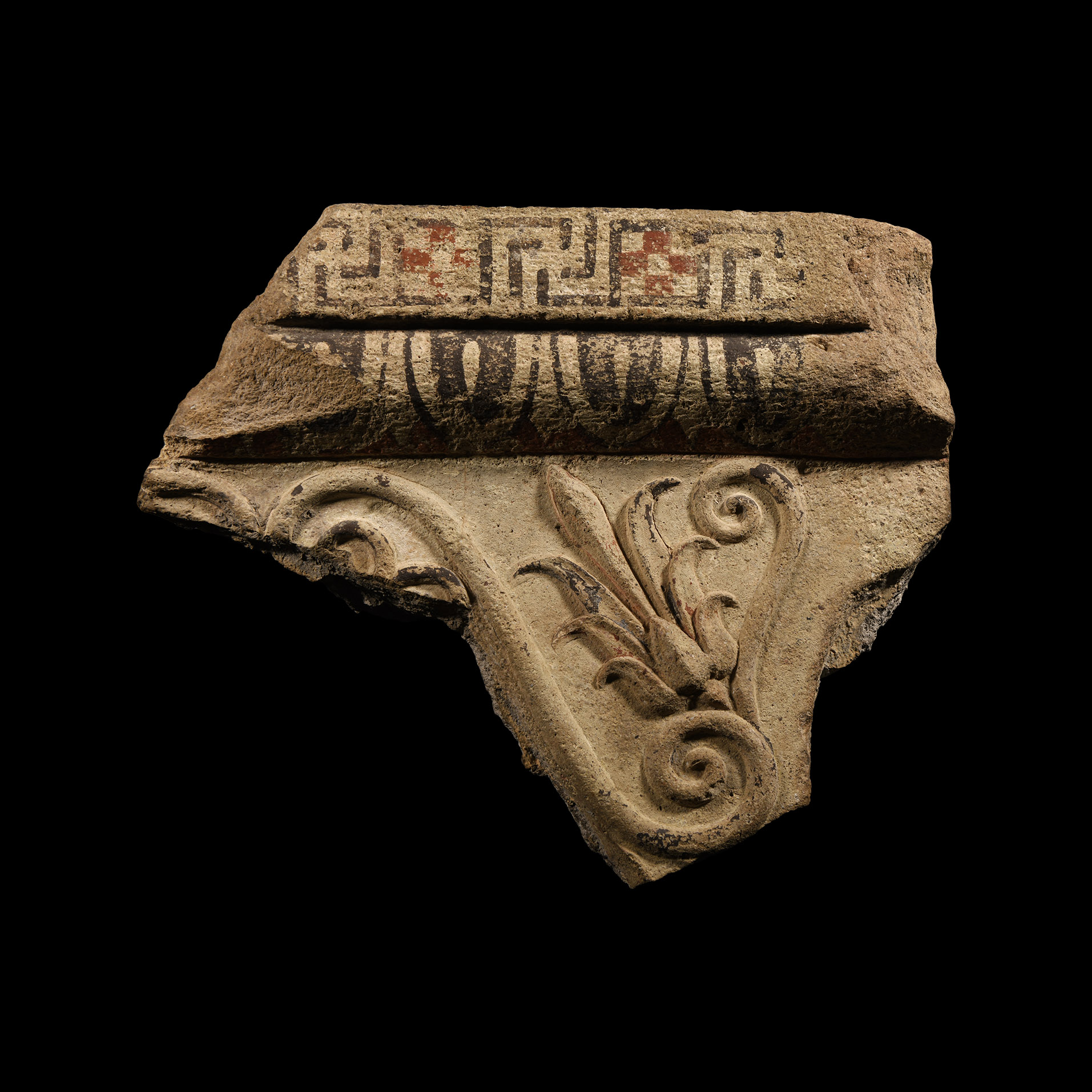
Etruscan Painted Terracotta Architectural Cornice Etruscan Painted Terracotta Architectural Cornice Etruscan Painted Terracotta Architectural Cornice
Use mousewheel to zoom in and out, click to enlarge
Details

LOT 0042

Etruscan Painted Terracotta Architectural Cornice

5TH-4TH CENTURY B.C.

13 1/2 in. (5.1 kg, 34.5 cm wide).

A fragment of amorphous form, decorated in relief with scrolling tendrils and anthemion, painted egg-and-dart ornament above, surmounted by moulded bands and a frieze of meander and chequerboard panels; remains of red and black painted pigment.

Provenance

Private collection, Switzerland, 1960s.
From the Sir Claude Hankes-Drielsma collection, prior to 2006.
with Christie's, London, The Stanford Place Collection of Antiquities, 26 April 2006, lot 36.

Accompanied by a copy of an Art Loss Register certificate number S00209802, dated 14 June 2021.
Accompanied by a detailed collector's catalogue pages including description and photograph.
This lot has been checked against the Interpol Database of stolen works of art and is accompanied by search certificate number no.203716.

CONDITION
VETTING:

TimeLine Auctions follows a vetting process to ensure the authenticity and legality of all items, reinforcing our commitment to integrity and responsible trading. Each antiquity, antique, and coin lot undergoes thorough examination by a vetting committee of at least ten external specialists, professional trade association members, scientists, and archaeologists: Our Vetting Process


AUCTIONS:

TimeLine is a leading auction house specialising in antiquities, ancient art, collectables, natural history, coins, medals, and books. Our auctions offer museums, collectors, historians, and enthusiasts the opportunity to acquire unique and historically significant pieces.

Live Bidding

LOT 0042

Etruscan Painted Terracotta Architectural Cornice

Sold for (Inc. bp): £3,900

Print page

RELATED LOTS
  • Italo-Geometric Painted Terracotta Amphora
    Italo-Geometric Painted Terracotta Amphora
    Circa 7th-6th century B.C.

    Sold for (Inc. bp): £1,040

    Decorated in red with geometric motifs including encircling bands, a horizontal wavy band with motifs at the shoulder, with two rows of vertical wavy linear panels below. 1.2 kg, 27 cm high


    From a New Mexico private collection, acquired before 1991. with Bonhams, 3 July 2019, lot 53, (£1,500-£2,500). Accompanied by a copy of a previous collector's catalogue pages with inventory number 20.13.

    Lot Details

  • Thracian Silver Bracelet Pair
    Thracian Silver Bracelet Pair
    1st century B.C.-1st century A.D.

    Sold for (Inc. bp): £2,080

    Each composed of a penannular body with stylised snake head terminals; each accompanied by a custom-made display stand. 52.4 grams total, 64 mm each (119 grams total, 82 mm high including stand)


    UK art market, 2000s. This lot has been checked against the Interpol Database of stolen works of art and is accompanied by searcher certificate no. 201181.

    The bracelets belong to the type with zoomorphic terminals, probably representing snake’s heads or dragons emerging from flat rectangular strips with incised decoration and continued as lobed bodies resembling stylised palm leaves or palmettes. This Thracian tradition is attested in the ancient kingdom of Dacia.

    Lot Details

  • Graeco-Roman Megarian Terracotta Cup with Nymphs
    Graeco-Roman Megarian Terracotta Cup with Nymphs
    2nd century B.C.

    Sold for (Inc. bp): £208

    Hemispherical in form with decoration in relief featuring fluting alternating with nymphs and symbols beneath an architectural border, cracked and chipped. 257 grams, 11.9 cm wide


    Private Dutch collection, 1970-2010. Ex private Dutch collection, 2010-2018.

    The term ‘Megarian’ bowl applied to this type of pottery is a modern convention for academic purposes. The name ‘Megarian’ was first given to this type of mould-made relief bowl in the late 19th century, because some of the first known examples were said to have come from the city of Megara. In reality, such terracotta items originated in Athens in the 3rd quarter of the 3rd century BC, and from that point were made in all major Greek cities for the duration of the Hellenistic period and into the Roman, especially in Alexandria. This relief-decorated pottery became more popular than painted pottery during the Hellenistic period. This class of hemispherical bowl was made in moulds and was characterised by decoration imitating metallic beakers. When the finished bowl was taken from the mould, it was probably dipped in varnish or dull paint and fired. According to Prof. P.V.C. Baur, the stamps used for making moulds were not produced in every manufacturing centre of ‘Megarian’ bowls, but were made only in important centres such as Athens, Pergamon, Antioch and Alexandria, and sold to potters throughout the Hellenistic world. The fact that the edge of the bowl is turned outwards suggests Athenian production, and a comparison with the decorative petals on the Delian Cup (no.1913.199 of the Rebecca Darlington collection) is also plausible.

    Lot Details

Stay up-to-date with the latest from TimeLine Auctions by joining our mailing list