
Loading, please wait...
LOT 0084
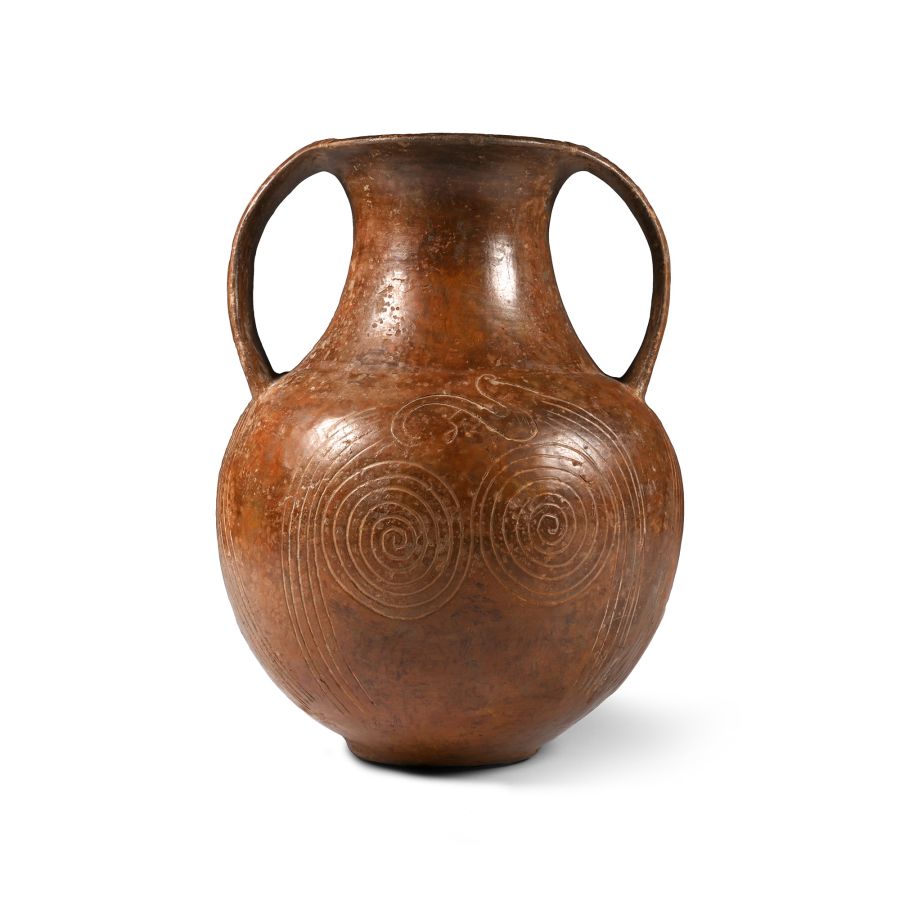
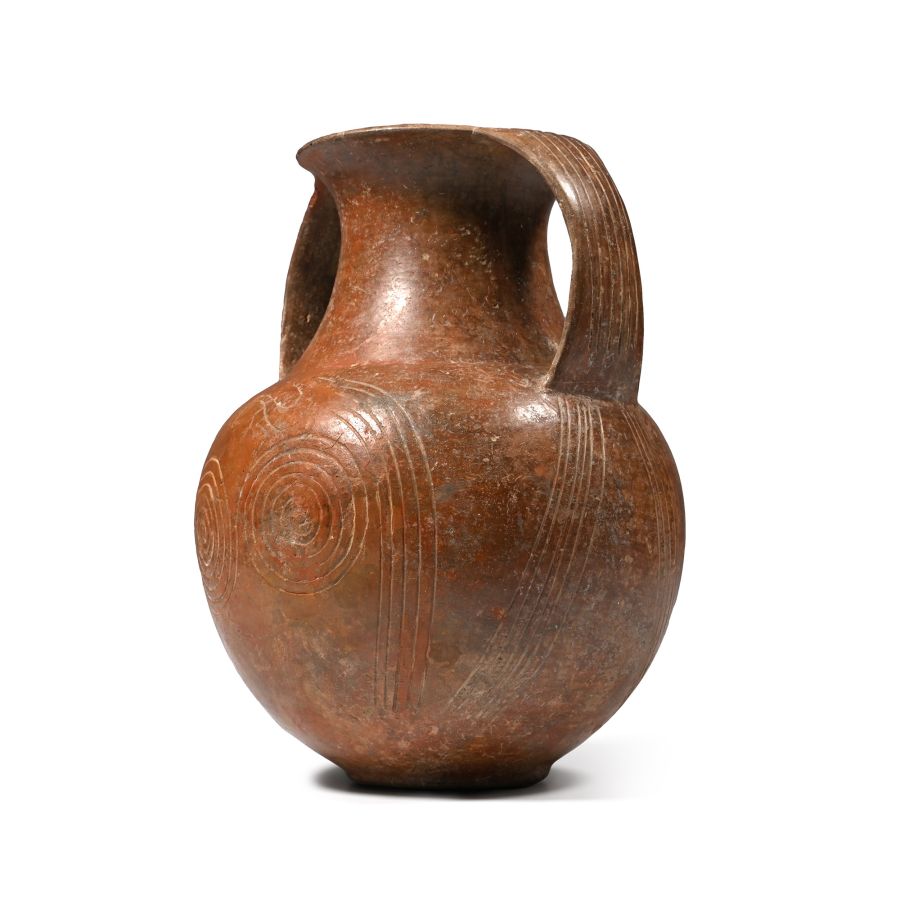
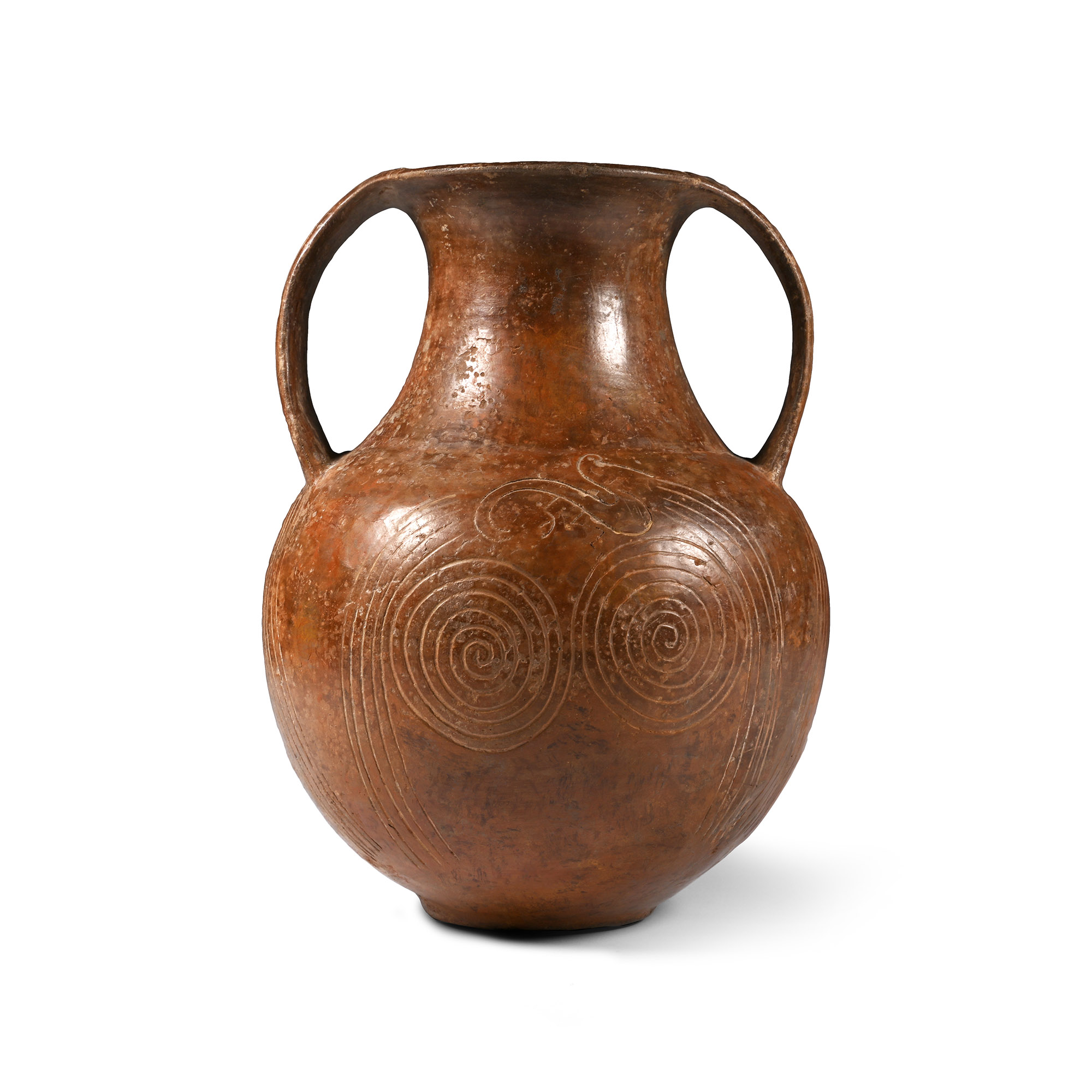
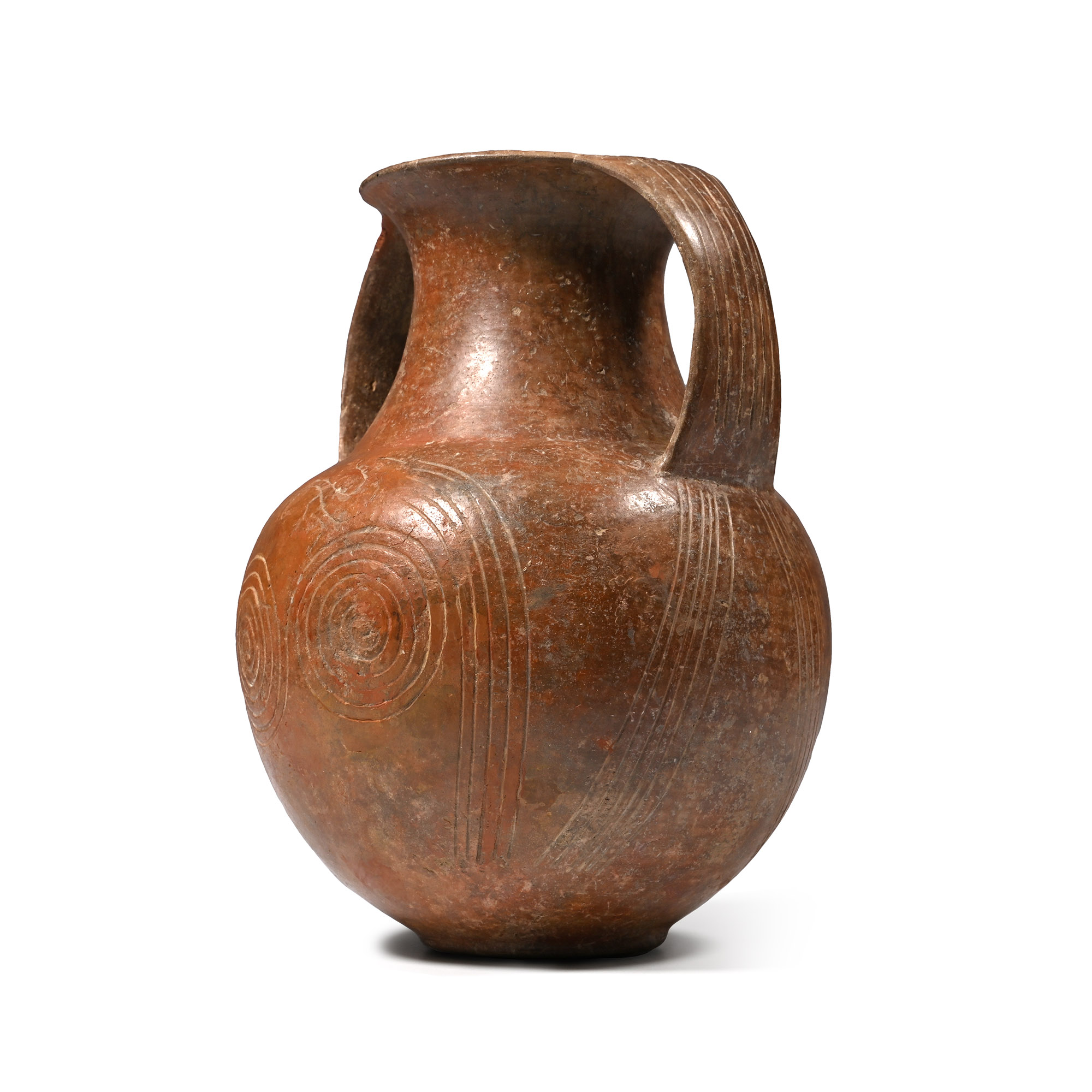
Etruscan Impasto 'Spiral' Amphora
7TH CENTURY B.C.
6 1/2 in. (343 grams, 16.5 cm).
Comprising a bulbous body and a short neck with everted rim, two strap handles with incised striations continuing in an inverted V-shape beneath the handles; on each side of the body a large double spiral flanked by five curving lines, a stylised bird above.
ProvenanceEx Fortuna, Gallery for Ancient Art (Zurich, Kirchgasse 31) Basel, 7 April 1984.
Private collection, Bern, Switzerland.
This lot is accompanied by an illustrated lot declaration signed by the Head of the Antiquities Department, Dr Raffaele D'Amato.
See Jucker, I., Israel Museum catalogue, Jerusalem, 1991, nos.219-223, for similar vase shapes and decoration.
FootnotesWith the arrival of the Greeks (775 B.C. at Pithekoussai, 750 B.C. at Cumae), a clear technical advancement in ceramic production was observed: impasto vessels began to show more varied patterns, were fired at higher temperatures, and were eventually replaced by wheel-made pottery in the Greek style. Despite growing populations, there remained a significant demand for this more 'old-fashioned' yet technically refined pottery. Note on the term impasto (Italian): in painting, it refers to the thick application of paint (a textured, paste-like technique). In ceramics, it refers to a thick layer of slip (a watered suspension of purified clay) applied before firing, which results in a homogenous, matte-glossy surface after firing.
CONDITIONTimeLine Auctions follows a vetting process to ensure the authenticity and legality of all items, reinforcing our commitment to integrity and responsible trading. Each antiquity, antique, and coin lot undergoes thorough examination by a vetting committee of at least ten external specialists, professional trade association members, scientists, and archaeologists: Our Vetting Process
AUCTIONS:
TimeLine is a leading auction house specialising in antiquities, ancient art, collectables, natural history, coins, medals, and books. Our auctions offer museums, collectors, historians, and enthusiasts the opportunity to acquire unique and historically significant pieces.
-
Greek Gold Floral Applique Pair
Circa 5th-3rd century B.C.Sold for (Inc. bp): £98
Comprising two sheet-gold repoussé mounts depicting eight-petalled flowers, two pairs of piercings to the outer edge. 0.21 grams total, 9-10 mm
Ex property of a late Japanese collector, 1970-2000s. This lot is accompanied by an illustrated lot declaration signed by the Head of the Antiquities Department, Dr Raffaele D'Amato. -
Large Hellenistic Aphrodite Gemstone in Gold Ring
2nd-1st century B.C.Estimate: £1,200 - 1,700 (+bp*)
Opening Bid: £600
Comprising a hoop of looped rods supporting an ellipsoid cell with inset carnelian intaglio of Aphrodite standing in floor-length robe holding a frond in one hand, elbow resting on a column. 9.03 grams, 27.69 mm overall, 15.50 mm internal diameter (approximate size British I 1/2, USA 4 1/2, Europe 8.07, Japan 7)
Private collection, UK. This lot is accompanied by an illustrated lot declaration signed by the Head of the Antiquities Department, Dr Raffaele D'Amato. -
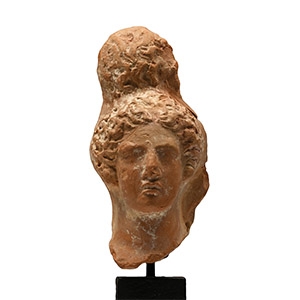
Greek Terracotta Head of a Goddess
Circa 4th-3rd century B.C.Sold for (Inc. bp): £208
An attractive head from a statuette of a goddess, thick hair ornately coiffed, lips pouted, and the traces of the artisan’s fingerprints preserved along the neck; mounted on a custom-made display stand. 64 grams total, 10.9 cm high including stand
From the private collection of C.R., Ticino, Switzerland, before 1970. with Galerie Rhéa, Zurich, Switzerland. This lot is accompanied by an illustrated lot declaration signed by the Head of the Antiquities Department, Dr Raffaele D'Amato.
The cults of Demeter and her daughter Persephone (kore) were particularly prominent in Magna Graecia, and likely this is a representation of one of these goddesses.
