
Loading, please wait...
_900x900.jpg "Etruscan Gold Filigree Leech Brooch")
_200x200.jpg "Etruscan Gold Filigree Leech Brooch")
_900x900.jpg "Etruscan Gold Filigree Leech Brooch")
_200x200.jpg "Etruscan Gold Filigree Leech Brooch")
.jpg "Etruscan Gold Filigree Leech Brooch")
.jpg "Etruscan Gold Filigree Leech Brooch")
LOT 0554
Etruscan Gold Filigree Leech Brooch
7TH CENTURY B.C.
2 3/4 in. (13.86 grams, 69 mm).
Hollow-formed bow with applied floral detailing, filigree and granules, double-coiled spring and pin; tongue-shaped foot with dense granule detailing, globe finial with rosette above.
ProvenanceAcquired in the 1970s.
Property of a London lady, part of her family's collection.
This lot has been checked against the Interpol Database of stolen works of art and is accompanied by search certificate no.12112-213116.
Cf. very similar fibulae in the Louvre Museum, inventories Bj831 and Bj832, in Gaultier, F. ; Metzger, C. (ed.), Trésors antiques : bijoux de la collection Campana, cat. exp. (Paris, Musée du Louvre, 2005/2006), Paris, Milan, Musée du Louvre / 5 Continents,Paris, 2005, p. 69, 140, 141, n° II, 106; cf. also Torelli et al., Treasures From Tuscany - The Etruscan Legacy, Edinburgh, 2004, items 57, 79, for a less decorative example of similar form; Torelli, M., Gli Etruschi, Monza, 2000, no.109, pp.467 and 575, for a similar decorative specimen.
CONDITIONTimeLine Auctions follows a vetting process to ensure the authenticity and legality of all items, reinforcing our commitment to integrity and responsible trading. Each antiquity, antique, and coin lot undergoes thorough examination by a vetting committee of at least ten external specialists, professional trade association members, scientists, and archaeologists: Our Vetting Process
AUCTIONS:
TimeLine is a leading auction house specialising in antiquities, ancient art, collectables, natural history, coins, medals, and books. Our auctions offer museums, collectors, historians, and enthusiasts the opportunity to acquire unique and historically significant pieces.
-
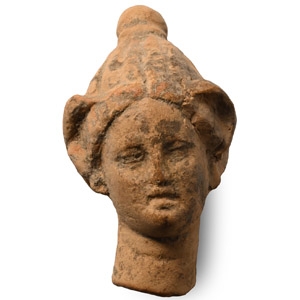
Tarentine Terracotta Head
3rd-1st century B.C.Sold for (Inc. bp): £234
Female head from an effigy, moulded with a segmented conical cap and lateral upturned flaps on the brim. earrings visible beneath; the head slightly turned and tilted downwards on a long slender neck. 32 mm, 63 mm
Acquired in the mid 1980s-1990s. Private collection, Switzerland, thence by descent. Private collection, since the late 1990s. -
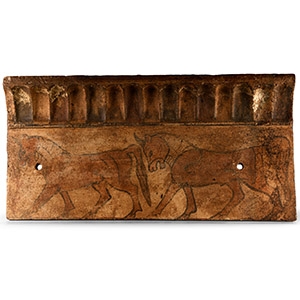
Large Etruscan Architectural Plaque with Bulls
6th century B.C.Estimate: £5,000 - 7,000 (+bp*)
Opening Bid: £2,500
For a temple pediment (sima), comprising a curved upper band with polychrome tongue-shaped grooves, a relief depicting a procession of bulls below, the bulls depicted in a dynamic pose with curving necks and raised tails, the horns painted in black; two attachment holes. 4.66 kg, 50 cm
Acquired on the European art market between 1960s-1980s. Property of a gentleman. with Bertolami Fine Arts Ltd, Auction 66, no.1. Accompanied by an academic report by Dr Raffaele D’Amato. This lot has been checked against the Interpol Database of stolen works of art and is accompanied by search certificate number no.12162-218594.
Terracotta plaques like this sima were used in the pediments of temples (Minerva at Veii, Portonaccio Sanctuary, 540-530 BC), or decorated the architecture of tombs. The procession of the bulls recalls the style of painting on a similar slab with a procession of hunting dogs, probably from Caere. -
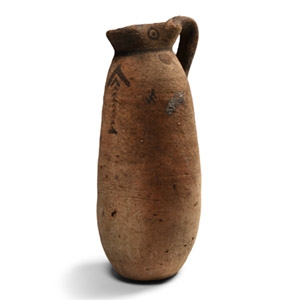
Cypriot Terracotta Trefoil Mouthed Jug
Early Iron Age, Archaic I, circa 750-600 B.C.Sold for (Inc. bp): £156
Of gently tapering profile with pinched trefoil rim to the mouth and strap handle to the rear, painted band to the neck and ring-and-dot motifs above, chevron herringbone motif below; mouth chipped. 272 grams, 18 cm
Acquired Christie's, London, 25 April 2001, no.477 (part). From an important Cambridgeshire estate; thence by descent. Accompanied by a copy of the relevant Christie's catalogue pages.
