
Loading, please wait...
LOT 0646
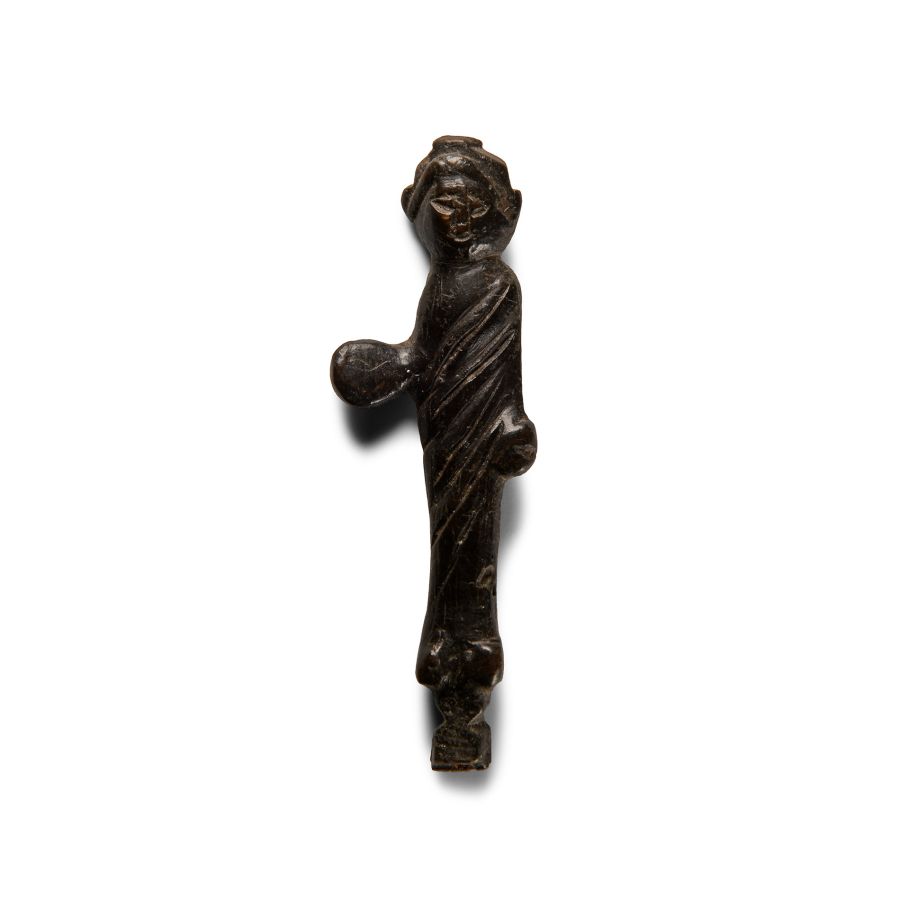
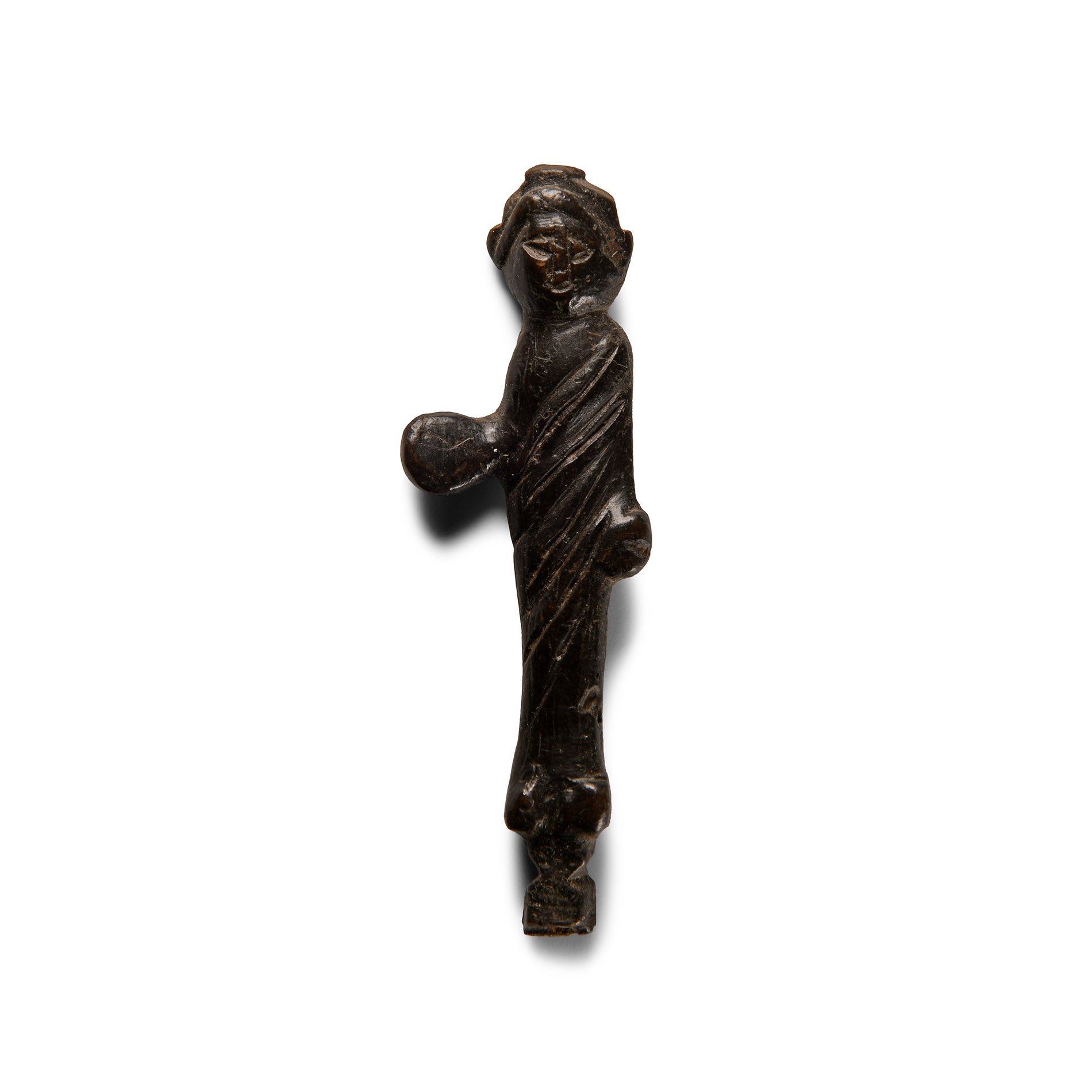
Etruscan Bronze Offering Statuette
4TH CENTURY B.C.
2 7/8 in. (27 grams, 73 mm).
Modelled in the round, standing figure in a tight-fitting wrapped mantle, patera in the right hand, dressed hair; possibly in an act of religious devotion. [No Reserve]
ProvenanceFrom a collection acquired on the UK art market from various auction houses and collections mostly before 2000.
From an important Cambridgeshire estate; thence by descent.
TimeLine Auctions follows a vetting process to ensure the authenticity and legality of all items, reinforcing our commitment to integrity and responsible trading. Each antiquity, antique, and coin lot undergoes thorough examination by a vetting committee of at least ten external specialists, professional trade association members, scientists, and archaeologists: Our Vetting Process
AUCTIONS:
TimeLine is a leading auction house specialising in antiquities, ancient art, collectables, natural history, coins, medals, and books. Our auctions offer museums, collectors, historians, and enthusiasts the opportunity to acquire unique and historically significant pieces.
-
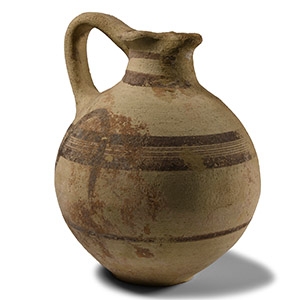
Cypriot Snake-Type Bichrome Terracotta Vessel
Iron Age, circa 11th-8th century B.C.Sold for (Inc. bp): £195
Globular in form with pinched trefoil mouth and tall strap handle; painted band of linear ornament to the shoulder and neck. 695 grams, 21.2 cm high
Property of a deceased estate. Acquired from Bonhams, London, 26 October 2007, no.375 (part). From an important Cambridgeshire estate; thence by descent. Accompanied by copies of the relevant Bonhams catalogue pages and original lot tag. -
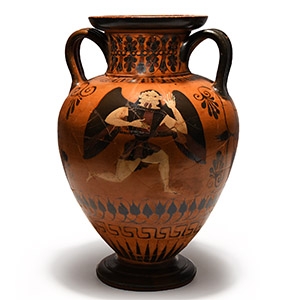
Attic Black-Figure Neck-Amphora with Gorgon and Quadriga Attributed to the Swing Painter
Circa 550 B.C.Sold for (Inc. bp): £41,600
With inverted echinus lip and tall neck, a ribbed handle to each side with coiling lotus buds and palmettes beneath the handles; Side a) a running winged Gorgon depicted frontally, dressed in a black and red chiton; Side b) an aristocratic warrior wearing a Chalcidian helmet and driving a quadriga, the two central horses superimposed, the other two turned outward; a frieze of lotus buds and a band Greek key motifs below, the neck decorated with red and black palmettes, and elongated lotus blossoms; restored. 3.25 kg, 39 cm high
Acquired in Geneva in 1954. Formerly in the Y. Forrer collection, Geneva, Switzerland. Private collection, Switzerland, 1999. with Gorny & Mosch, Munich, 20 June 2012, no.73. Accompanied by an academic report by Dr Raffaele D’Amato. This lot has been checked against the Interpol Database of stolen works of art and is accompanied by a search certificate number no.11798-206784.
This wonderful vase can be attributed to the Swing Painter, active in Athens during the last part of the 6th century B.C. Beazley named him after the subject of a girl on a swing that he painted more than once. He was a pot painter, perhaps a pupil of the Princeton Painter. His black-figure paintings included a range of mythological subjects and some quite unusual images. A very large number of vases have been attributed to his hand on the basis of style. Characteristic of his paintings are contemporary touches, such as the presence of hoplites, in mythological scenes (München, Staatliche Antikensammlungen 1385 [J 729], Beazley Archive Pottery Database 301590; Poseidon fighting the giant Polybotes, Louvre F226). An important artwork is the famous representation of the Tyrant Pysistratos and his Rabdophoroi (bodyguards armed with clubs, Athens National Archaeological Museum 15111, Beazley Archive Pottery Database 301523). -
.jpg)
Etruscan Bronze Statuette of Hercle
Circa 4th-3rd century B.C.Sold for (Inc. bp): £845
Modelled in the round figure of Hercle (Roman Hercules, Greek Herakles) standing nude with the lionskin mantle draped over his extended left forearm, the right arm bent and fist raised (originally holding a club); the hair cut short and radiating from the crown of the head, lentoid eyes flanking a snub nose; mounted on a custom-made stand. 87 grams total, 77 mm (10.2 cm high including stand)
From the estate of Eldert Bontekoe (1954-2020). Ex Ann Arbor, Michigan, USA, acquired before 2000. with Artemis Gallery, Colorado, USA, 26 December 2020, no.8. Property of a South Australian private collector, with collection reference 20.38. Accompanied by an original Artemis Gallery certificate of authenticity dated 27 January 2021. Accompanied by detailed collector's catalogue pages including description and photograph.
