
Loading, please wait...
_900x900.jpg "Etruscan Bronze Lion Head")
_200x200.jpg "Etruscan Bronze Lion Head")
_900x900.jpg "Etruscan Bronze Lion Head")
_200x200.jpg "Etruscan Bronze Lion Head")
.jpg "Etruscan Bronze Lion Head")
.jpg "Etruscan Bronze Lion Head")
LOT 0150
Etruscan Bronze Lion Head
CENTRAL ITALY, LATE 6TH CENTURY B.C.
6 7/8 in. (1.11 kg total, 17.5 cm including stand).
A decorative fitting with roaring mouth and protruding fangs and tongue, the whiskers depicted in raised radiating ridges, with lidded, elongated almond-shaped eyes and small, round ears; mounted on a custom-made display stand.
Provenancewith Christie’s, New York, 8 June 2001, no.58.
Donati collection, Lugano, prior to 1982.
Collection of Banca della Svizzera Italiana, Lugano, prior to 1986.
Formerly in the Bourgknecht collection, Switzerland.
Accompanied by Art Loss certificate no.S00123227.
Testimonianze d’arte Etrusca in collezioni private Ticinesi, collection of Banca della Svizzera Italiana, 1986, p.31, no.7.2, illus.
LiteratureCf. Curtis, D., 'The Barberini Tomb' in Memoirs of the American Academy in Rome, 1925, Vol. 5 (1925), pp. 9-52, pl.30, for a similar head of a lion; Canciani, F., and Von Hase, F.W., La tomba Bernardini di Palestrina, Rome, 1979, p.56, no.67; p.57, no.69, for parallels; Jucker, I., Italy of the Etruscans, The Israel Museum in Jerusalem, pp.290-291, no.387, for a head of a lion.
FootnotesThis head was probably, as was the parallel head of the Barberini Tomb, originally attached to a magnificent bronze cauldron. These large cauldrons of hammered bronze were realised with heads and necks of two lions and two gryphons attached to the rim. The cauldrons were spherical in form and rested on a stand.
CONDITIONTimeLine Auctions follows a vetting process to ensure the authenticity and legality of all items, reinforcing our commitment to integrity and responsible trading. Each antiquity, antique, and coin lot undergoes thorough examination by a vetting committee of at least ten external specialists, professional trade association members, scientists, and archaeologists: Our Vetting Process
AUCTIONS:
TimeLine is a leading auction house specialising in antiquities, ancient art, collectables, natural history, coins, medals, and books. Our auctions offer museums, collectors, historians, and enthusiasts the opportunity to acquire unique and historically significant pieces.
LOT 0150
Etruscan Bronze Lion Head
Estimate £10,000 - 14,000€11,600 - 16,240 (for guidance only)$13,500 - 18,900 (for guidance only)
-
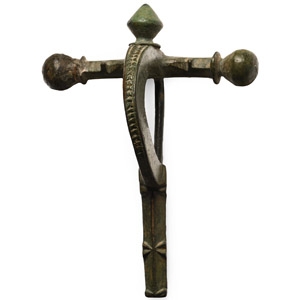
Roman Bronze Crossbow Brooch
4th century A.D.Sold for (Inc. bp): £156
With two onion-shaped knops on the crossbar and a biconical above the bow; billeted decoration to the outer face of the narrow bow, rectangular footplate with chamfered sides, catch to the reverse and hinged pin. 15.8 grams, 55 mm
From a private Tyneside collection, formed since the early 2000s. -
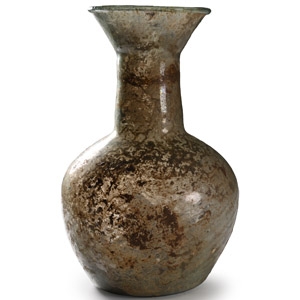
Roman Glass Flask
4th-5th century A.D.Sold for (Inc. bp): £304
With squat bulbous body and broad shoulder, tapering neck with flared rim, dimpled base. 81 grams, 15.5 cm
From an important London collection of glass, 1990s. This lot is accompanied by an illustrated lot declaration signed by the Head of the Antiquities Department, Dr Raffaele D'Amato.
This kind of bottles are common in the Eastern Empire workshops of the Levant. Similar vessels, with faint ribs, have been excavated in the necropolises of Beit Ras, Jordan, and Samaria-Sebaste, Israel. -
.jpg)
Roman Black Glass Bead Necklace String
1st-4th century A.D. and laterSold for (Inc. bp): £65
Restrung designer necklace string of oblate and other types with teardrop pendant centrepiece. 5.65 grams, 46 cm
London, UK, collection, 2000s.
