Loading, please wait...

Engraved Gold and Black Enamel Memento Mori Ring Engraved Gold and Black Enamel Memento Mori Ring Engraved Gold and Black Enamel Memento Mori Ring Engraved Gold and Black Enamel Memento Mori Ring Engraved Gold and Black Enamel Memento Mori Ring Engraved Gold and Black Enamel Memento Mori Ring
Use mousewheel to zoom in and out, click to enlarge
Details

LOT 2010

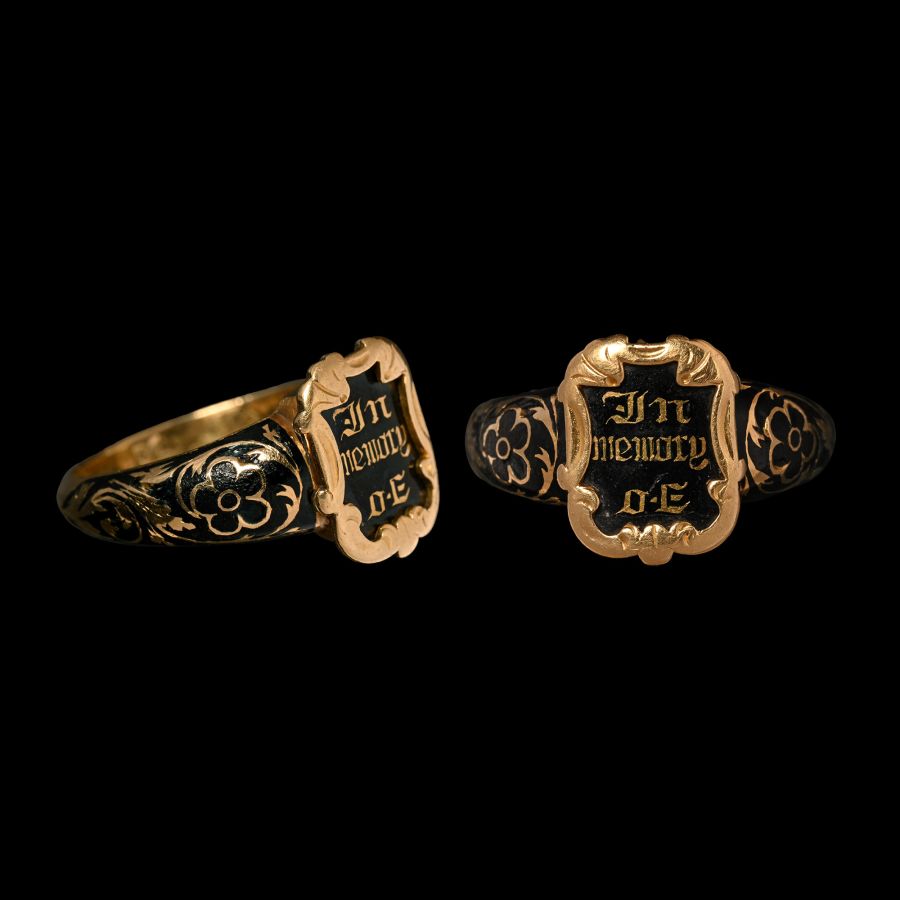
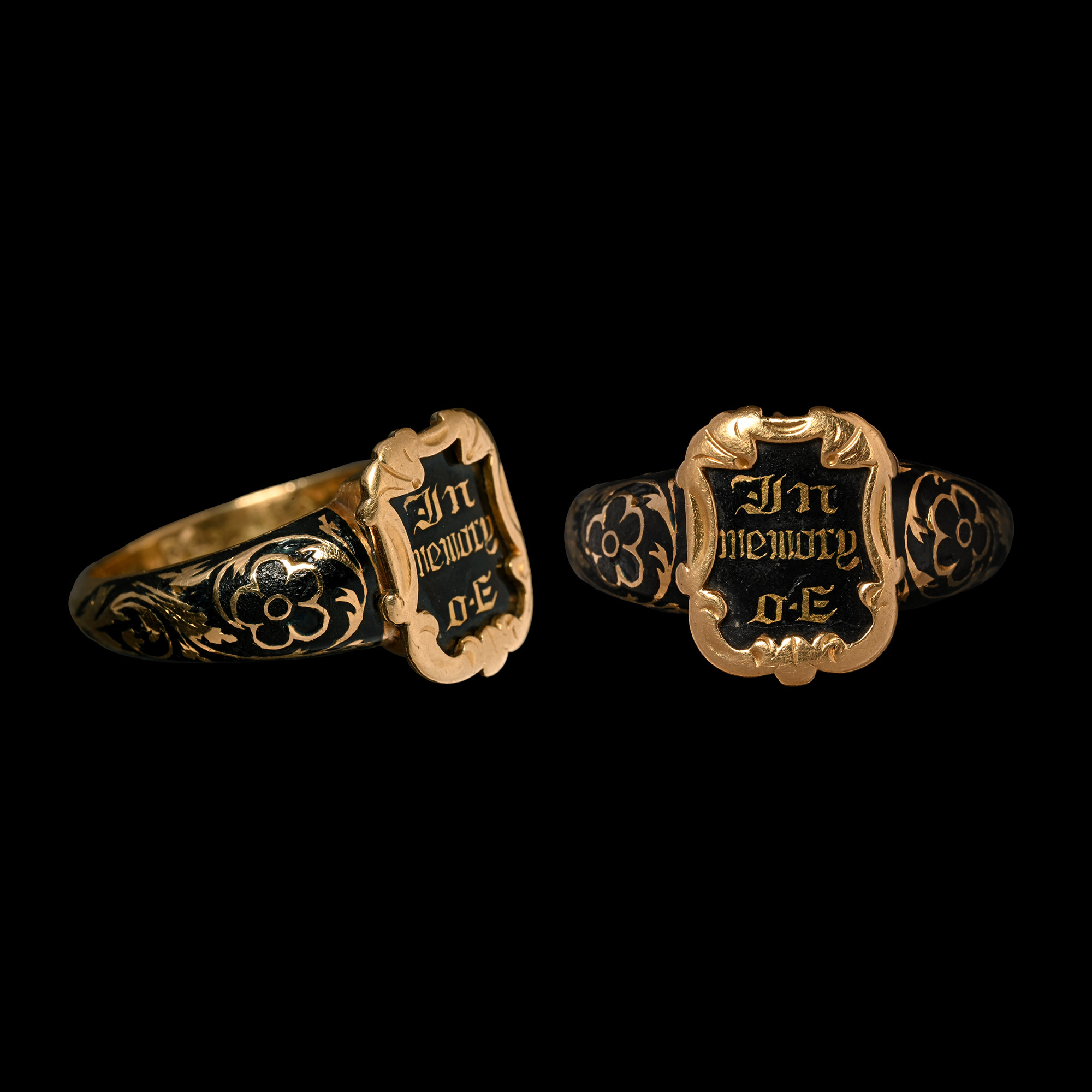
Engraved Gold and Black Enamel Memento Mori Ring

19TH CENTURY A.D.

7/8 in. (4.14 grams, 22.74 mm overall, 17.43 mm internal diameter (approximate size British O, USA 7, Europe 14.98, Japan 14)).

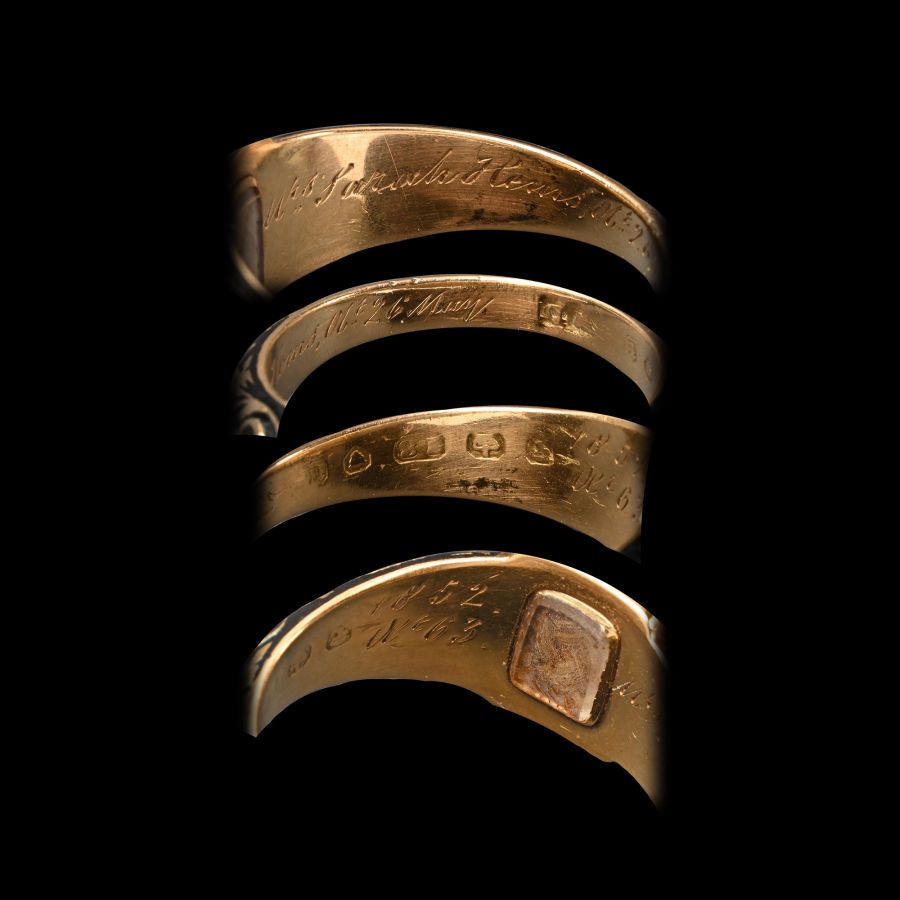
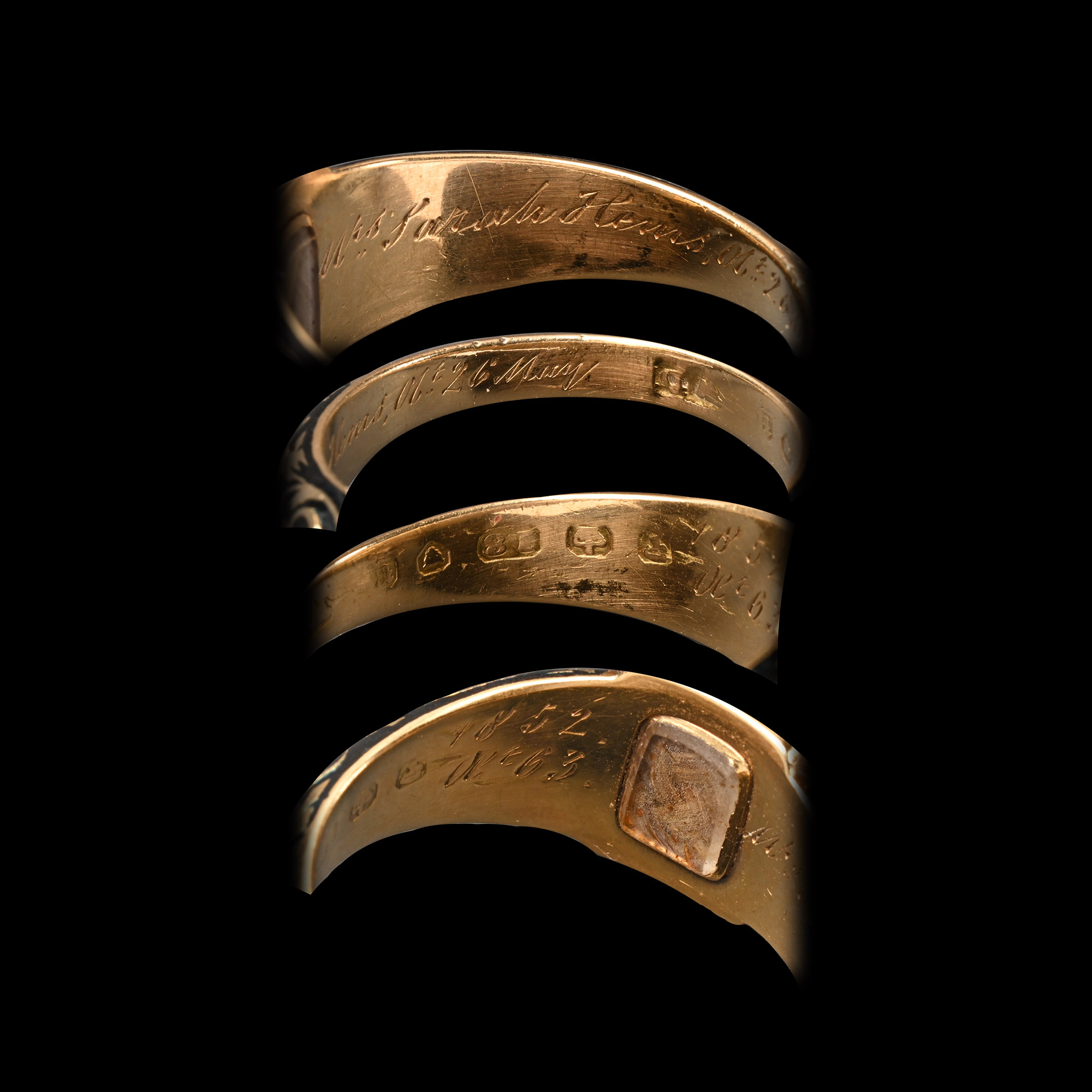
With D-section tapering hoop, black enamel finish with reserved rosettes and tendrils, the bezel an ornate heater shield with reserved text 'In memory OE' and copperplate engraving to the inner face '1852 / obt.63', 'Mrs.Sarah Hems, obt.26 May' and stamped assay marks: crown, '18', leopard's head, gothic 'k' in octagonal panel (dated to 1845).

Provenance

Acquired on the UK art market.
Property of an East Sussex collector.

CONDITION
VETTING:

TimeLine Auctions follows a vetting process to ensure the authenticity and legality of all items, reinforcing our commitment to integrity and responsible trading. Each antiquity, antique, and coin lot undergoes thorough examination by a vetting committee of at least ten external specialists, professional trade association members, scientists, and archaeologists: Our Vetting Process


AUCTIONS:

TimeLine is a leading auction house specialising in antiquities, ancient art, collectables, natural history, coins, medals, and books. Our auctions offer museums, collectors, historians, and enthusiasts the opportunity to acquire unique and historically significant pieces.

LOT 2010

Engraved Gold and Black Enamel Memento Mori Ring

Estimate £600 - 800€700 - 930 (for guidance only)$810 - 1,080 (for guidance only)

Print page

RELATED LOTS
  • Large Painted Wooden Icon of Mother of God of Tikhvin
    Large Painted Wooden Icon of Mother of God of Tikhvin
    Russia, 16th century A.D.

    Estimate: £5,000 - 7,000 (+bp*)

    Opening Bid: £2,500

    Oil and tempera, depicting the Virgin Mary and the infant Jesus on a plain gold field; Mary wearing a red maphorion mantle over a blue robe, with golden brocade to the hem, in the style of Hodegetria (She who shows the way); the Virgin pointing at Jesus with her right hand, while looking towards the spectator; the infant facing left, resting on Mary's left arm, dressed in white tunic, wrapped in a red-orange shawl, right hand blessing the mother, left hand extended holding a scroll of the Holy Scriptures, while crossing his legs to reveal the naked sole of one of his feet; very effaced Greek inscriptions in red lettering 'ΜΡ ΘΥ (Μήτηρ (τοῦ) Θεοῦ = Mother of God)' flanking Mary's head; inscription in Greek 'ΙϹ ΧϹ' (ΙΗϹΟΥϹ ΧΡΙϹΤΟϹ = Jesus Christ) above the infant; rectangular wooden board with mounting bars to reverse and old collector's label 'Vierge Hodigitria, type Tikhvin, Icone russe du 16eme siècle, achetée á Constantinople…chez Monsieur Captain…peinture transmise sur nouvelle planche [Virgin Hodigitria, Tikhvin type, Russian icon from the 16th century, purchased in Constantinople...from Monsieur Captain...painting moved on a new board]'; border with pointillé lozenges and other detailing. 4.7 kg, 70.3 x 52.5 cm


    Acquired on the UK art market. Private collection, London, UK. Accompanied by an academic report by Dr Raffaele D’Amato. This lot has been checked against the Interpol Database of stolen works of art and is accompanied by search certificate number no. 19929-246334.

    According to the legend, this particular icon of the Mother of God appeared in Rus' in 1383 near Veliky Novgorod over Lake Ladoga, and travelled through the air to the Tikhvin River, stopping at several points along the way and performing miracles. On Tikhvin, where the icon came to rest, a stone Dormition Cathedral was built by order of Grand Prince of Moscow Vasil III in 1515, and in 1560, Ivan the Terrible founded the Tikhvin Dormition Monastery near this cathedral. In 1613, the Dormition Monastery withstood the Swedish invasion, and in 1617, the Treaty of Stolbovo was concluded with Sweden. These events were associated with the miraculous intercession of the icon. Until 1936, the icon was kept in the Dormition Cathedral. In 1936, services in the cathedral were discontinued, and the icon was housed in various churches in Tikhvin. In November 1941, Tikhvin was occupied by German troops. The icon was taken abroad and remained in Chicago since the 1950s. In 2004, the icon was again ceremoniously transferred to the Dormition Cathedral of the Tikhvin Monastery.

    Lot Details

  • Georgian Bronze Spoon with Makers Mark
    Georgian Bronze Spoon with Maker's Mark
    18th century A.D.

    Sold for (Inc. bp): £59

    With shallow bowl and flat handle with notched finial, stamped mark 'LO[?]' to bowl. 38.8 grams, 17.2 cm


    Found Norfolk, UK.

    Lot Details

  • Russian Wooden Icon with St John the Baptist
    Russian Wooden Icon with St John the Baptist
    19th century A.D.

    Estimate: £1,500 - 2,000 (+bp*)

    Opening Bid: £800

    Comprising a painted board with mounting panel and slots to the reverse, gessoed surface with painting of St John the Baptist standing nimbate with wings spread behind him, left hand supporting a bowl containing his severed head and holding an unfurled scroll with Cyrillic text 'Repent ye, for the Kingdom of Heaven is at hand,' (Matthew 3:2); right hand raised in blessing; landscape with sand-dunes and trees; gilded title above; the upper border with gilt Slavonic inscription reading 'Holy John the Forerunner'; from the Palekh Icon School, probably made in Mstera circa 1890. 1.02 kg, 31 cm high

    Fine condition.

    Ex property of a London lady, part of her family's collection. This lot has been checked against the Interpol Database of stolen works of art and is accompanied by a search certificate no.11546-196366.

    The Palekh icon school emerged in the 17th century, inspired by the Moscow and Suzdal traditions of icon painting. Although preserving many features of traditional Russian iconography, the school created its own style that remained active into the 18th century. The hallmarks of the school include the frequent use of gold on the clothes of the saints and a rich palette. Bodies are shown as tall and slender and abrupt transitions between light and shadow are distinctive features of Palekh icons. The wings of Saint John derive from the double meaning of the Greek word used to describe him in Mark 1:2 - Angelos, meaning both messenger and angel. John is often called a 'Heavenly Man' and 'Earthly Angel' in Orthodoxy. At his feet is shown a small tree with an axe cutting into it, illustrating Luke 3:9, 'And now also the axe is laid unto the root of the tree...'

    Lot Details

Stay up-to-date with the latest from TimeLine Auctions by joining our mailing list