
Loading, please wait...
_900x900.jpg "English Medieval Iron Kidney Dagger")
_200x200.jpg "English Medieval Iron Kidney Dagger")
.jpg "English Medieval Iron Kidney Dagger")
LOT 0264
English Medieval Iron Kidney Dagger
LATE 15TH-EARLY 16TH CENTURY A.D.
12 1/4 in. (178 grams, 31 cm).
Comprising a single-edged blade, whittle tang and cylindrical grip terminating in a bulbous openwork pommel.
ProvenanceAcquired 1960s-1990s.
Late Alison Barker collection, a retired London barrister.
Cf. Gilliot, C., Armes & Armures/Weapons & Armours, Bayeux, 2008, pp.142-143, for similar daggers; for a similar handle, see a specimen in Leeds Armoury, inventory no.X.1705.
FootnotesCarried universally throughout Europe, the kidney dagger or ballock dagger (dague a rognons) seems to have been used by all classes of society. Early effigies and brasses prove that the ballock dagger was a knightly weapon. Later on, the more elaborate daggers suggest that it was also a weapon of the emerging merchant and artisan classes. Of course there are also some very simple and crude examples which would probably have been used by the peasants.
CONDITIONTimeLine Auctions follows a vetting process to ensure the authenticity and legality of all items, reinforcing our commitment to integrity and responsible trading. Each antiquity, antique, and coin lot undergoes thorough examination by a vetting committee of at least ten external specialists, professional trade association members, scientists, and archaeologists: Our Vetting Process
AUCTIONS:
TimeLine is a leading auction house specialising in antiquities, ancient art, collectables, natural history, coins, medals, and books. Our auctions offer museums, collectors, historians, and enthusiasts the opportunity to acquire unique and historically significant pieces.
-
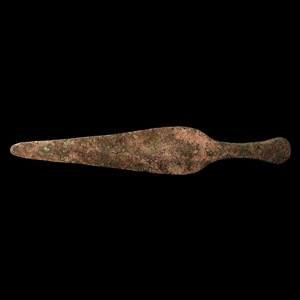
Western Asiatic Bronze Dagger with Integral Hilt
3rd-2nd millennium B.C.Estimate: £100 - 140 (+bp*)
Opening Bid: £50
Composed of a leaf-shaped blade, round-section grip with wide flat tang and lobe pommel. 740 grams, 40 cm
Fine condition.
Abelita family collection, 1980-2015. -
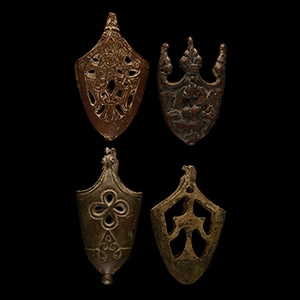
Viking Age Bronze Sword Scabbard Chape Collection
9th-11th century A.D.Sold for (Inc. bp): £715
Comprising: one heater-shaped with openwork raven motif to each face; one similar with openwork raven enmeshed in tendrils; one with fleur-de-lys to the centre of each upper edge and a lobed spur to each side; one with openwork quatrefoil to each face and knop finial to the apex. 145 grams total, 55-85 mm
From the collection of a North American gentleman, formed in the 1990s. -
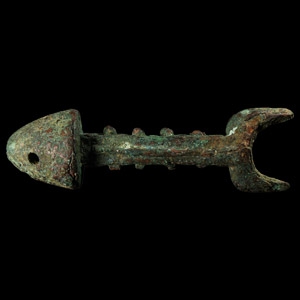
Luristan Bronze Sword Hilt
2nd millenium B.C.Sold for (Inc. bp): £234
With crescent-shaped guard to accept blade, square-section grip with central rib to two sides and four evenly-spaced studs to the other two, and a conical hollow-cast mushroom pommel pierced on three sides. 492 grams, 16.5 cm
Acquired in the early 1990s. Ex Guernsey collection. The Kusmirek Collection, UK.
