
Loading, please wait...


LOT 2065
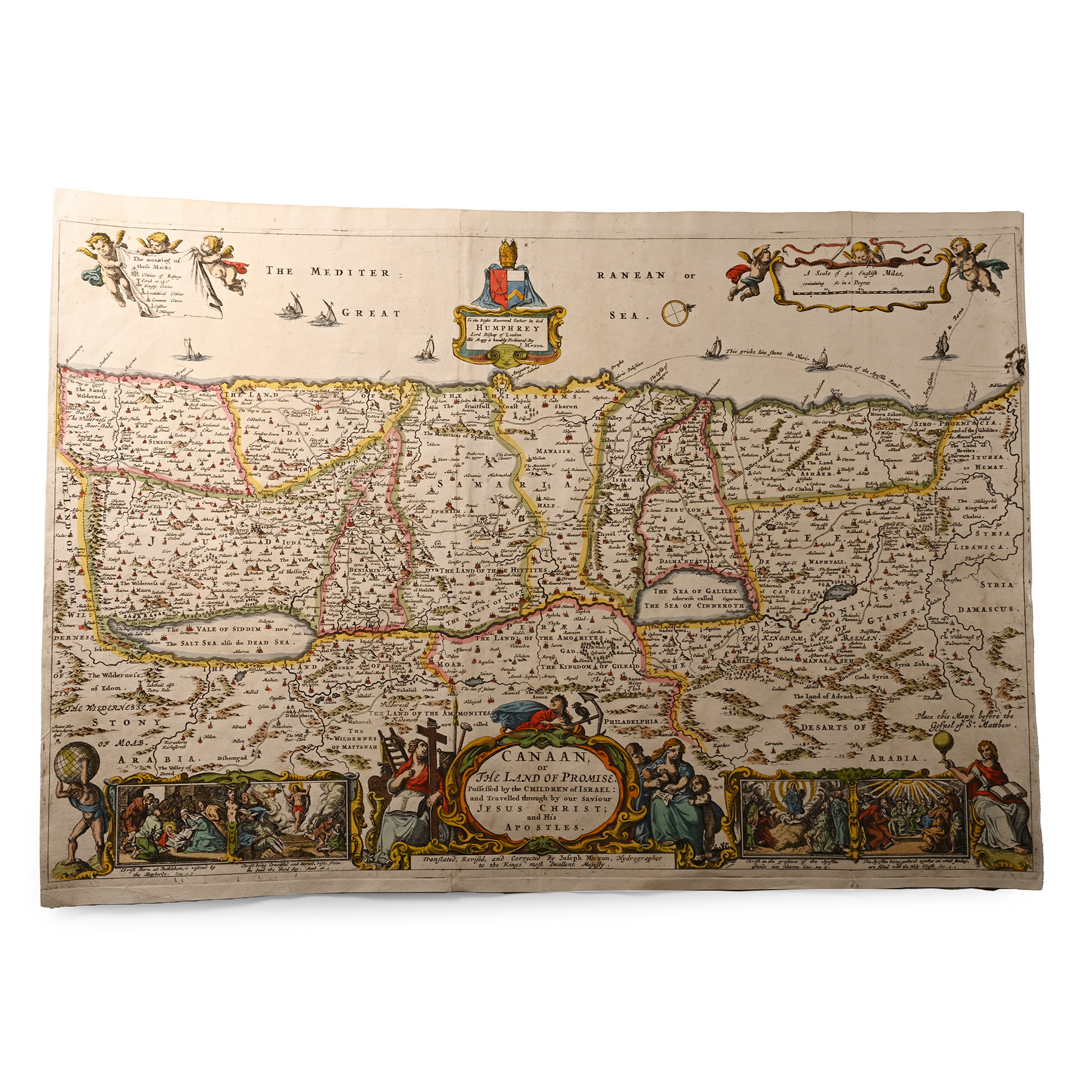
English Map of the Holy Land by Joseph Moxon
LONDON, CIRCA 1691 A.D.
18 1/2 x 13 in. (53 grams, 47 x 33 cm).
Laid paper map with hand-tinted detailing to the political boundaries, heraldic embellishments and miniature scenes; centre-bottom an ellipse with the title 'Canaan, or The Land of Promise possessed by the Children of Israel and travelled through by our Saviour Jesus Christ and His Apostles.', strip below with 'Translated, Revised and Corrected by Joseph Moxon, Hydrographer to the Kings most Excellent Majesty'; top centre a heater shield surmounted by a bishop's mitre above an ornate panel with the text 'To the Right Reverend father in God Humphrey Lord Bishop of London this Mapp is humbly Dedicated by J. Moxon'; top left: legend for symbols; top right: 'A Scale of 40 English Miles'; bottom row: scenes depicting the Nativity, Crucifixion, Resurrection and instruction of the Apostles.
ProvenanceAcquired on the UK art market.
Scottish private collection.
The dedication to 'Humphrey Lord Bishop of London' suggests a date of engraving during the episcopacy of Humphrey Henchman, between 1663 and 1675; he is the only man of that name to have held the office. The map can have been printed subsequently.
CONDITIONTimeLine Auctions follows a vetting process to ensure the authenticity and legality of all items, reinforcing our commitment to integrity and responsible trading. Each antiquity, antique, and coin lot undergoes thorough examination by a vetting committee of at least ten external specialists, professional trade association members, scientists, and archaeologists: Our Vetting Process
AUCTIONS:
TimeLine is a leading auction house specialising in antiquities, ancient art, collectables, natural history, coins, medals, and books. Our auctions offer museums, collectors, historians, and enthusiasts the opportunity to acquire unique and historically significant pieces.
-

Post Medieval Walnut Relief Panel Depicting The Victory of Maximilian I and Henry VIII Over the French at The Battle of The Spurs
German or Austrian, 19th century A.D. or earlierSold for (Inc. bp): £6,240
A substantial carved wooden panel with figures in low-relief, representing knights of second half of 16th century A.D. engaged in a deadly battle; the armoured knights depicted facing each other, with the lance couché, trampling over the dead and wounded, while on the background the clash among the infantrymen of the opposed armies can be seen; after the work of Albrecht Dürer and Alexander Colyn, with old typed labels translating to: 'Alexander Colins. Flemish sculptor, born 1526 in Mechelen, died 1617 in Innsbruck. Created important works of art from around 1550 onwards. His sculptures include those at the Heidelberg Castle, the tomb of Emperor Maximilian I in the Court Church in Innsbruck and other important grave monuments.' 2.7 kg, 45 cm wide
Private collection, New York, USA. Ex central London gallery. Accompanied by an academic report by Dr Raffaele D’Amato. This lot has been checked against the Interpol Database of stolen works of art and is accompanied by search certificate no.12180-221703.
The second battle of Guinegate, or Battle of the Spurs, was an episode of the early 16th century wars (August, 16th 1513), when Henry VIII and the Holy Roman Emperor Maximilian I surprised and routed a body of French knights under Jacques de la Palice. The Flemish artist represented the victory as one of the main scenes for the imperial grave of Emperor Maximilian I, the sketches for which were made by the well known German sculptor, painter and architect Albrecht Dürer. -
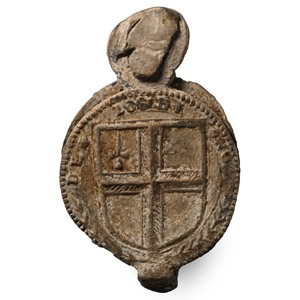
Charles I City of London Lead Seal
1625-1631 A.D.Sold for (Inc. bp): £111
Two-part, four-lobed seal with strap and tag above; obverse with heater shield bearing the arms of the City of London with legend to beaded border 'DE * LO[.]DI ONO' (from London); reverse with angel holding an orb with legend 'GLORIA * IN * EXCELSIS' (glory in the highest); accompanied by a letter from the British Museum, with attachments. 37.5 grams, 57 mm
From the collection of the famous author, writer and speaker, Gordon Bailey, Essex, UK; formed since 1968. Accompanied by the original Museum of London letter by Geoff Egan dated 3rd January 1979.
The item was identified by Geoff Egan (then on secondment from the Museum of London to the British Museum) in 1979 as a four-lobed cloth seal, of a type which had recently been found from a shipwreck off the coast of Norway. The likelihood is that the seal was issued by or in connection with Blackwell Hall, which had a near-monopoly on the cloth trade in 17th c. London. The significance of the angel motif and the motto were not known to Egan, and are still debated. -

Civil War and Later Iron Cannon Ball and Shot Group
17th-19th century A.D.Sold for (Inc. bp): £33
Mixed group of iron and other musket and cannon balls. 3.8 kg total, 32-78 mm
From the collection of the famous author, writer and speaker, Gordon Bailey, Essex, UK; formed since 1968.
