
Loading, please wait...
LOT 0298
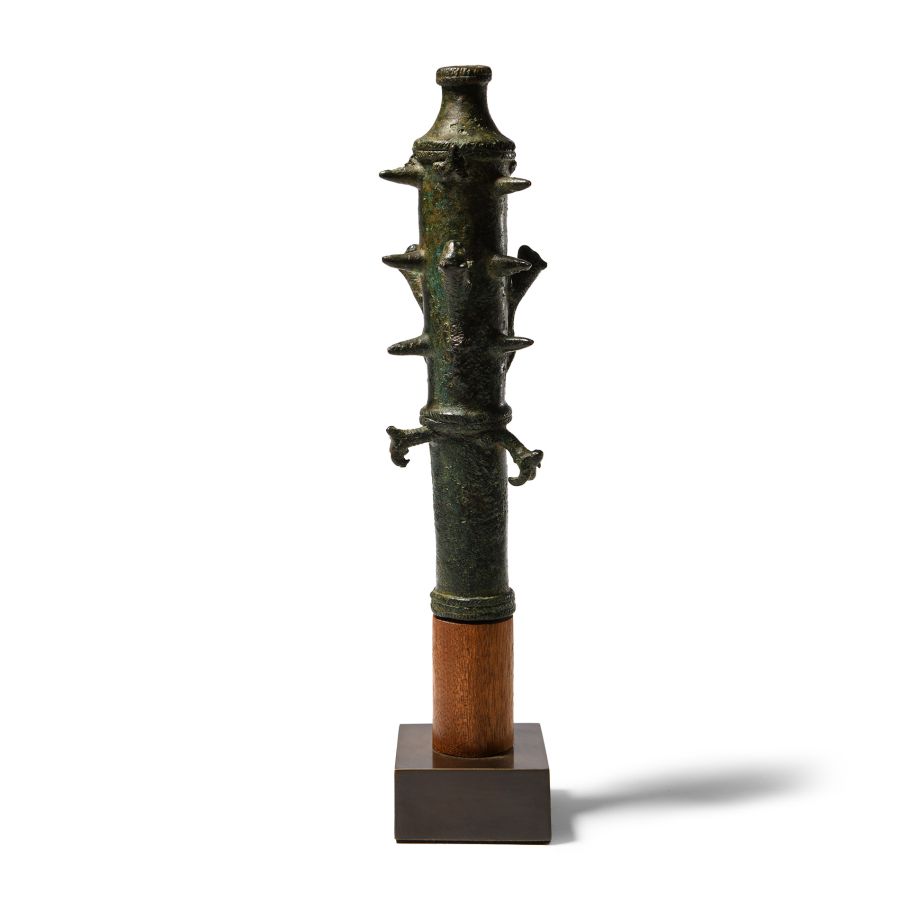
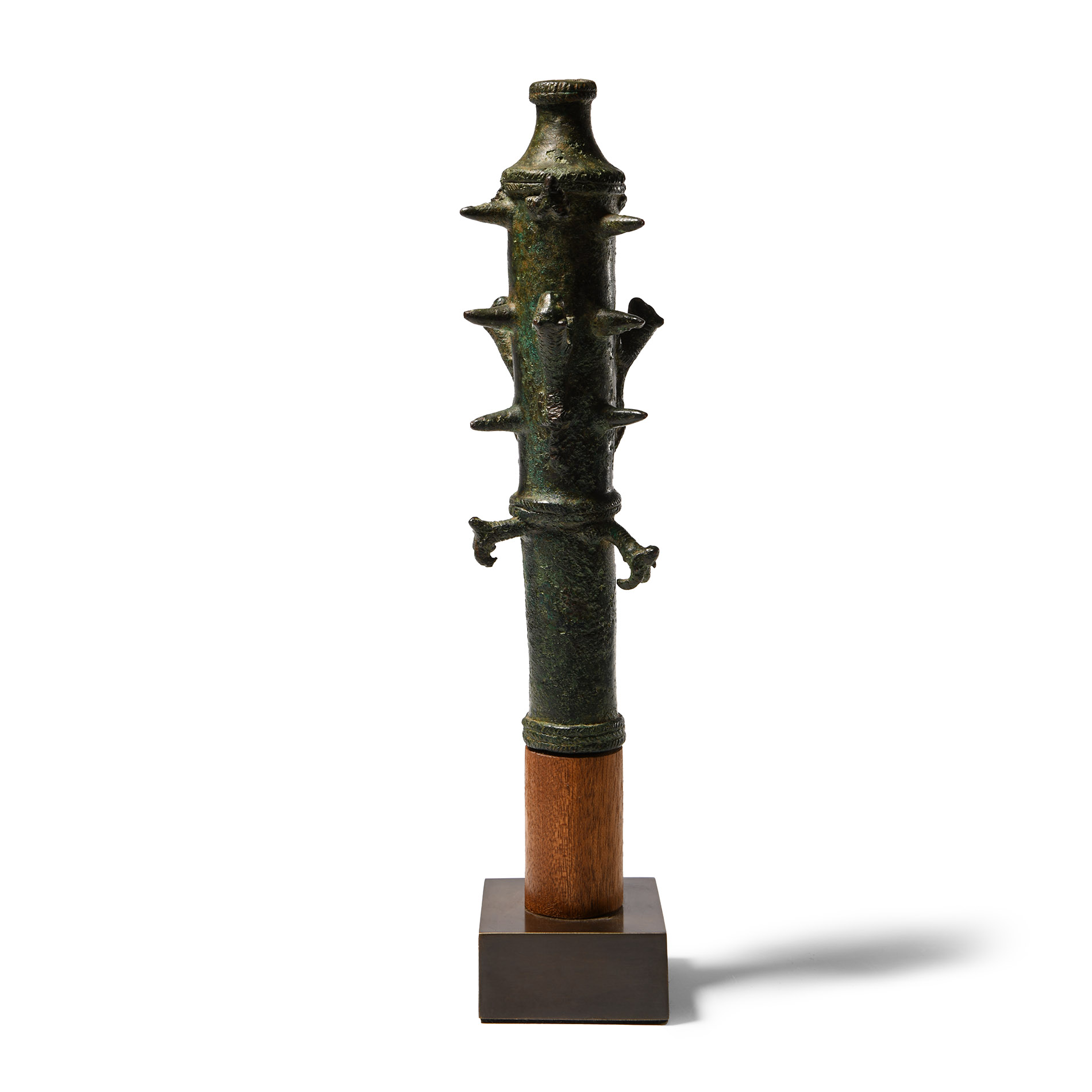
Elamite Bronze Cudgel with Animals
CIRCA MID 3RD-EARLY 2ND MILLENNIUM B.C.
7 1/4 in. (10 3/8 in.) (650 grams total, 18.5 cm high (26.5 cm high including stand)).
With ribbed terminals; the upper body with three relief panels of herringbone design, the main body decorated with spikes, three lion bodies arranged vertically, and three ram-head protomes under the central herringbone panel; mounted on a custom-made stand.
ProvenanceEx Kuizenga collection, Netherlands.
Acquired in Hamburg, Germany, 22 December 1995.
Cf. Moorey, P.R.S., Ancient Persian Bronzes in the Adam Collection, Oxford, 1974, p. 49, no. 18; Mahboubian, H., Art of Ancient Iran. Copper and Bronze, London, 1997, p.169, no.177.
FootnotesMoorey notes that though the rows of spikes suggest that these objects were designed to be mounted on wooden shafts as cudgels, the projections in the form of lions (?) indicates the possibility that they were also used as votive or parade weapons. However, it does not exclude an effective use on the battlefield, especially if used by commanders as signs of rank.
CONDITIONTimeLine Auctions follows a vetting process to ensure the authenticity and legality of all items, reinforcing our commitment to integrity and responsible trading. Each antiquity, antique, and coin lot undergoes thorough examination by a vetting committee of at least ten external specialists, professional trade association members, scientists, and archaeologists: Our Vetting Process
AUCTIONS:
TimeLine is a leading auction house specialising in antiquities, ancient art, collectables, natural history, coins, medals, and books. Our auctions offer museums, collectors, historians, and enthusiasts the opportunity to acquire unique and historically significant pieces.
LOT 0298
Elamite Bronze Cudgel with Animals
Estimate £1,200 - 1,700€1,390 - 1,970 (for guidance only)$1,620 - 2,300 (for guidance only)
-
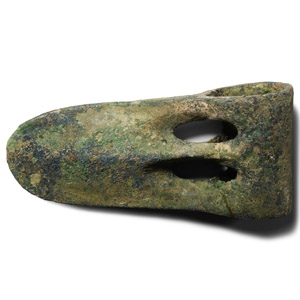
Babylonian Bronze Duck-Billed Axehead
2nd millennium B.C.Sold for (Inc. bp): £156
Duck-billed shaft-hole axehead featuring a curved, tongue-shaped blade with two voided 'eyes' and a raised median ridge; repaired. 168 grams, 10.3 cm
Collected from 1969-1999. From the collection of the late Mr S.M., London, UK. -
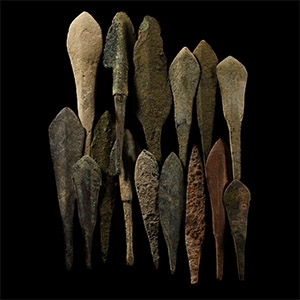
Western Asiatic Bronze Arrowhead Group
2nd-1st millennium B.C.Sold for (Inc. bp): £117
Comprising fifteen tanged examples, including one slender arrowhead in iron. 112 grams total, 44-75 mm
Acquired 1980-2015. Ex Abelita family collection. -
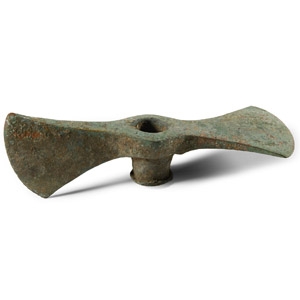
Large Luristan Bronze Socketted Axe-Adze
13th-7th century B.C.Sold for (Inc. bp): £195
With tapering socket and flared rim to the mouth, vertical axe-blade with curved cutting edge, horizontal adze blade of similar proportions. 1.14 kg, 24 cm
Acquired 1980-2015. Ex Abelita family collection.
The earliest axe-adzes from the 3rd millennium B.C. were weapons and tools furnished with socketted holes. Usually the socket is a more secure way of attaching the object to a wooden haft than having a tang. These weapons developed into a range of different forms in the 2nd millennium B.C., which were used until at least 800 B.C.
