
Loading, please wait...
LOT 1382
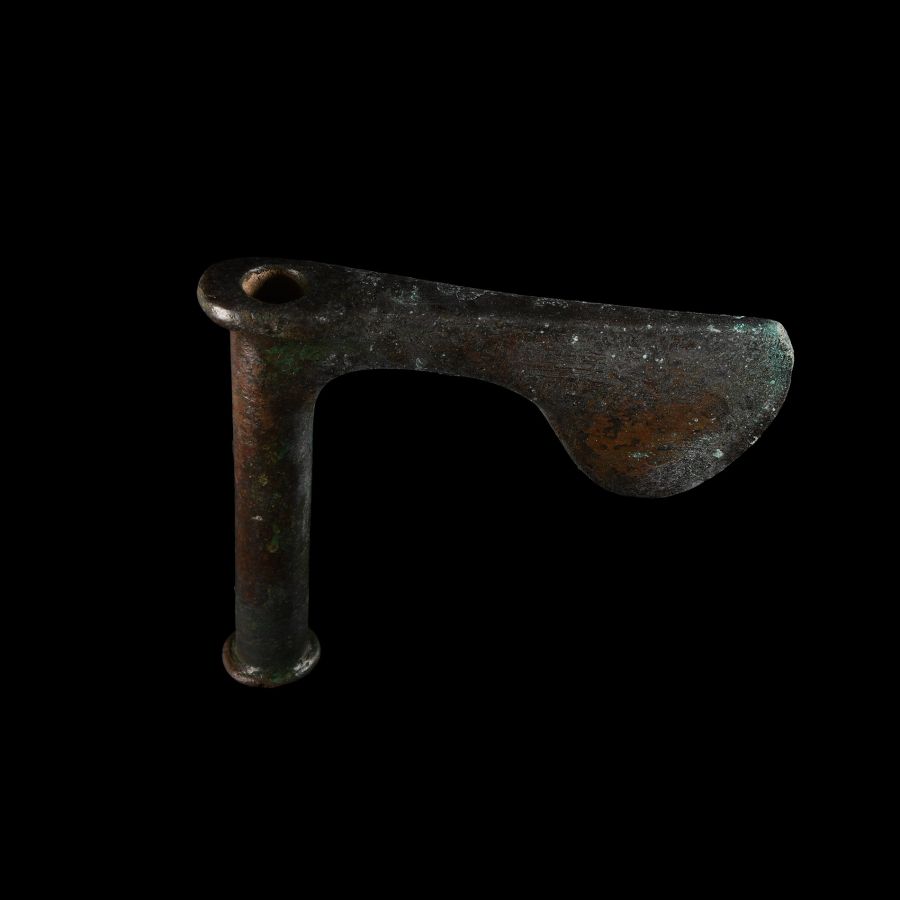
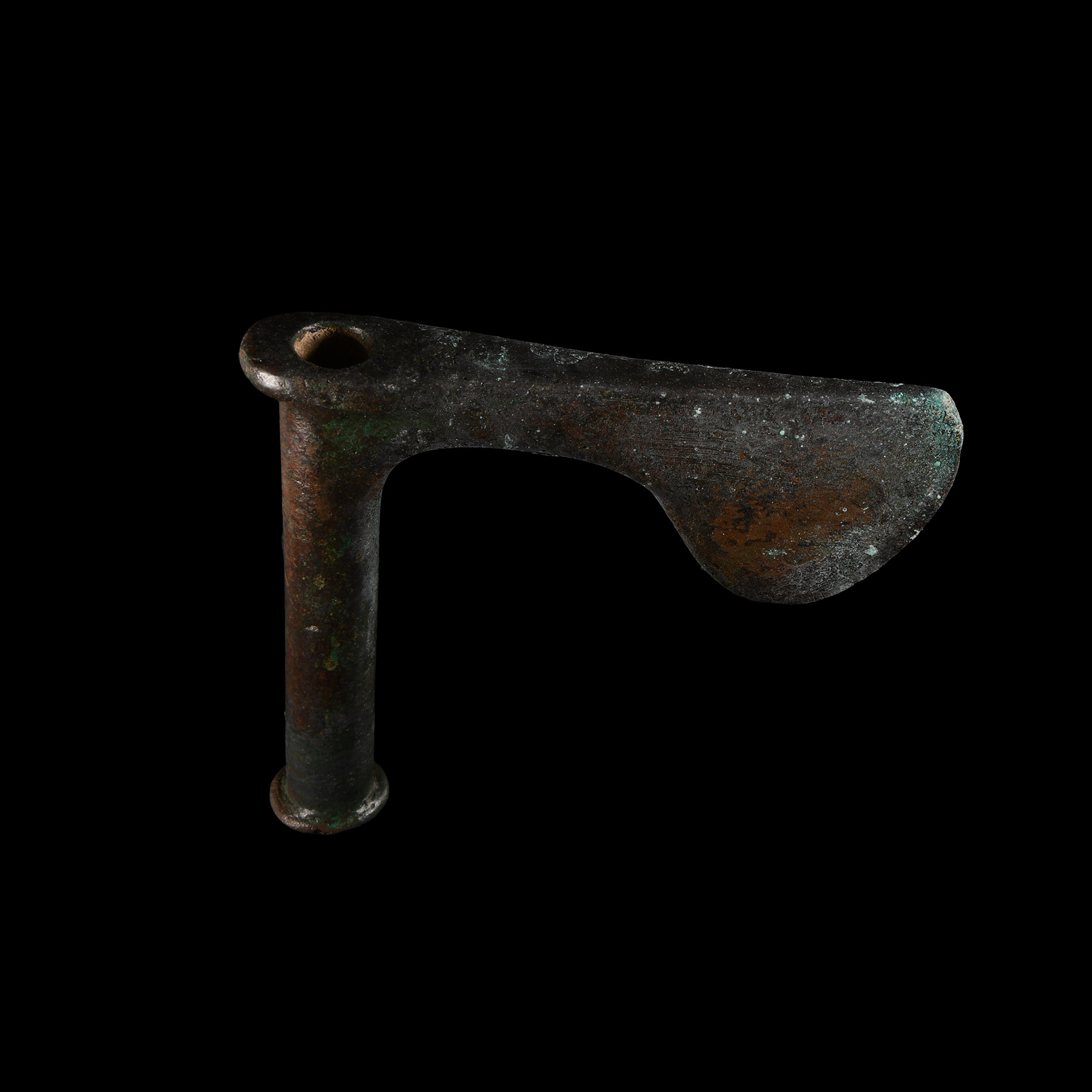
Elamite Bronze Crescentic Axehead
MID 3RD-EARLY 2ND MILLENNIUM B.C.
5 in. (333 grams, 12.5 cm).
With slender tubular socket, horizontal upper cheek and curved lower one, scooped profile to blade with convex cutting edge.
ProvenanceAcquired 1980-2015.
Ex Abelita family collection.
See Gorelik, M., Weapons of Ancient East, IV millennium BC-IV century BC, Saint Petersburg (2003), pl.XIX, no.68 (Susa, Elam), for similar.
CONDITIONTimeLine Auctions follows a vetting process to ensure the authenticity and legality of all items, reinforcing our commitment to integrity and responsible trading. Each antiquity, antique, and coin lot undergoes thorough examination by a vetting committee of at least ten external specialists, professional trade association members, scientists, and archaeologists: Our Vetting Process
AUCTIONS:
TimeLine is a leading auction house specialising in antiquities, ancient art, collectables, natural history, coins, medals, and books. Our auctions offer museums, collectors, historians, and enthusiasts the opportunity to acquire unique and historically significant pieces.
LOT 1382
Elamite Bronze Crescentic Axehead
Estimate £150 - 200€170 - 230 (for guidance only)$200 - 270 (for guidance only)
-
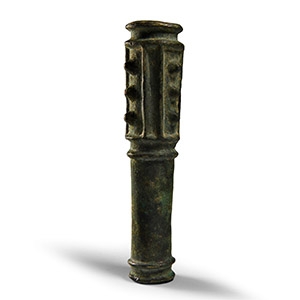
Luristan Bronze Macehead
Late 2nd millennium B.C.Sold for (Inc. bp): £286
Of cylindrical shape, the upper section with alternating rectangular panels and vertical rows of three prominent spikes, short cylindrical shaft edged at top and bottom. 244 grams, 13.5 cm
Ex London, UK, collection, before 1988.
The mace was probably the oldest weapon used by humans. This weapon has been used in different ways and it was probably considered the main tool in the civilisation of the Kassites because of the high number of maces found in this area. Bronze maces in Luristan probably had wooden handles, although most of them unfortunately have been eroded and severely deteriorated. According to Khorasani, such maces were realised with lost-wax process. -
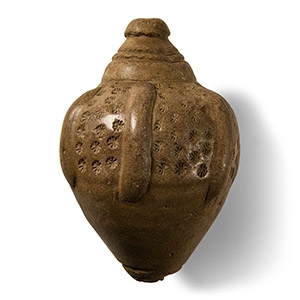
Byzantine 'Greek Fire' Ceramic Fire Bomb or Hand Grenade
9th-11th century A.D.Sold for (Inc. bp): £176
Piriform body with thick ribs to the shoulder and impressed panels between, domed filler-hole, intended to be filled with explosive liquid and wick, used as a hand grenade. 708 grams, 15 cm
Acquired 1980-2015. Ex Abelita family collection. Accompanied by an academic paper by military specialist Dr Raffaele D'Amato, dated 15 July 2019 and titled 'Eastern Roman Empire - Greek Fire Bomb or Hand Grenade (μεσαίον kακάβιον) 9th-11th century AD'.
Apart from the use of siphons or manual flame-throwers called cheirosiphona, special corps of Roman soldiers employed terracotta grenades, in the form of small jars, abundantly evidenced in archaeological excavations. They were called μεσαία kακαβιά or κυτροκακάβια where the former had a bulbous shape and the latter a more cylindrical form. -
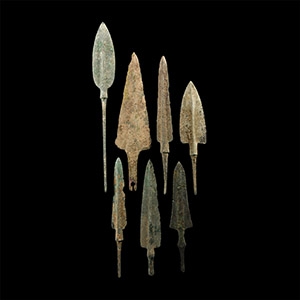
Luristan Bronze Arrowhead Group
13th-7th century B.C.Sold for (Inc. bp): £156
Comprising mainly tanged arrowheads including various types of leaf-shaped heads with midribs. 200 grams total, 12-15.3 cm
Acquired 1990s. From the collection of a late Japanese weaponry collector.
The barbed arrowhead seems to belong to the type V, subcategory type C, according to the classification of Khorasani and Negahban. In the four categories of triangular bronze arrowheads from Luristan, Marlik and Northern Iran individuated by Negahban, subtypes C and D of type V are larger arrow or javelin heads, C large triangular arrowheads with barbed shoulders and D with lanceolate shape and rounded midrib. The straight shoulders recalls a Marlik typology (see Khorasani, 2006, p.307, fig.379).
