
Loading, please wait...
_900x900.jpg "Elaborate Canaanite Bronze 'Anchor' Axehead")
_200x200.jpg "Elaborate Canaanite Bronze 'Anchor' Axehead")
_900x900.jpg "Elaborate Canaanite Bronze 'Anchor' Axehead")
_200x200.jpg "Elaborate Canaanite Bronze 'Anchor' Axehead")
.jpg "Elaborate Canaanite Bronze 'Anchor' Axehead")
.jpg "Elaborate Canaanite Bronze 'Anchor' Axehead")
LOT 0265
Elaborate Canaanite Bronze 'Anchor' Axehead
EARLY 2ND MILLENNIUM B.C.
4 3/8 in. (305 grams, 11.2 cm wide).
Comprising a deep crescentic blade with two spurs at each end intended to brace against the shaft, a narrow neck, and flared socket with vertical spurs to the reverse and a knop finial.
ProvenanceAcquired in the mid 1980s-1990s.
Private collection, Switzerland, thence by descent.
Private collection, since the late 1990s.
TimeLine Auctions follows a vetting process to ensure the authenticity and legality of all items, reinforcing our commitment to integrity and responsible trading. Each antiquity, antique, and coin lot undergoes thorough examination by a vetting committee of at least ten external specialists, professional trade association members, scientists, and archaeologists: Our Vetting Process
AUCTIONS:
TimeLine is a leading auction house specialising in antiquities, ancient art, collectables, natural history, coins, medals, and books. Our auctions offer museums, collectors, historians, and enthusiasts the opportunity to acquire unique and historically significant pieces.
LOT 0265
Elaborate Canaanite Bronze 'Anchor' Axehead
Estimate £800 - 1,000€930 - 1,160 (for guidance only)$1,080 - 1,350 (for guidance only)
-
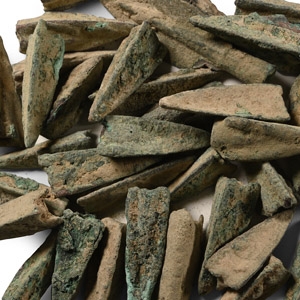
Greek Period Bronze Arrowhead Collection
Circa 5th-3rd century B.C.Sold for (Inc. bp): £117
Including triangular-section, leaf-shaped and other types. 115 grams total, 19 - 44 mm
Acquired in the 1990s. Ex Abelita family collection. This lot is accompanied by an illustrated lot declaration signed by the Head of the Antiquities Department, Dr Raffaele D'Amato. -
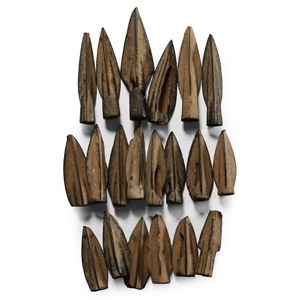
Greek and Other Bronze Arrowhead Collection
Circa 5th-3rd century B.C.Sold for (Inc. bp): £117
The group comprising triangular trilobate types, all socketted. 63.5 grams total, 24-42 mm
Ex London art market, 1980-1990s. This lot is accompanied by an illustrated lot declaration signed by the Head of the Antiquities Department, Dr Raffaele D'Amato.
In the Greek warfare, archers were mainly employed by Scythians and Cretans. Both used composite bows made of wood, horn, bone and sinew. This explains the great range of Scythian arrowheads found on the Greek sites. -
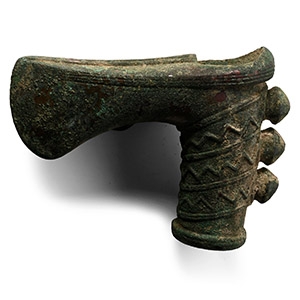
Elamite Decorated Bronze Axehead
2nd-1st millennium B.C.Estimate: £500 - 700 (+bp*)
Opening Bid: £250
With a slender, scooped blade, a round socket with a ribbed outer flange, and three lobed extensions to the rear of the socket with low-relief decorative bands. 360 grams, 10.4 cm
French collection, 1980s. Acquired on the London art market. Private collection, London, UK.
