
Loading, please wait...
_900x900.jpg "Egyptian Wooden Model Boat with Oarsmen")
_200x200.jpg "Egyptian Wooden Model Boat with Oarsmen")
.jpg "Egyptian Wooden Model Boat with Oarsmen")
LOT 0052
Egyptian Wooden Model Boat with Oarsmen
MIDDLE KINGDOM, LATE 11TH-EARLY 12TH DYNASTY, 2010-1961 B.C.
16 3/8 in. (1.29 kg, 41.5 cm wide).
Comprising a cream-coloured crescent-shaped boat manned by a crew of seven oarsmen, each with a short black wig, their bodies painted in reddish-brown and wearing cream-coloured kilts; all with pivoting arms and with hands drilled to accept oars (now missing); an outline around the boat's deck and a net pattern at the prow and stern in red; a portion of an inward slanting stern post remains, with traces of another at the prow; the oarsmen re-affixed.
ProvenanceAcquired in the 1960s.
From the collection of the late Egyptologist Surgeon Commander P.H.K. Gray RN.
From a Surrey, UK, collection.
Accompanied by an academic report by Egyptologist Paul Whelan.
This lot has been checked against the Interpol Database of stolen works of art and is accompanied by search certificate no.11943-209563.
This lot has been cleared against the Art Loss Register database, and is accompanied by an illustrated lot declaration signed by the Head of the Antiquities Department, Dr Raffaele D'Amato.
Cf. Freed, R.E. et al., The Secrets of Tomb 10A - Egypt 2000 BC, p.167, fig.127, for a similar example from the tomb of Djehuty-nakht at Deir el-Bersha.
FootnotesModels of various boat types were sometimes provided for the same burial. For the different types see Winlock, H.E., Models of Daily Life in Ancient Egypt from the Tomb of Meket-Re' at Thebes, Cambridge MA, 1955, pp.92-103.
CONDITIONTimeLine Auctions follows a vetting process to ensure the authenticity and legality of all items, reinforcing our commitment to integrity and responsible trading. Each antiquity, antique, and coin lot undergoes thorough examination by a vetting committee of at least ten external specialists, professional trade association members, scientists, and archaeologists: Our Vetting Process
AUCTIONS:
TimeLine is a leading auction house specialising in antiquities, ancient art, collectables, natural history, coins, medals, and books. Our auctions offer museums, collectors, historians, and enthusiasts the opportunity to acquire unique and historically significant pieces.
LOT 0052
Egyptian Wooden Model Boat with Oarsmen
Estimate £8,000 - 10,000€9,280 - 11,600 (for guidance only)$10,800 - 13,500 (for guidance only)
-
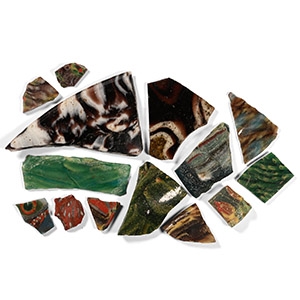
Egyptian and Other Mosaic Glass Fragment Collection
3rd century B.C.-4th century A.D.Sold for (Inc. bp): £234
Comprising fourteen polychrome fragments displaying vibrant colours and patterns, two with a rounded lip. 58 grams total, 15-71 mm
Ex Gallery Mikazuki before 1984. London gallery, latterly Mayfair, UK, collection. This lot is accompanied by an illustrated lot declaration signed by the Head of the Antiquities Department, Dr Raffaele D'Amato. -
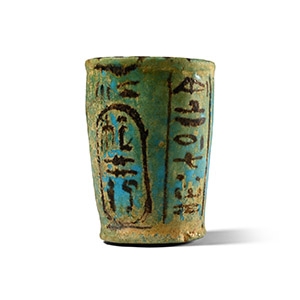
Egyptian Blue Glazed Libation Cup of Ramesses III
New Kingdom, 20th Dynasty, circa 1183-1152 B.C.Sold for (Inc. bp): £1,235
Ritual cup with sides tapering towards the base; the black glazed rectangular panel containing two columns of text: 'Lord of Appearances, Ramesses ruler of Heliopolis (Ramses heqa Iwnw) given life, beloved of Osiris, Lord of Rosetau'. 50 grams, 53 mm
with Hoshigaoka Gallery Co. Ltd, Japan. Private collection, London, acquired from the above on the 26th September 1981. This lot has been checked against the Interpol Database of stolen works of art and is accompanied by a search certificate number no.12637-235085. This lot is accompanied by an illustrated lot declaration signed by the Head of the Antiquities Department, Dr Raffaele D'Amato. -
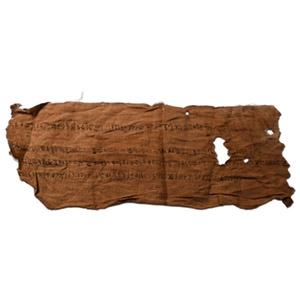
Egyptian Mummy Shroud Section with Hieratic Text
Late-Ptolemaic Period, circa 480-30 B.C.Sold for (Inc. bp): £910
A rectangular section of woven linen textile featuring four lines of neat hieratic text in black. 8 grams, 32 cm
From the collection of a gentleman, acquired on the London art market in the 1990s. This lot is accompanied by an illustrated lot declaration signed by the Head of the Antiquities Department, Dr Raffaele D'Amato.
From the fifth century B.C., mummy wrappings for the affluent frequently display lines of hieratic script—a cursive variant of Egyptian hieroglyphs used for both daily and religious writings. These often include excerpts from funerary texts like the Book of the Dead, along with prayers and invocations designed to safeguard and guide the deceased in the afterlife. These texts, sometimes accompanied by vignettes, were inscribed directly on the linen strips before or during the mummification process. Some of these bandages could be remarkably long; one example from Brussels, measuring only 6.2 cm in width, spans an incredible 26 metres.
