
Loading, please wait...
_900x900.jpg "Egyptian Wooden Animal-Headed Furniture Leg")
_200x200.jpg "Egyptian Wooden Animal-Headed Furniture Leg")
.jpg "Egyptian Wooden Animal-Headed Furniture Leg")
LOT 0465
Egyptian Wooden Animal-Headed Furniture Leg
LATE PERIOD, 664-332 B.C.
13 in. (14 in.) (260 grams, 33 cm high (529 grams total, 35.5 cm high including stand)).
Representing the head, chest and split forelegs of a lion with ochre-tan surface and applied black detailing; ledge to the reverse and socket to accept a mounting peg or mortice; mounted on a custom-made stand. [No Reserve]
ProvenanceSwiss collection prior to late 1990s.
Private London collection since 1999.
Cf. Metropolitan Museum of Art, New York, under accession number 1977.170, for a similar item made in glazed composition.
CONDITIONTimeLine Auctions follows a vetting process to ensure the authenticity and legality of all items, reinforcing our commitment to integrity and responsible trading. Each antiquity, antique, and coin lot undergoes thorough examination by a vetting committee of at least ten external specialists, professional trade association members, scientists, and archaeologists: Our Vetting Process
AUCTIONS:
TimeLine is a leading auction house specialising in antiquities, ancient art, collectables, natural history, coins, medals, and books. Our auctions offer museums, collectors, historians, and enthusiasts the opportunity to acquire unique and historically significant pieces.
-
.jpg)
Egyptian Lower Legs from an Unfinished Limestone Figure
Possibly First Intermediate Period, 2181-2055 B.C. or laterSold for (Inc. bp): £143
Showing the shins and two feet from a larger figure, rectangular section back and base. 560 grams, 10.2 cm
Fair condition.
Acquired in the 1970s. Property of a London gentleman. -
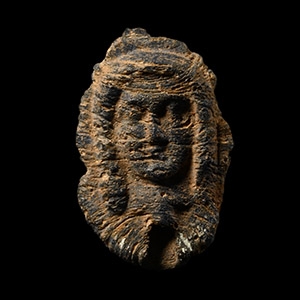
Phoenician Blue Glass Bifacial 'Lady in the Window' Type Pierced Disc
7th-6th century B.C.Sold for (Inc. bp): £124
Composed of a bifacial oval plaque showing a female face in relief to both sides, stylised facial detailing and shoulder-length hair; mounting socket to one end. 2.49 grams, 26 mm
From the private collection of the late Mr S.M., London, UK, thence by descent. -
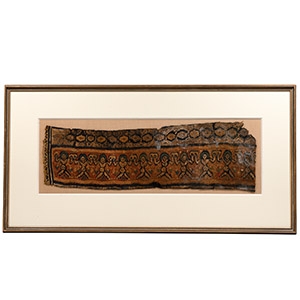
Large Framed Coptic Wool Garment Fragment with Dancing Nymphs
Circa 6th-7th century A.D.Sold for (Inc. bp): £520
Comprising a series of nude female figures on red background, probably maenads or nymphs, dancing to the sounds of cymbals held in their outstretched hands, each wearing a green proploma; wide band of geometric decoration above; mounted in a custom-made glazed frame. 2.1 kg total, 71 x 36 cm including frame
Ex Dutch collection, 1960s. UK collection 2018.
The band is probably the terminal part of a large wall carpet. The warp material is raw natural twisted wool in one strand, with weft in linen and raw wool in red, orange, ochre yellow, blue green, olive green, blue. The motif still echoes themes of the pagan world, despite being made in the Christian Roman Empire.
