
Loading, please wait...
LOT 0017
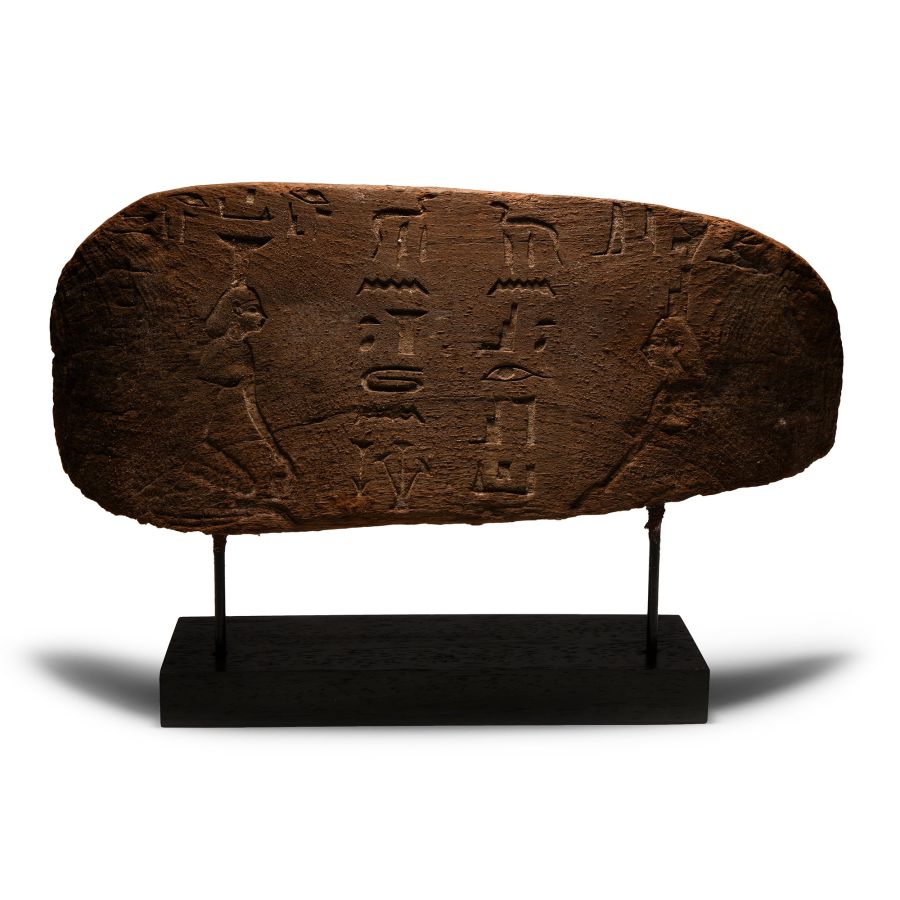
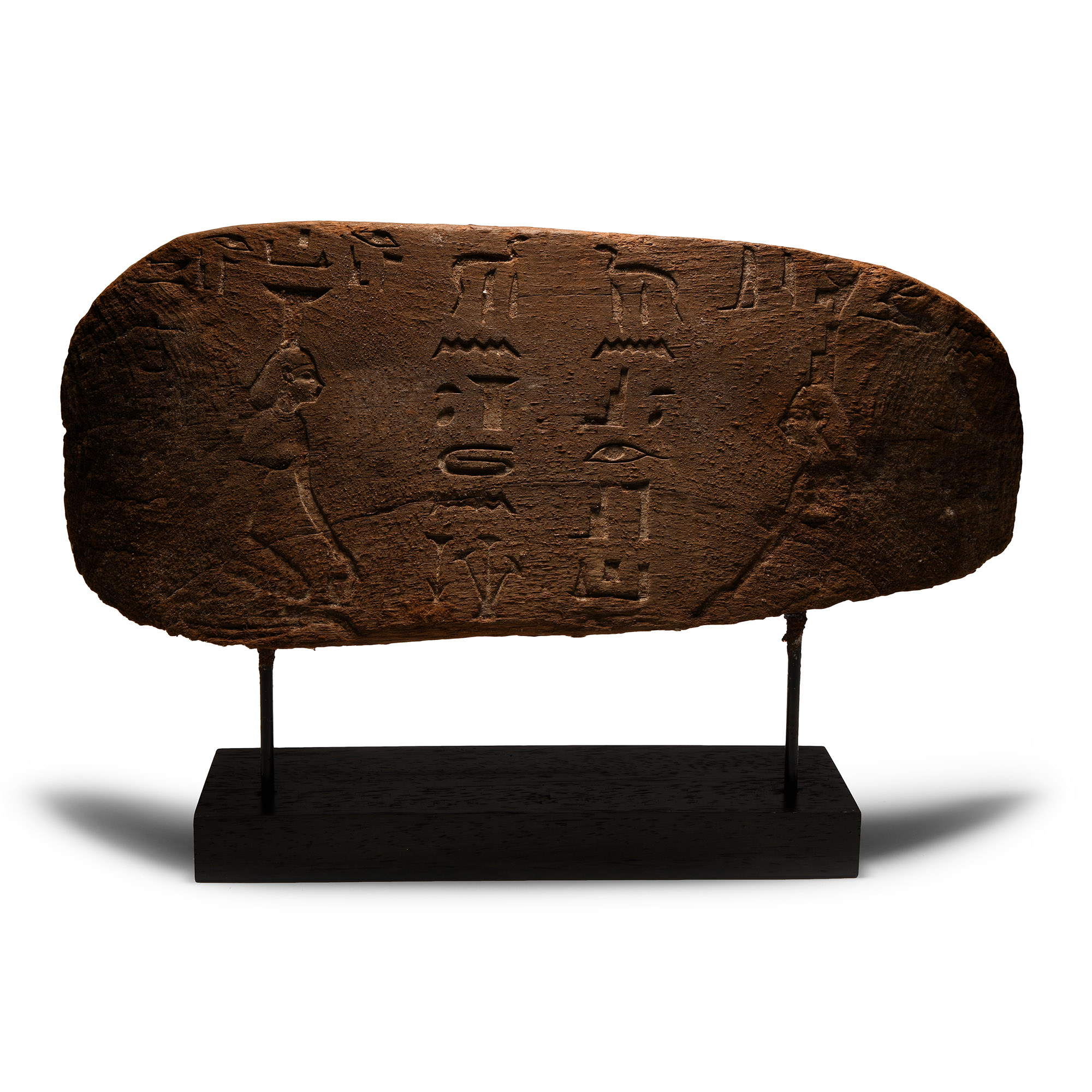
Egyptian Wood Panel with Hieroglyphs for Padi-Wsir
LATE PERIOD, 664-332 B.C.
12 1/4 in. (652 grams total, 31 cm wide including stand).
Foot panel from a cedarwood sarcophagus with carved socket to the inner face to accept the feet and mortices for attaching to sides; the outer face in low relief, a figural scene depicting the sisters of Osiris (Nephthys to the left and Isis to the right) with their arms extended; text translatable as 'Words spoken for Neftis, which surrounds ...Words spoken for Osiris, Padi-Wsir. I have come into existence as [...] Osiris, Padi-Wsir, the righteous [...]'.
ProvenanceFrom a Dutch private collection, acquired in the 1970s.
Acquired from J. Bagot Ancient Art, Barcelona, Spain, in 2016.
From the Keane private collection, Kent, UK.
Accompanied by a copy of the J. Bagot certificate of authenticity and invoice (2,800 euros).
This lot has been checked against the Interpol Database of stolen works of art and is accompanied by a search certificate number no.12078-216769.
'Padi Wsir' is probably the name of the owner of the sarcophagus; the same name was elsewhere transliterated as 'Padiusir' and Hellenised as 'Petosiris'', a familiar name in the Late Period.
CONDITIONTimeLine Auctions follows a vetting process to ensure the authenticity and legality of all items, reinforcing our commitment to integrity and responsible trading. Each antiquity, antique, and coin lot undergoes thorough examination by a vetting committee of at least ten external specialists, professional trade association members, scientists, and archaeologists: Our Vetting Process
AUCTIONS:
TimeLine is a leading auction house specialising in antiquities, ancient art, collectables, natural history, coins, medals, and books. Our auctions offer museums, collectors, historians, and enthusiasts the opportunity to acquire unique and historically significant pieces.
-
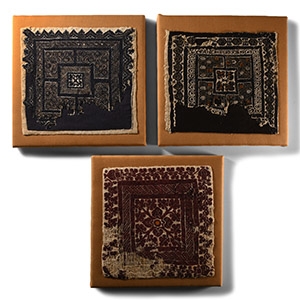
Egyptian Fabric Panel Group
Coptic, 4th century A.D.Sold for (Inc. bp): £130
Comprising: square panel with border of repeated motif of an amphora and vine issuing from the top, guilloche, radiating foliage; similar with guilloche enclosing repeating ring motifs, knotwork band and central radiating fleur-de-lys motifs; similar with concentric bands of roundels and central floret; each mounted on a wooden-framed fabric backing. 1.08 kg total, 25.3 x 25.5 cm each
Acquired from Esther Fitzgerald Rare Textiles, London, UK. Property of a North American gallery. -
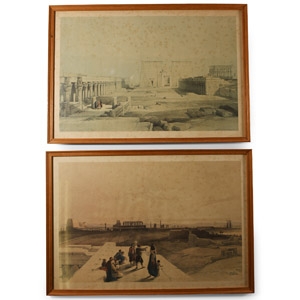
David Roberts Print of Karnak
19th century A.D.Sold for (Inc. bp): £65
Hand-tinted lithographs of a view over the temple complex at Karnak, and of a view of the Great Hypostyle Hall; each mounted in a glazed wooden frame. 2.9 kg total, 34.5 x 50 cm each
From the private collection of the late Mrs Belinda Ellison, a long time member of the Egyptian Exploration Society, c.1940-2020. -
.jpg)
Egyptian Funerary Cone for Djedher
1st millennium B.C.Sold for (Inc. bp): £2,470
Columnar terracotta cone with flattened base, five horizontal bands of reserved hieroglyphic text giving the dedication: 'Djedher, true of voice, son of Ankhhor who is the son of the hereditary noble, great mayor, great one of the Meshwesh (an ancient Libyan tribe), mayor, overseer of the priests of Banebdju, Djedher, his mother, mistress of the house, Shepensepedet, true of voice.' 895 grams, 16.5 cm
Acquired on the German art market, 1989-1995. with The Museum Gallery, 19 Bury Place, London, WC1, UK, 1998-2003. Property of a London based academic, 2003-present.
Funerary cones were used to decorate the facades of tombs. The 'tail' was pushed into the soft plaster coating so that only the disc was visible. This cone belongs to Djedher, whose tomb is likely to be in the Asasif region of the Theban necropolis, where other examples of his funerary cones have been found.
