
Loading, please wait...


LOT 0466
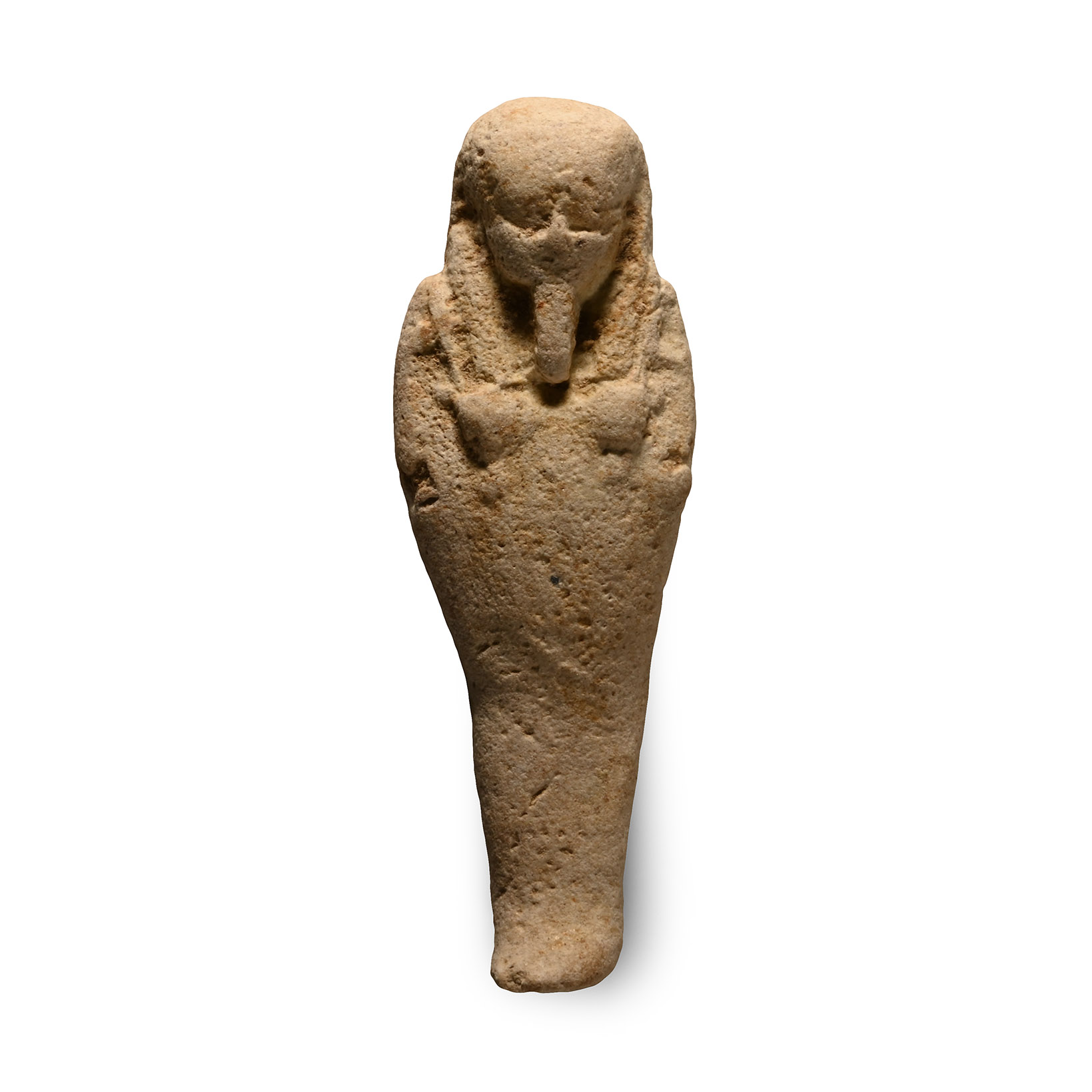
Egyptian White Faience Shabti
PTOLEMAIC PERIOD, 332-30 B.C.
3 in. (18 grams, 78 mm).
Modelled in the half-round with rounded facial features, lappet wig, false beard and crossed arms holding a pick and a hoe. [No Reserve]
ProvenanceEx H. Norry collection, 1980s-1990s.
LiteratureCf. Stewart, H.M., Egyptian Shabtis, Princes Risborough, 1995, item 32.
FootnotesOne of the primary purposes of shabti figures was to carry out heavy manual tasks on behalf of a person in the afterlife, and they were often depicted with necessary implements in their hands, such as baskets, picks, and hoes. Over time, the number of shabtis in a standard elite burial increased, from one in the Eighteenth Dynasty to several in the Nineteenth Dynasty, to one for every day of the year by the Third Intermediate Period. The high number of shabtis remained a feature in the Late and Ptolemaic Periods.
CONDITIONTimeLine Auctions follows a vetting process to ensure the authenticity and legality of all items, reinforcing our commitment to integrity and responsible trading. Each antiquity, antique, and coin lot undergoes thorough examination by a vetting committee of at least ten external specialists, professional trade association members, scientists, and archaeologists: Our Vetting Process
AUCTIONS:
TimeLine is a leading auction house specialising in antiquities, ancient art, collectables, natural history, coins, medals, and books. Our auctions offer museums, collectors, historians, and enthusiasts the opportunity to acquire unique and historically significant pieces.
-
.jpg)
Egyptian Gold Uraeus Amulet
Late New Kingdom, 1070-900 B.C.Estimate: £300 - 400 (+bp*)
Opening Bid: £150
In rearing cobra pose with body coiled below. 0.38 grams, 11 mm
From an early 20th century French collection. -
.jpg)
Romano-Egyptian Terracotta Votive Figure of Eros
1st-2nd century A.D.Estimate: £4,000 - 6,000 (‡+bp*)
Opening Bid: £2,222
Depicted nude in a dynamic pose with his legs apart and the weight of the body upon his right leg, standing in front of a two storey structure, probably an oven; his left arm raised and right arm extended in front of his torso and resting on the edge of the structure; the oven painted pink at the top and white at the bottom with an offering receptacle at floor level. 232 grams, 15 cm
Ex Dr Daniel Marie Fouquet (1859-1914), Cairo. with Pierre Berge & Associes, Auction, Archaeology 29 November 2014, no.193. Accompanied by a French cultural export permit, no.161028. Accompanied by an academic report by Dr Raffaele D'Amato. Accompanied by a copy of the relevant pages in: Perdrizet, P., Les Terres Cuites Grecques d'Egypt de la Collection Fouquet, Nancy, 1921, where it is published. This lot has been checked against the Interpol Database of stolen works of art and is accompanied by search certificate no.12000-211884.
The image of the ‘Eros Baker’ is part of a wide production of Roman terracotta imitating Greek models, although in somewhat crude way. In the Roman age, designs tended to be commonplace and were often indifferent copies of Greek originals. However, the production of terracotta in Hellenistic Egypt continued without interruption and the most subjects of these votive statuettes (in this case probably a baker invoking the blessing of the god upon his activity) were religious, Eros being one of the favourites. -
.jpg)
Egyptian Painted Wooden Mummy Mask
4th-3rd century B.C.Estimate: £3,000 - 4,000 (‡+bp*)
Opening Bid: £1,600
Displaying semi-naturalistic detailing in relief, beneath a band of headdress ornament composed of rows of architectural dot-and-dash and zig-zag patterns over a segmental panel, possible hieroglyphs to the top tier; attachment pegs to the sides of the face and through the head; extensive remains of painted black pigmentation and composition fill to the eyes. 677 grams, 36 cm
From a French estate, acquired between 1960 and 1980. with SAS Cornette de Saint Cyr Auction, Paris, Vente 882, Mobilier et Objets d'art, 2 December 2014, lot 69. Accompanied by a copy of a French cultural passport no.167062. Accompanied by an academic report by Dr Alberto Maria Pollastrini. This lot has been checked against the Interpol Database of stolen works of art and is accompanied by search certificate no.11807-206837.
