
Loading, please wait...
LOT 0038
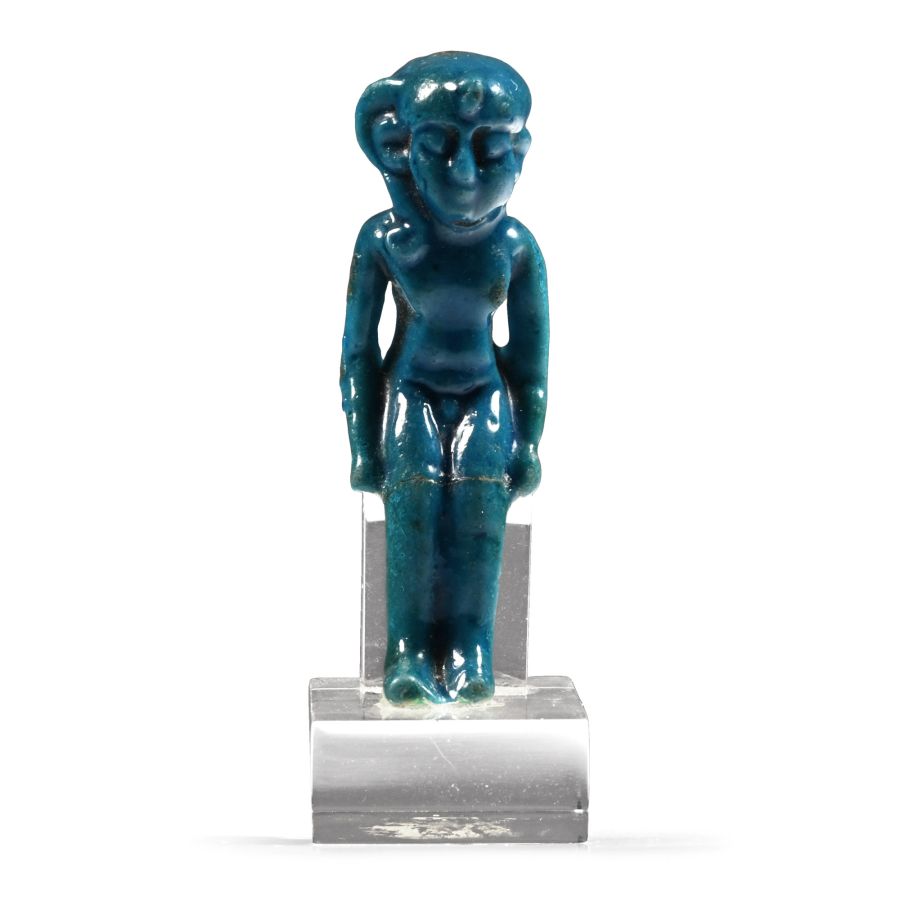
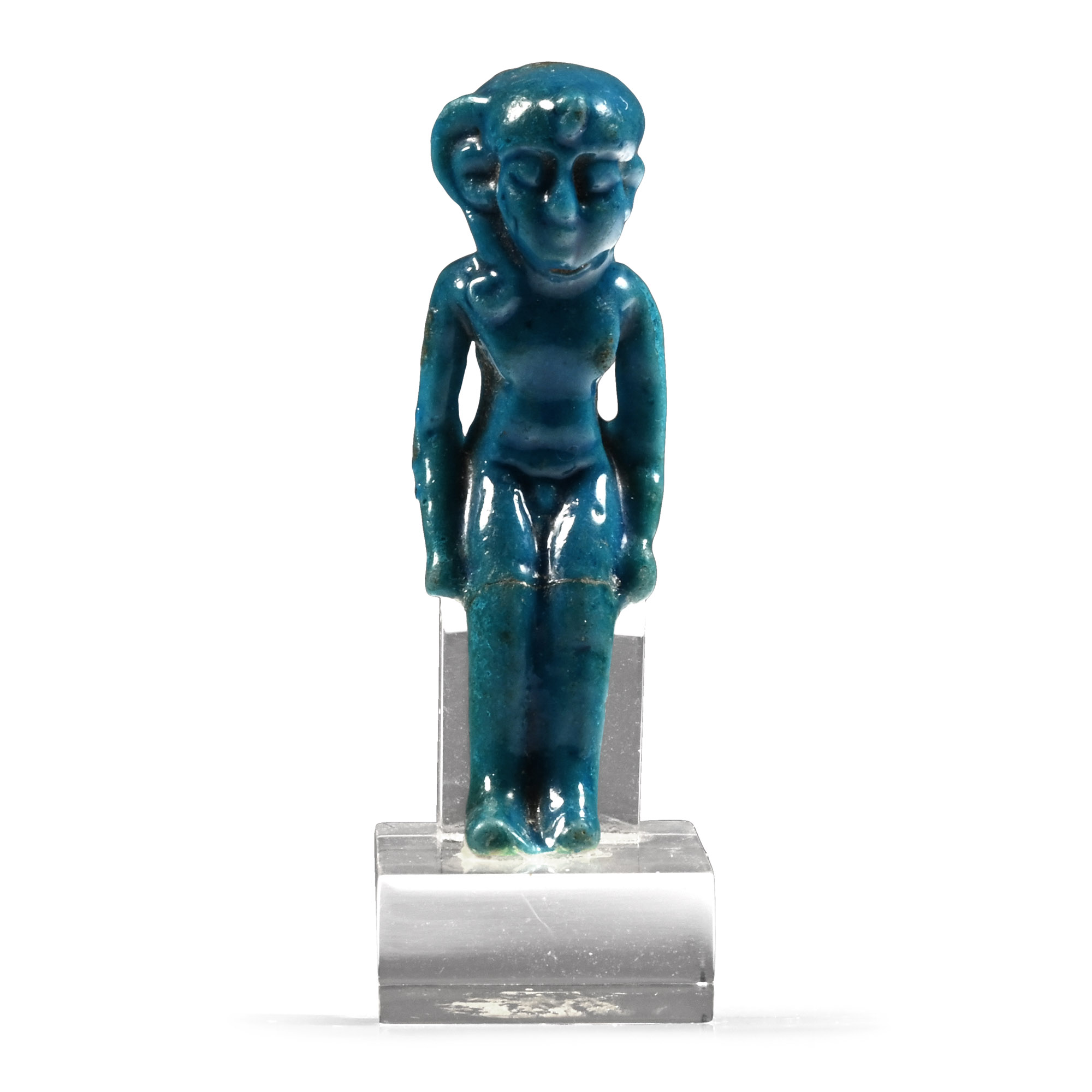
Egyptian Turquoise Glazed Seated Harpocrates
LATE PERIOD, 26TH DYNASTY, CIRCA 664-525 B.C.
2 in. (10 grams total, 52 mm including stand).
The god in a semi-seated pose with sidelock and uraeus; mounted on a custom-made stand.
ProvenanceCollection de Son Excellence Mandou Riaz (1895-1963).
Archéologie, François de Ricqlès, Paris, 11-12 November 2001, no.186.
Private collection, London, UK, acquired from the above sale.
Accompanied by a copy of the François de Ricqlès invoice.
This lot is accompanied by an illustrated lot declaration signed by the Head of the Antiquities Department, Dr Raffaele D'Amato.
Cf. Daressy, G., Catalogue général des antiquités égyptiennes du Musée du Caire N° 38001-39384 Statues de divinités, Cairo, 1906, pl. X, for bronze examples of Harpocrates in a similar semi-seated pose.
FootnotesWhile the semi-seated pose of the figurine may imply that it was part of a composite statuette, possibly featuring a separately modelled throne or seated on the lap of his mother, Isis, independent amulets with suspension loops depicting the god in this pose are also prevalent.
Harpocrates is the Greek rendering of the Egyptian Hor-pa-khered, which translates as ‘Horus the Child’. This designation refers to Horus as the divine infant of Isis and Osiris. Wearing the amulet of Harpocrates could grant the wearer the same protection that Isis provided to her beloved son.
TimeLine Auctions follows a vetting process to ensure the authenticity and legality of all items, reinforcing our commitment to integrity and responsible trading. Each antiquity, antique, and coin lot undergoes thorough examination by a vetting committee of at least ten external specialists, professional trade association members, scientists, and archaeologists: Our Vetting Process
AUCTIONS:
TimeLine is a leading auction house specialising in antiquities, ancient art, collectables, natural history, coins, medals, and books. Our auctions offer museums, collectors, historians, and enthusiasts the opportunity to acquire unique and historically significant pieces.
LOT 0038
Egyptian Turquoise Glazed Seated Harpocrates
Estimate £500 - 700€580 - 810 (for guidance only)$680 - 950 (for guidance only)
-
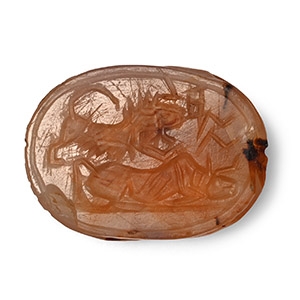
Phoenician Scarab Seal for Belonging to H-N-N (The Merciful)
Circa 800-400 B.C.Estimate: £3,500 - 4,500 (+bp*)
Opening Bid: £1,750
Accompanied by an old scholarly note, typed and signed by W.G. Lambert, late Professor of Assyriology, University of Birmingham, 1970-1993, which states: 'Stamp Seal of Chalcedony/Carnelian 14.5 x 20 x 10 mm. This s a scarab on a flat base, the insect nicely modelled, and the seal design on the flat base is contained within a linear border. It shows a prancing lion above a fallen bull and there is an inscription in the West Semitic alphabet [three characters] l-h-n-n Property of H-n-n. This is a Phoenician seal, exact date not easy to fix but c.800-400 B.C. is the likely range. The seal, which is not pierced, is chipped around the edges but otherwise in very good condition.' 4.76 grams, 20 mm
Acquired on the German art market, 1989-1995. with The Museum Gallery, 19 Bury Place, London, WC1, UK, 1998-2003. Property of a London based academic, 2003 to present. This lot has been checked against the Interpol Database of stolen works of art and is accompanied by a search certificate number no.12634-233894. This lot has been cleared against the Art Loss Register database, and is accompanied by an illustrated lot declaration signed by the Head of the Antiquities Department, Dr Raffaele D'Amato. -
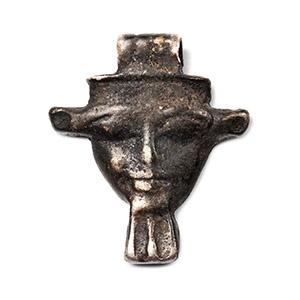
Egyptian Silver Hathor Amulet
Late-Ptolemaic Period, 664-30 B.C.Sold for (Inc. bp): £975
D-shaped mask representing the human-headed Hathor with cow ears and a short beard, a ribbed suspension loop above. 0.7 grams, 11 mm
From an early 20th century collection. This lot is accompanied by an illustrated lot declaration signed by the Head of the Antiquities Department, Dr Raffaele D'Amato. -
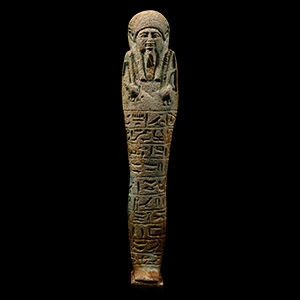
Egyptian Blue Glazed Hieroglyphic Shabti for Ta-Amun
Saite Period, 26th Dynasty, 664-525 B.C. or laterEstimate: £1,200 - 1,700 (+bp*)
Opening Bid: £600
Slender columnar shabti featuring a dorsal pillar, with ten rows of hieroglyphic text on the lower body beginning with the dedication 'The illuminated one, the Osiris priest Ta-Amun born of Ta-seh-nebty' ( sḥḏ wsỉr ḥm nṯr TꜢ-I͗mn ms (n) TꜢ-sḥ-nbty); the features of the small face are finely modelled, including a long, plaited false beard and a heavy lappet wig; the arms are crossed, with hands holding a pick and a hoe, along with a cord for a seed bag. 137 grams, 17.8 cm
Acquired on the German art market, 1989-1995. with The Museum Gallery, 19 Bury Place, London, WC1, UK, 1998-2003. Property of a London based academic, 2003-present. This lot is accompanied by an illustrated lot declaration signed by the Head of the Antiquities Department, Dr Raffaele D'Amato.
