
Loading, please wait...
_900x900.jpg "Egyptian Turquoise Glazed Faience Four Sons of Horus Mount Set")
_200x200.jpg "Egyptian Turquoise Glazed Faience Four Sons of Horus Mount Set")
_900x900.jpg "Egyptian Turquoise Glazed Faience Four Sons of Horus Mount Set")
_200x200.jpg "Egyptian Turquoise Glazed Faience Four Sons of Horus Mount Set")
.jpg "Egyptian Turquoise Glazed Faience Four Sons of Horus Mount Set")
.jpg "Egyptian Turquoise Glazed Faience Four Sons of Horus Mount Set")
LOT 0036
Egyptian Turquoise Glazed Faience Four Sons of Horus Mount Set
25TH DYNASTY, CIRCA 747-656 B.C.
3 3/4 x 3 1/8 in. (81 grams total, 95 x 80 mm including stand).
Set of four flat-backed plaques depicting the standing figures of the four sons of Horus (from left to right: Duamutef, Imsety, Hapy, and Qebehsenuef) in profile, each wearing a tripartite wig, broad collars, and holding a long folded cloth; mounted on a stand.
ProvenanceGunther Markert collection, Germany/Switzerland, 1954 or 1961.
with Robert Bigler, Switzerland.
Private collection, London, UK, acquired from the above on 12 October 2001.
Accompanied by a copy of the Robert Bigler invoice.
This lot has been cleared against the Art Loss Register database, and is accompanied by an illustrated lot declaration signed by the Head of the Antiquities Department, Dr Raffaele D'Amato.
Cf. Andrews, C., Amulets of Ancient Egypt, London, 1994, p. 46, fig. 50, for similar, finely detailed examples.
FootnotesThe Four Sons of Horus were deities tasked with protecting the internal organs of the deceased. The human-headed Imsety safeguarded the liver, the baboon-headed Hapy looked after the lungs, the jackal-headed Duamutef defended the stomach, and the falcon-headed Qebehsenuef protected the intestines. Amulets featuring these deities were included within the mummy wrappings.
CONDITIONTimeLine Auctions follows a vetting process to ensure the authenticity and legality of all items, reinforcing our commitment to integrity and responsible trading. Each antiquity, antique, and coin lot undergoes thorough examination by a vetting committee of at least ten external specialists, professional trade association members, scientists, and archaeologists: Our Vetting Process
AUCTIONS:
TimeLine is a leading auction house specialising in antiquities, ancient art, collectables, natural history, coins, medals, and books. Our auctions offer museums, collectors, historians, and enthusiasts the opportunity to acquire unique and historically significant pieces.
LOT 0036
Egyptian Turquoise Glazed Faience Four Sons of Horus Mount Set
Sold for (Inc. bp): £5,200
-
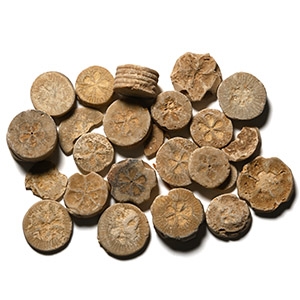
Egyptian Limestone Floral Inlay Group
Roman Period, 30 B.C.-323 A.D. or earlierSold for (Inc. bp): £104
Group of cylindrical and discoid inlay plaques or gaming counters, crinoids with cinquefoil motif. 48.8 grams total, 12-20 mm
From a central London ADA dealership, 1980-1990. This lot is accompanied by an illustrated lot declaration signed by the Head of the Antiquities Department, Dr Raffaele D'Amato.
Flowers were symbolic of rebirth due to the daily reopening of their petals after nightfall. As a result, they were widely used in domestic settings, religious and funerary contexts, and as adornments. Similar rosette discs, like those recovered from the Ramesside Period palace at Qantir, were used as decorative elements in royal palaces. -
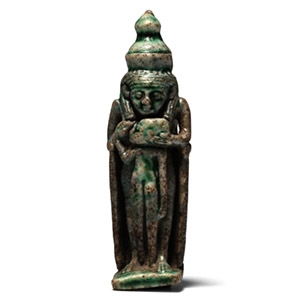
Egyptian Green Glazed Steatite Syncretic Amulet of Mut
Third Intermediate Period, circa 1069-735 B.C.Estimate: £2,500 - 3,500 (+bp*)
Opening Bid: £1,250
Modelled in the round, formed as the goddess standing before a high-backed throne cradling the head of a standing child to her chest; the goddess with tiered double-crown and tripartite wig; throne with low-relief figure of the lioness-headed goddess Sekhmet to the rear with spread wings forming the arms of the chair. 22.6 grams, 61 mm
with Jean-Phillipe Mariaud de Serres, Paris, France. Private collection, London, UK, acquired from the above in 1992. This lot has been checked against the Interpol Database of stolen works of art and is accompanied by a search certificate number no.12633-235083. This lot has been cleared against the Art Loss Register database, and is accompanied by an illustrated lot declaration signed by the Head of the Antiquities Department, Dr Raffaele D'Amato.
Mut was a prominent mother goddess in ancient Egyptian religion, associated with creation, motherhood, and the sky. She was the consort of the god Amun and the mother of Khonsu, forming the Theban triad with them in Thebes. Mut's name ("mother" in ancient Egyptian), reflects her role as a divine mother and patroness of motherhood. Sekhmet was revered as a powerful and fierce protector. Her presence was believed to ward off evil and safeguard the people from harm. In ancient Egyptian mythology, Sekhmet was also a manifestation of Hathor, another powerful birth goddess. -
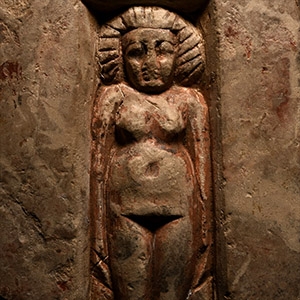
Egyptian Plaque with Fertility Figure
Late-Ptolemaic Period, 664-31 B.C.Sold for (Inc. bp): £910
Carved rectangular plaque with central recess, carved image of a nude female modelled in the half-round with a deeply striated bag wig, arms by her side; traces of red and black pigment on the body; mounted on a custom-made stand. 502 grams total, 17.1 cm including stand
From a central London collection, formed 1980-2000. From the private collection of Mr David Barker, London, UK; thence by descent. This lot is accompanied by an illustrated lot declaration signed by the Head of the Antiquities Department, Dr Raffaele D'Amato.
The rectangular limestone plaque almost certainly represents a shrine. Such plaques first appeared in Lower Egypt and became widespread in the Late Period and Ptolemaic era. They may have developed from earlier female figurines depicted on beds and are usually associated with the female goddesses Isis and Hathor, both powerful protectors of women and childbirth and associated with fertility.
