
Loading, please wait...
_900x900.jpg "Egyptian Turquoise Faience Amphora")
_200x200.jpg "Egyptian Turquoise Faience Amphora")
.jpg "Egyptian Turquoise Faience Amphora")
LOT 0515
Egyptian Turquoise Faience Amphora
ROMAN PERIOD, 1ST-2ND CENTURY A.D.
8 1/4 in. (2.2 kg, 21 cm wide).
A turquoise blue faience jar probably made in Roman Egypt, in a form similar to that of a Greek column krater, with a broad shoulder and rim, two angled strap handles with scalloped ends, band of raised scales to the shoulder, lotus leaves to the body and shoulder; restored.
ProvenanceAcquired on the European art market mid 1990s.
with Bonhams, Knightsbridge, 22 September 1998, lot 31.
with Bonhams, Knightsbridge, 22 April 1999, lot 641.
with Christie's, London, 18 October 2005, lot 10.
Previously with Mansour Gallery, London W1.
Property of a North West London gentleman.
Accompanied by a copy of the relevant Christie's and Bonhams catalogue pages.
Cf. The Metropolitan Museum, accession number 2021.41.171, for a very similar example; cf. Grimm, G., 'Two Early Imperial Faience Vessels from Egypt', in Thompson, D. (ed.), Miscellanea Wilbouriana 1, The Brooklyn Museum, New York, 1972, pp.71-100, fig.10, for a discussion of a vessel similar in style and almost identical in height (17cm) in the Egyptian Museum in Cairo.
CONDITIONTimeLine Auctions follows a vetting process to ensure the authenticity and legality of all items, reinforcing our commitment to integrity and responsible trading. Each antiquity, antique, and coin lot undergoes thorough examination by a vetting committee of at least ten external specialists, professional trade association members, scientists, and archaeologists: Our Vetting Process
AUCTIONS:
TimeLine is a leading auction house specialising in antiquities, ancient art, collectables, natural history, coins, medals, and books. Our auctions offer museums, collectors, historians, and enthusiasts the opportunity to acquire unique and historically significant pieces.
-
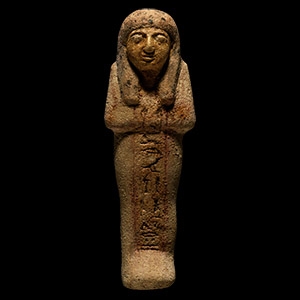
Egyptian Painted Limestone Shabti for Abet-iyiry
Late New Kingdom, circa 1100 B.C.Sold for (Inc. bp): £910
With remains of pigment to the tripartite wig, face and eyes; vertical band of hieroglyphic inscription in black on the front giving dedication: 'sḥḏ wsir Ꜣbt-iyiry(?) mꜢʾ ḫrw' ‘The illuminated, the Osiris, Abet-iyiry(?), true of voice’; with remains of red borders and red detailing to the back. 162 grams, 13.3 cm
Acquired 1970s-1996. Property of a North American collector. London collection, 2016. -
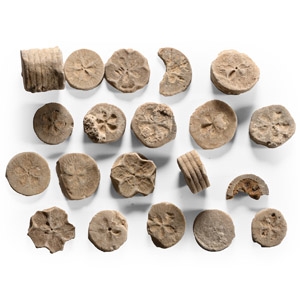
Egyptian Limestone 'Floral' Inlay Group
Roman Period, 30 B.C.-323 A.D. or earlierSold for (Inc. bp): £26
Group of discoid inlay plaques or gaming counters, crinoids with cinquefoil motif. 35 grams total, 14-18 mm
From a central London ADA dealership, 1980-1990.
Flowers were symbolic of rebirth due to the daily reopening of their petals after nightfall. As a result, they were widely used in domestic settings, religious and funerary contexts, and as adornments. Similar rosette discs, like those recovered from the Ramesside Period palace at Qantir, were used as decorative elements in royal palaces. -
.jpg)
Egyptian Multi-Stranded Mummy Bead Necklace
Late Period, 664-332 B.C.Sold for (Inc. bp): £156
Multi-stranded designer necklace composed of beads of mainly annular and tubular types. 23 grams total, 66 cm long
Acquired before 1979. From the private collection of Mr F. A., South Kensington, London, UK; thence by descent 2014.
For thousands of years, artisans in Egypt created vibrant ceramics to echo the beauty of rare jewels. These ornaments were created with almost every material, colour, and texture imaginable and they come from across Egypt and beyond: vibrant blue lapis lazuli from Afghanistan, glossy black obsidian from Turkey, and aqua-green turquoise from the Sinai. They were worn in life and, after death, they served as precious ornamentation for mummies
