
Loading, please wait...
_900x900.jpg "Egyptian Stone Stela with Royal Offering Scene")
_200x200.jpg "Egyptian Stone Stela with Royal Offering Scene")
.jpg "Egyptian Stone Stela with Royal Offering Scene")
LOT 0013
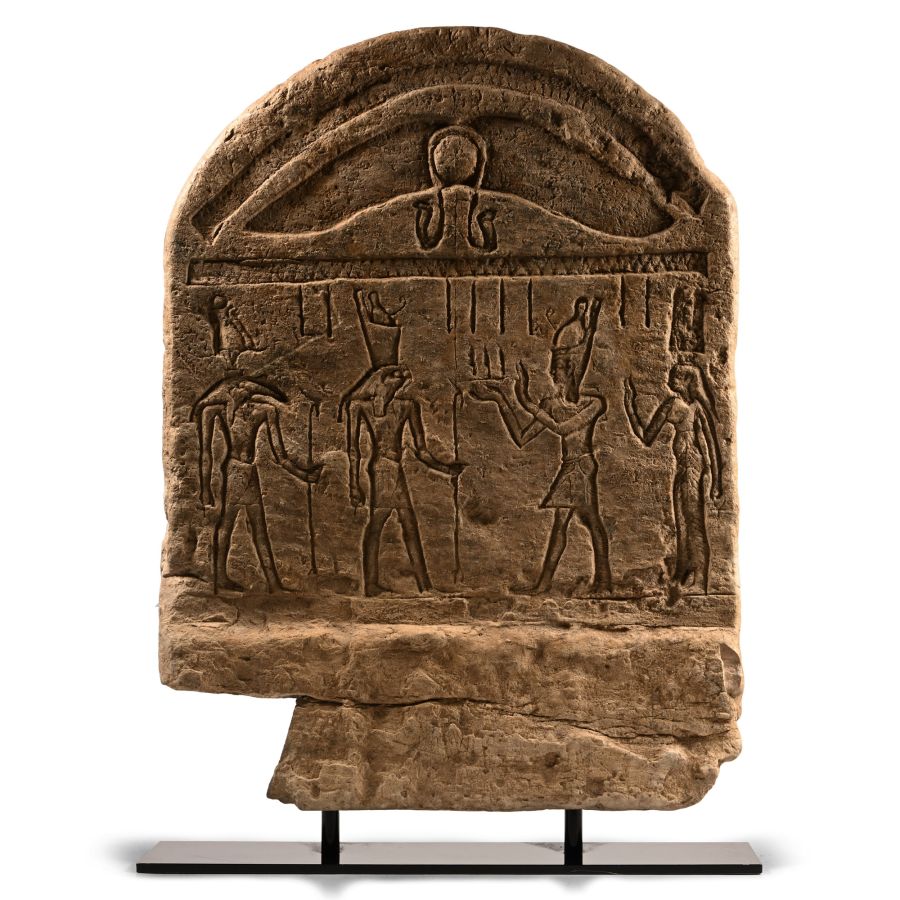
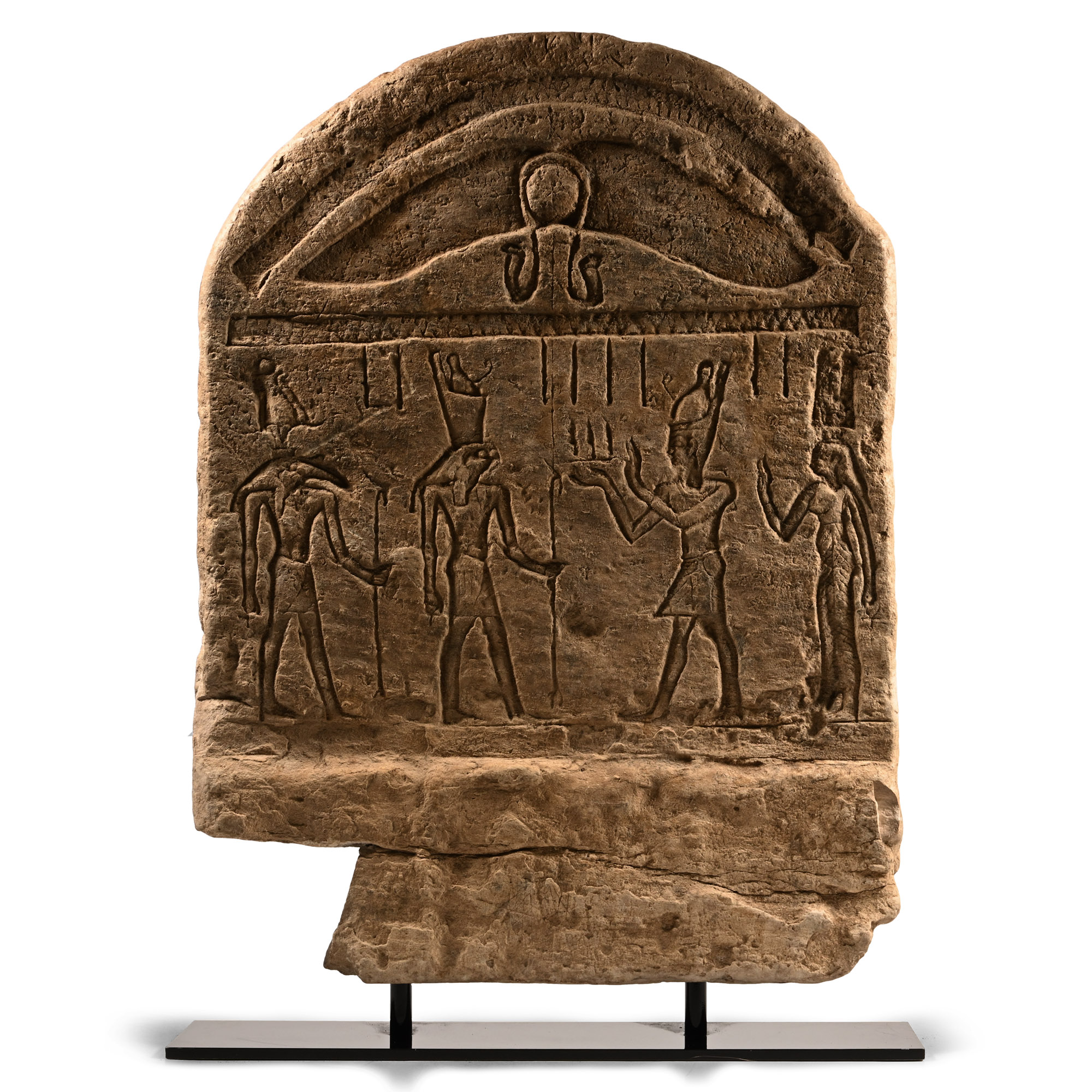
Egyptian Stone Stela with Royal Offering Scene
PTOLEMAIC PERIOD, 3RD-2ND CENTURY B.C.
21 5/8 in. (19.45 kg total, 55 cm including stand).
Round-topped stela with decoration on two registers; the lunette, featuring a winged sun disk with pendant uraei; the main panel with a frieze in sunk relief depicting the pharaoh wearing the double crown, facing left offering the hieroglyphic symbol for 'fields'; a goddess stands behind him, possibly Isis, wearing a tight-fitting robe and sporting a tall two-plumed headdress, with one hand raised in praise; facing the pharaoh is the falcon-headed god, possibly Horus or Her-wer, wearing a double-crown, and behind him stands the ibis-headed Thoth wearing the Atef crown, both gods hold a was-sceptre; repaired, mounted on a custom-made stand.
ProvenanceAcquired in the mid-1980s-1990s.
Private collection, Switzerland, thence by descent.
Private collection, since the late 1990s.
Accompanied by an academic report by Egyptologist Paul Whelan.
This lot has been checked against the Interpol Database of stolen works of art and is accompanied by search certificate number no.12200-222172.
Cf. Bosticco, S., Museo archaeologico di Firenze: le stele egiziane di epoca tarda Rome, 1972, no. 58, for an arch-topped stela depicting the pharaoh offering the 'field' symbol to the gods Her-wer and Sobek.
FootnotesThe overall tripartite composition is comparable to numerous stelae of the Ptolemaic Period and can be dated to the 3rd-2nd century B.C. The decorative lunette and/or sky bands and bold sunk relief winged sun disc are characteristic of this period, as is the fringed detailing of the female’s garment. The offering of the ‘field’ symbol is also a frequent depiction of the stelae of this period, which can be understood as a ‘catch-all’ device representing an offering of all the produce from the fields. Such stelae were often produced as stock products to which clients would have their names and other details added. Therefore, the stela is likely an example of a stela awaiting a purchaser. After the purchase, the hieroglyphic labels would be added to the figurative tableau, and a dedicatory text would be carved into the plain rectangle in the lower part. Sometimes, however, it appears that a purchaser could not afford the additional expense of a professionally engraved inscription, and so would scratch a short dedication in the lower panel as seen, for example, in the stela for Horudja from the Delta site of Tanis and now in the Musée du Louvre (inv. no. AF 11682).
CONDITIONTimeLine Auctions follows a vetting process to ensure the authenticity and legality of all items, reinforcing our commitment to integrity and responsible trading. Each antiquity, antique, and coin lot undergoes thorough examination by a vetting committee of at least ten external specialists, professional trade association members, scientists, and archaeologists: Our Vetting Process
AUCTIONS:
TimeLine is a leading auction house specialising in antiquities, ancient art, collectables, natural history, coins, medals, and books. Our auctions offer museums, collectors, historians, and enthusiasts the opportunity to acquire unique and historically significant pieces.
LOT 0013
Egyptian Stone Stela with Royal Offering Scene
Estimate £18,000 - 24,000€20,880 - 27,840 (for guidance only)$24,300 - 32,400 (for guidance only)
-
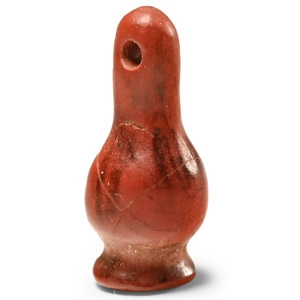
Egyptian Jasper Poppy Head Amulet
New Kingdom, 18th-19th Dynasty, circa 1550-1213 B.C.Sold for (Inc. bp): £104
Polished and with integral pierced suspension loop. 0.78 grams, 15 mm
From an early 20th century collection.
Amulets in the form of poppies were used to heal, alleviate pain, and ward off death. This type of amulet was also associated with Osiris, the Egyptian deity of agriculture, death, and the afterlife. -
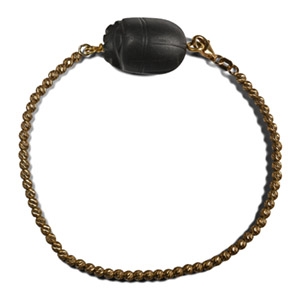
Egyptian Hardstone Scarab in Gold Bracelet
Late Period, 664-332 B.C. and laterSold for (Inc. bp): £572
Scarab, plano-convex in section with incised carapace and leg detailing, stylised djed pillar to the underside; mounted in a 20th-century gold bracelet. 12.30 grams, 22.5 cm
From the private collection of the late Mrs Belinda Ellison, long time member of the Egyptian Exploration Society, c.1940-2020. -
.jpg)
Egyptian Faience Scarab with Hieroglyphs
Late Period, 664-332 B.C.Sold for (Inc. bp): £624
Naturalistic detailing to the blue stained body and legs with section of openwork between the front and back legs; hieroglyphs on base giving the good luck message 'When Amun is behind you, do not fear'; pierced for suspension. 1.72 grams, 15 mm
Ex collection of Emil Saad, Paris-Alexandria.
