
Loading, please wait...

LOT 0468
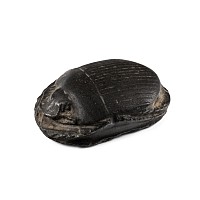
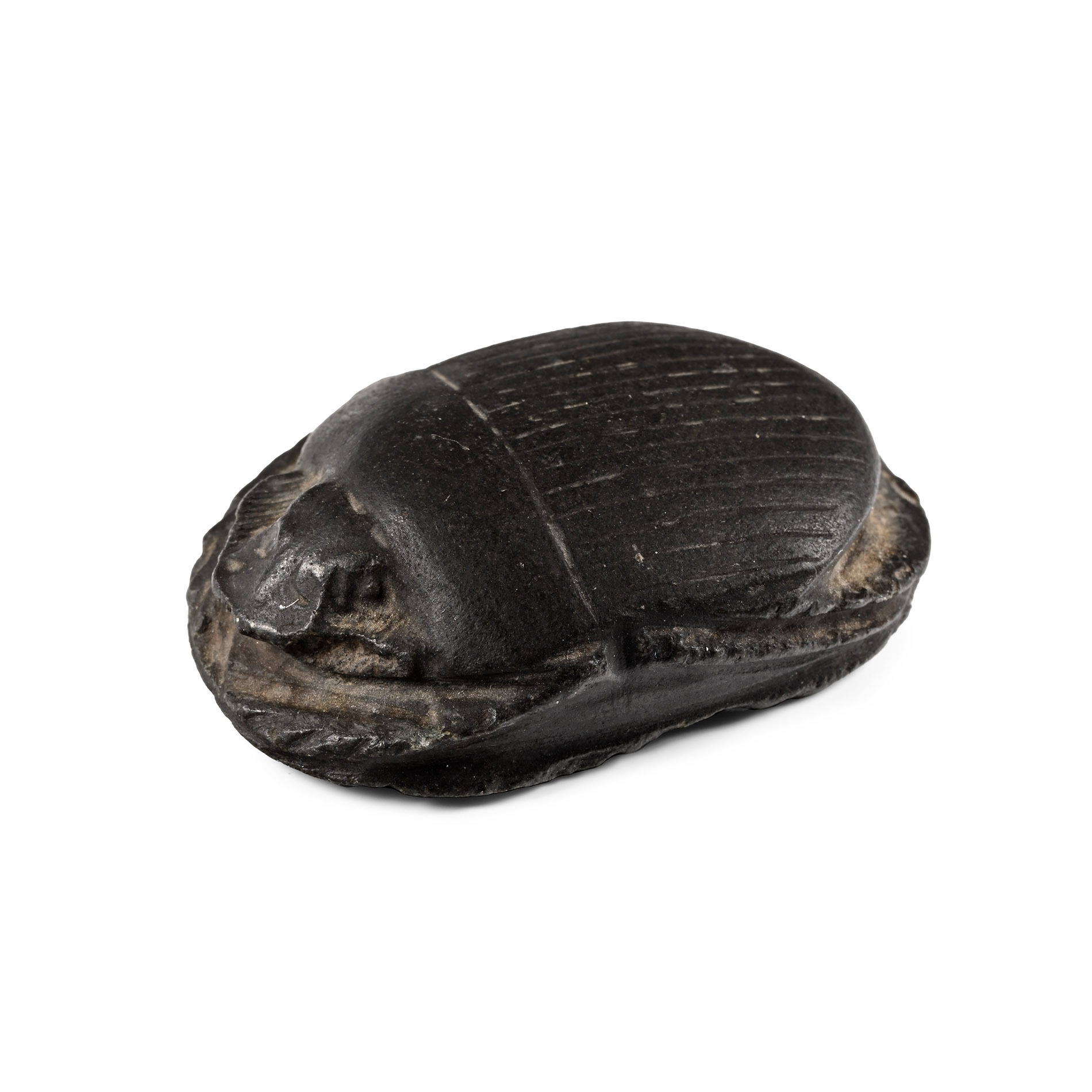
Egyptian Stone Scarab
LATE PERIOD, 664-332 B.C.
1 7/8 in. (38 grams, 48 mm).
Black hardstone scarab with finely carved head, eyes, clypeus, prothorax, elytra, and legs; plain underside.
ProvenanceEx Irene Newman, Birdham, Chichester, West Sussex, England.
with Stride & Son Auctioneers, Chichester, West Sussex, England, 23 April 2015, no.1599 [Part].
Acquired by the present owner at the above sale.
Cf. Schulz, R., Seidel, M., Egyptian Art. The Walters Art Museum, Oakville, 2007, pl.18, cat. no.124, for a similar example.
FootnotesThe scarab, representing the dung beetle, was a popular amulet in ancient Egypt for about two thousand years until the Ptolemaic Period. It extended beyond Egypt and was exported to and manufactured in regions like Phoenicia and Israel. The beetle is named khepri and was considered the embodiment of the creator god Khepri. The Egyptians believed that the beetle emerging from the dung ball was an act of self-creation.
CONDITIONTimeLine Auctions follows a vetting process to ensure the authenticity and legality of all items, reinforcing our commitment to integrity and responsible trading. Each antiquity, antique, and coin lot undergoes thorough examination by a vetting committee of at least ten external specialists, professional trade association members, scientists, and archaeologists: Our Vetting Process
AUCTIONS:
TimeLine is a leading auction house specialising in antiquities, ancient art, collectables, natural history, coins, medals, and books. Our auctions offer museums, collectors, historians, and enthusiasts the opportunity to acquire unique and historically significant pieces.
-
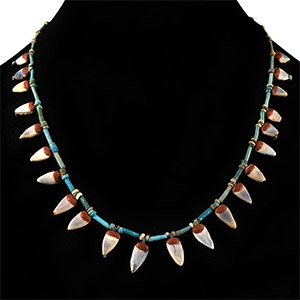
Egyptian Amarna Period Beaded Fruit Necklace
18th Dynasty, 1332-1346 B.C.Sold for (Inc. bp): £598
Restrung necklace of annular and tabular beads with fructiform amulets. 13.1 grams, 44 cm
Ex London, UK, collection, 1990s.
Petal-shaped beads of faience and glass were widely used in jewellery during the Amarna Period. During this era, advanced production methods enabled the creation of bi-chrome and polychrome designs, which often included newly developed colours. This resulted in vibrant necklaces that resembled festive collars made of natural floral elements. -
.jpg)
Egyptian Multi-Stranded Mummy Bead Necklace
Late Period, 664-332 B.C.Sold for (Inc. bp): £156
Multi-stranded designer necklace composed of beads of mainly annular and tubular types. 23 grams total, 66 cm long
Acquired before 1979. From the private collection of Mr F. A., South Kensington, London, UK; thence by descent 2014.
For thousands of years, artisans in Egypt created vibrant ceramics to echo the beauty of rare jewels. These ornaments were created with almost every material, colour, and texture imaginable and they come from across Egypt and beyond: vibrant blue lapis lazuli from Afghanistan, glossy black obsidian from Turkey, and aqua-green turquoise from the Sinai. They were worn in life and, after death, they served as precious ornamentation for mummies -
.jpg)
Egyptian Faience Scarab with Hieroglyphs
Late Period, 664-332 B.C.Sold for (Inc. bp): £624
Naturalistic detailing to the blue stained body and legs with section of openwork between the front and back legs; hieroglyphs on base giving the good luck message 'When Amun is behind you, do not fear'; pierced for suspension. 1.72 grams, 15 mm
Ex collection of Emil Saad, Paris-Alexandria.
