
Loading, please wait...
LOT 0444
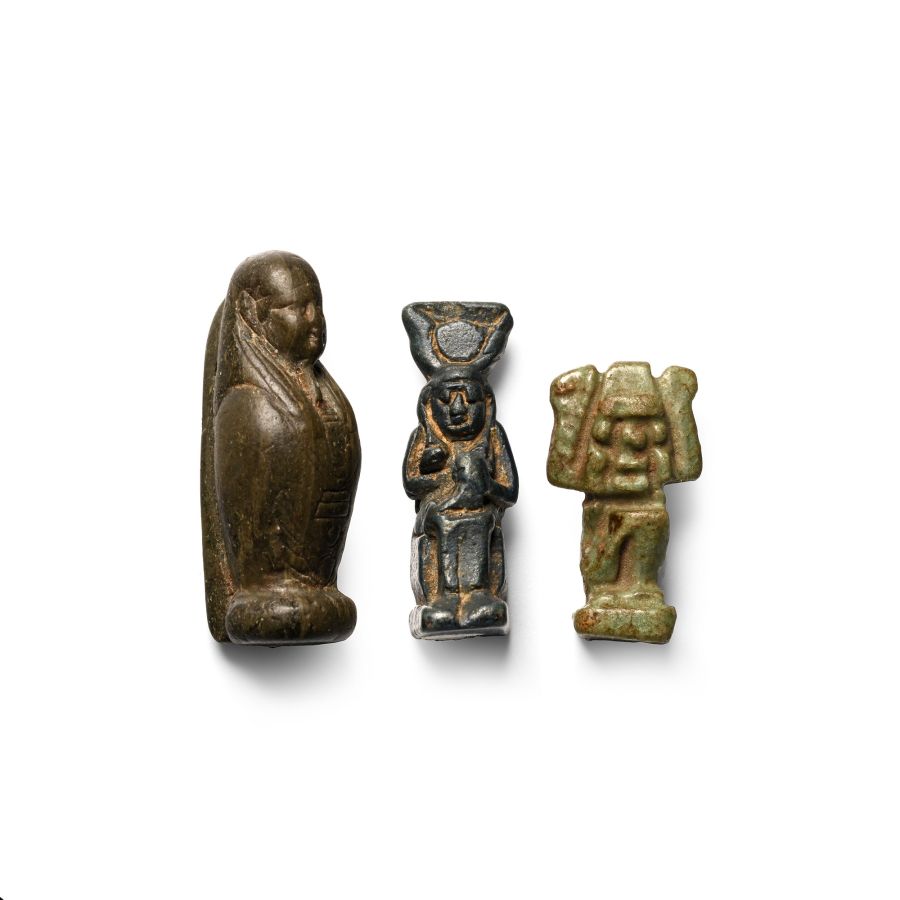
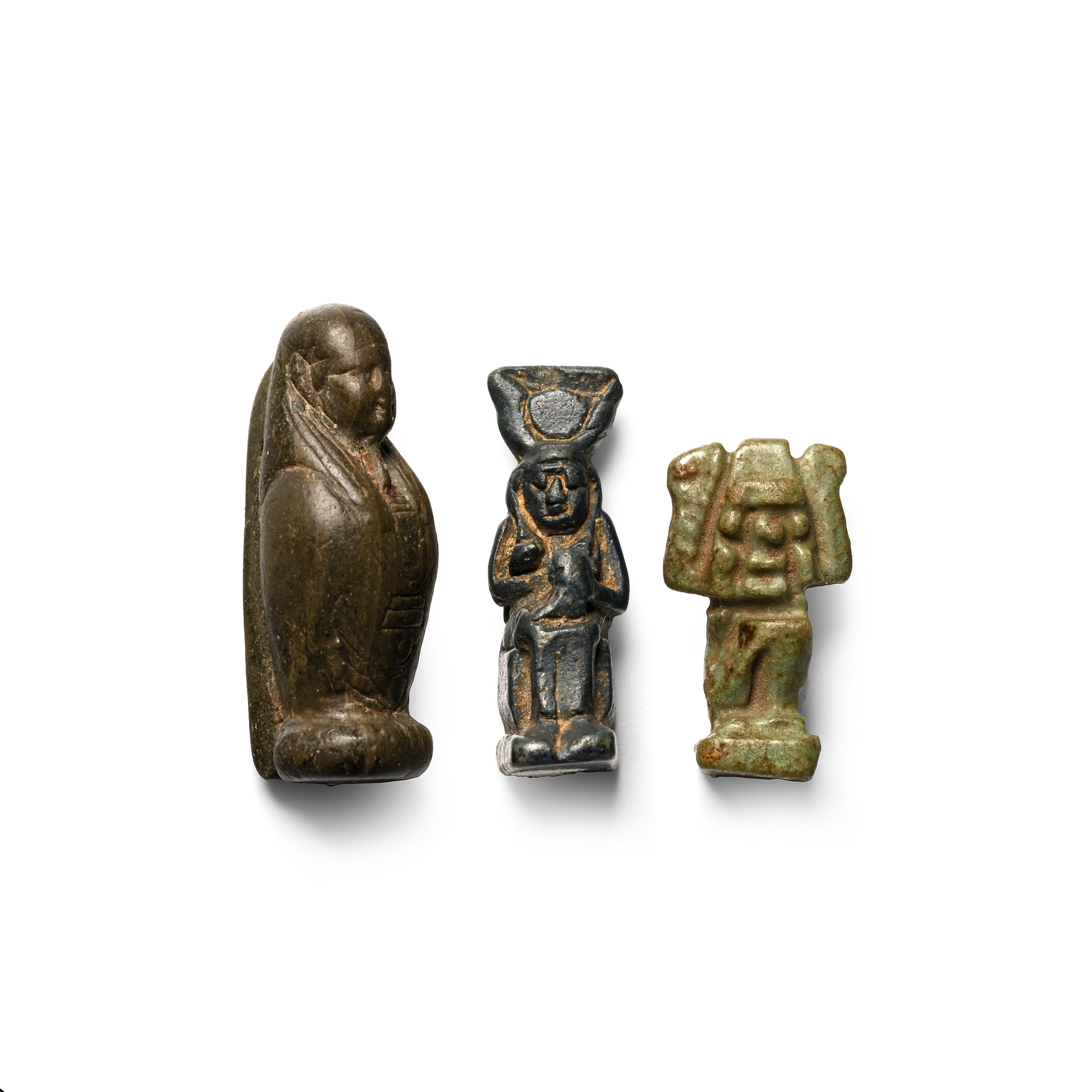
Egyptian Stone and Faience Amulet Group
LATE PERIOD-ROMAN PERIOD, CIRCA 664 B.C.-100 A.D.
3/4 - 1 in. (6.47 grams total, 18-25 mm).
Comprising: a seated figure of Isis suckling infant Horus on her lap, the goddess crowned with large cow horns flanking a solar disc, pierced behind the head; a mummiform Osiris-Canopus amulet wearing a nemes headdress and plain dorsal pillar, a winged scarab with solar disc above at the base of the figure; a kneeling Shu amulet, his arms raised above his head holding a large solar disc, pierced through the dorsal pillar. [3]
ProvenanceEx Prof. Dr Emil Vogt (1906-1974), The Former Director of the Swiss National Museum, Zürich, in his collection before 1970.
with Galerie Rhéa, Zurich, Switzerland.
This lot is accompanied by an illustrated lot declaration signed by the Head of the Antiquities Department, Dr Raffaele D'Amato.
Cf. Petrie, W.M.F., Amulets. Illustrated by the Egyptian Collection in University College, London, 1914, pl. XXVIII, 158n, for a similar Osiris-Canopus amulet in bronze; Petrie, W.M.F., Amulets. Illustrated by the Egyptian Collection in University College, London, 1914, pl. XXVId and XXVIe, for similar Isis lactans amulets; Daressy, G., Catalogue général des antiquités égyptiennes du Musée du Caire N° 38001-39384 Statues de divinités, Cairo, 1906, pl. VIII, no. 38.229, for a Shu of similar form.
CONDITIONTimeLine Auctions follows a vetting process to ensure the authenticity and legality of all items, reinforcing our commitment to integrity and responsible trading. Each antiquity, antique, and coin lot undergoes thorough examination by a vetting committee of at least ten external specialists, professional trade association members, scientists, and archaeologists: Our Vetting Process
AUCTIONS:
TimeLine is a leading auction house specialising in antiquities, ancient art, collectables, natural history, coins, medals, and books. Our auctions offer museums, collectors, historians, and enthusiasts the opportunity to acquire unique and historically significant pieces.
-
.jpg)
Egyptian Green Glazed Faience Openwork Ring
Third Intermediate Period, circa 1069-735 B.C.Sold for (Inc. bp): £1,430
With the reserved figure of a seated falcon-headed deity holding the Maat feather, a stylised lotus bloom above and below. 3.53 grams, 24.05 mm overall, 19.40 mm internal diameter (approximate size British S, USA 9, Europe 20, Japan 19)
with Christie's, London, 19 October 1994, no.133 (part). Private collection, London, UK, acquired from the above sale. This lot is accompanied by an illustrated lot declaration signed by the Head of the Antiquities Department, Dr Raffaele D'Amato. -
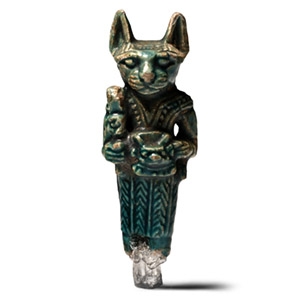
Egyptian Glazed Steatite Amulet of Bastet
Late Period, circa 664-332 B.C.Sold for (Inc. bp): £1,820
Modelled in advancing pose wearing a tight-fitting robe, cat-headed, with a sistrum in one hand and a Bes head emblem in the other; suspension loop between shoulders. 3.75 grams, 38 mm
François de Ricqlès, Paris, Archéologie, 30 September-1 October 1996, no.332. Private collection, London, UK, acquired from the above sale. Accompanied by a copy of a French cultural passport, dated 2 October 1996. This lot is accompanied by an illustrated lot declaration signed by the Head of the Antiquities Department, Dr Raffaele D'Amato.
Bastet is typically depicted with the head of a lioness or domestic cat. The cat symbolises protection, motherhood, and, later, gentleness and domesticity, qualities associated with Bastet, especially in her later evolution from a fierce lioness to a more benevolent feline goddess. The sistrum she holds is a ritual musical instrument associated with Hathor and other birth goddesses and is linked to joy, music, and divine protection. Bastet was often invoked during music and dance ceremonies, and the sistrum reinforces her role in celebration and protection. Bes was a dwarf god known for guarding households, particularly mothers and children. His image on Bastet’s amulet emphasises her protective role, especially at home and during childbirth. -
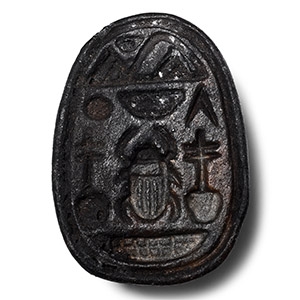
Egyptian Black Stone Scarab
Late Period, 664-332 A.D.Sold for (Inc. bp): £351
A finely detailed scarab body rests on an oval plate, its underside featuring deeply incised hieroglyphs, including the sun rising over a mountain, two neb signs, the khepri beetle, two nefer signs, a sun disc, and an enigmatic symbol, possibly the hepet sign. 15.5 grams, 31 mm
From the collection of a gentleman, acquired on the London art market in the 1990s. This lot is accompanied by an illustrated lot declaration signed by the Head of the Antiquities Department, Dr Raffaele D'Amato.
