
Loading, please wait...
_900x900.jpg "Egyptian Steatite Harpocrates Statuette")
_200x200.jpg "Egyptian Steatite Harpocrates Statuette")
_900x900.jpg "Egyptian Steatite Harpocrates Statuette")
_200x200.jpg "Egyptian Steatite Harpocrates Statuette")
.jpg "Egyptian Steatite Harpocrates Statuette")
.jpg "Egyptian Steatite Harpocrates Statuette")
LOT 0031
Egyptian Steatite Harpocrates Statuette
LATE PERIOD, 664-332 B.C.
3 in. (15.26 grams, 78 mm).
Carved in the round, the nude standing figure of the god sporting a solar disc and uraeus headdress, wearing a sidelock, and holding a lotus flower, accompanied by an integral dorsal pillar and base; one arm missing.
ProvenanceEx Thomas collection, UK, 1980s-1990s.
This lot has been cleared against the Art Loss Register database, and is accompanied by an illustrated lot declaration signed by the Head of the Antiquities Department, Dr Raffaele D'Amato.
Cf. Daressy, G., Catalogue général des antiquités égyptiennes du Musée du Caire N° 38001-39384 Statues de divinités, Cairo, 1906, pl. X, nos. 38.165, for an example in bronze with the solar disc.
FootnotesHarpocrates is the Greek rendering of the Egyptian Hor-pa-khered, which translates as ‘Horus the Child’. This designation refers to Horus as the divine infant of Isis and Osiris. His nudity represents youth and purity. The sun disc and lotus flower symbolises divine rebirth and solar renewal. The sun disc connects him to Ra and the daily cycle of rebirth, while the lotus—opening with the sunrise—emphasises creation and emergence from chaos. Together, these elements express triumph over death and the promise of eternal life.
CONDITIONTimeLine Auctions follows a vetting process to ensure the authenticity and legality of all items, reinforcing our commitment to integrity and responsible trading. Each antiquity, antique, and coin lot undergoes thorough examination by a vetting committee of at least ten external specialists, professional trade association members, scientists, and archaeologists: Our Vetting Process
AUCTIONS:
TimeLine is a leading auction house specialising in antiquities, ancient art, collectables, natural history, coins, medals, and books. Our auctions offer museums, collectors, historians, and enthusiasts the opportunity to acquire unique and historically significant pieces.
LOT 0031
Egyptian Steatite Harpocrates Statuette
Estimate £1,500 - 2,000€1,740 - 2,320 (for guidance only)$2,030 - 2,700 (for guidance only)
-
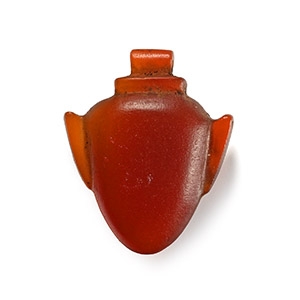
Egyptian Carnelian Heart Amulet
New Kingdom, 1550-1070 B.C.Sold for (Inc. bp): £780
A large heart, ib, amulet of classic egg-form with shallow lugs on either side with short flared top and tubular suspension loop. 5.27 grams, 26 mm
From an early 20th century collection London and Home Counties, UK. This lot is accompanied by an illustrated lot declaration signed by the Head of the Antiquities Department, Dr Raffaele D'Amato.
According to ancient Egyptian beliefs, the heart (ib) was considered to be the centre of intelligence, emotions, and behaviour. The heart was also believed to store an individual's memories. During the Weighing of the Heart ceremony in the afterlife, the heart could speak up for the deceased and account for their lifetime of actions before Osiris. For this reason, heart amulets were placed on the mummy to safeguard the organ and ensure a favourable outcome during judgment. -
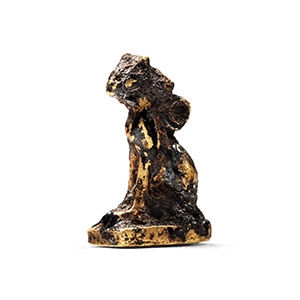
Egyptian Gold Goddess Bastet Cat Amulet
Late New Kingdom, 1070-900 B.C.Sold for (Inc. bp): £468
Modelled seated on a tongue-shaped base, suspension loop on the back. 0.53 grams, 8 mm
From an early 20th century French collection. This lot is accompanied by an illustrated lot declaration signed by the Head of the Antiquities Department, Dr Raffaele D'Amato.
The goddess Bastet was believed to be the daughter of the sun god and was shown with the features of a lion up until about 1000 B.C. when she was first portrayed as a cat or human with a cat head. As the daughter of Ra she was associated with the rage inherent in the sun god's eye which was considered to be his instrument of vengeance. Her development into a cat goddess occurred during the New Kingdom but did not fully develop until the Late Period. She was still associated with the destructive power of the sun and was shown on the prow of the solar boat, decapitating the evil serpent Apophis in the Book of the Dead. The maternal, protective and hunting characteristics of the cat are obvious in Bastet and she was seen as a protector of pregnant women and young children. In the Pyramid Texts she is invoked by the deceased king to act as his protector and to help him reach the sky to join the sun god; the king proclaims that Bastet is his mother and nurse. Like her counterpart, Sekhmet, Bastet has an aggressive side and, in a text from Karnak, Amenhotep II described his enemies being slaughtered like the victims of Bastet. The goddess had a shrine at Karnak, where she is known as the 'Lady of Asheru' which aligns her closely with the goddess Mut, the consort of Amun-Ra. Her most famous shrine was in the north-east Delta region, at Bubastis, and was known as Per-Bastet or 'the House of Bastet.' Herodotus describes the festival of Bastet as one of the most elaborate in all of Egypt and identifies her with the Greek Artemis. Cemeteries of cats have been excavated at Bubastis and at Saqqara and Memphis. -
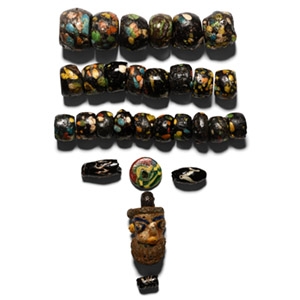
Phoenician Glass Bead Collection
6th-3rd century B.C. or laterEstimate: £1,200 - 1,700 (+bp*)
Opening Bid: £650
Comprising a group of crumb-decorated polychrome oblate beads and a centrepiece pendant formed as a stylised bearded head. 179 grams total, 12-42 mm
From the collection of a gentleman, acquired on the London art market in the 1990s. This lot is accompanied by an illustrated lot declaration signed by the Head of the Antiquities Department, Dr Raffaele D'Amato.
The Phoenicians, renowned seafarers and traders, were also skilled glassworkers. They produced a wide variety of glass beads using core-forming and winding techniques, with vivid colours and elaborate designs that reflect both technical mastery and cross-cultural influence. Among the most iconic Phoenician beads are glass 'head' beads, crafted in the form of stylised human or mythological faces. Typically, they feature exaggerated facial details like bulging eyes, large noses, beards, and headdresses, often with expressive or comic features. They were possibly worn as amulets to ward off evil or attract protection, though they may also represent deities, ancestors, or foreigners. These beads often incorporate Egyptian, Greek, and Near Eastern stylistic elements, reflecting the Phoenicians’ extensive trade networks.
