
Loading, please wait...
LOT 0418
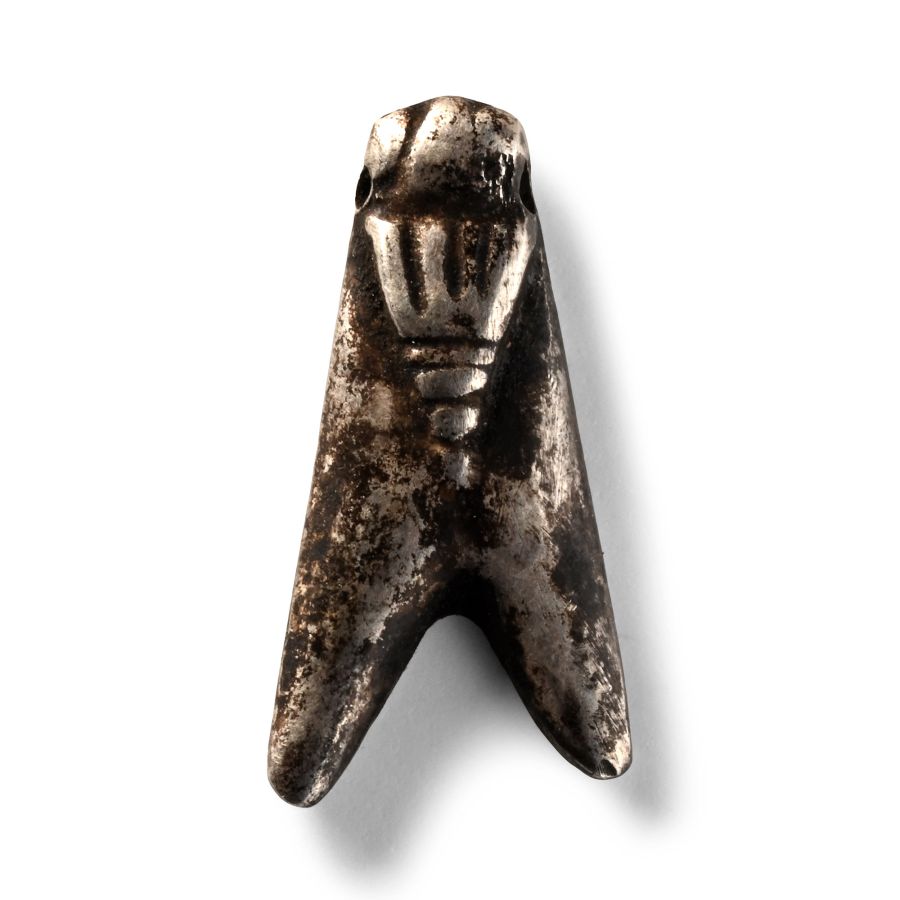
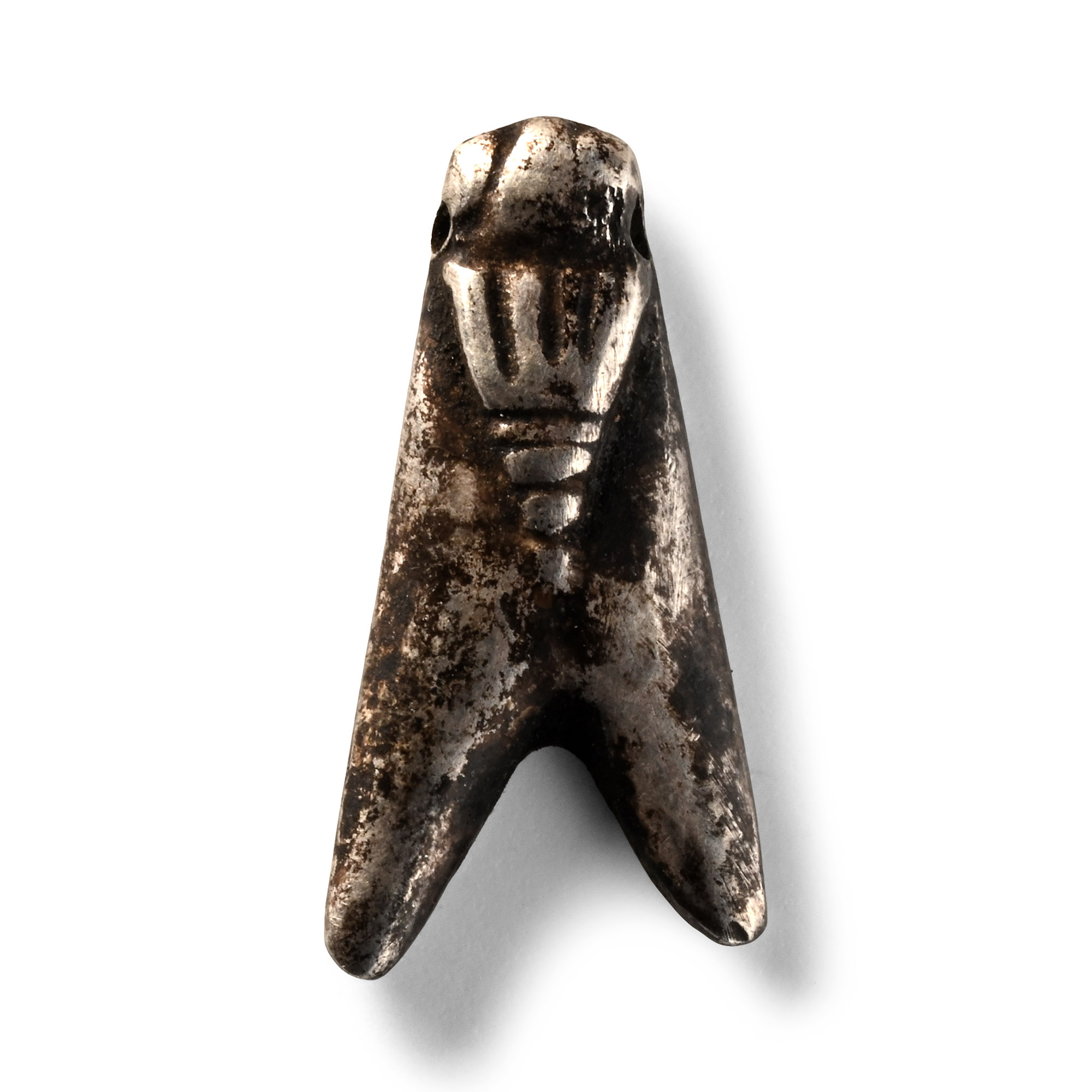
Egyptian Silver Fly Amulet
LATE PERIOD, 664-332 B.C.
5/8 in. (0.80 grams, 16 mm).
With detailing to wings and eyes, pierced for suspension through the head. [No Reserve]
ProvenanceFrom a gentleman's family collection, 2000s.
LiteratureCf. Andrews, C., Amulets of Ancient Egypt, London, 1994, pp.62-3.
CONDITIONTimeLine Auctions follows a vetting process to ensure the authenticity and legality of all items, reinforcing our commitment to integrity and responsible trading. Each antiquity, antique, and coin lot undergoes thorough examination by a vetting committee of at least ten external specialists, professional trade association members, scientists, and archaeologists: Our Vetting Process
AUCTIONS:
TimeLine is a leading auction house specialising in antiquities, ancient art, collectables, natural history, coins, medals, and books. Our auctions offer museums, collectors, historians, and enthusiasts the opportunity to acquire unique and historically significant pieces.
-
Egyptian Yellow Faience Bastet Cat Amulet
New Kingdom, circa 1550-1070 B.C.Sold for (Inc. bp): £715
Figure of Bastet as a cat with pointed ears, seated on a rectangular base with a rounded end; suspension loop on the back, ear repaired. 2.51 grams, 26 mm
Ex London gallery and Belinda Elliston, a member of the Egyptian Exploration Society, 1940s onwards.
In ancient Egypt, the cat was venerated as the sacred animal of the goddess Bastet, whose principal cult centre was Bubastis in the Nile Delta. Although cats were once part of folk practice, their veneration as part of formal cults spread across Egypt during the Late Period. Bastet was closely linked to lion-headed goddesses like Sekhmet, Tefnut, and Pakhet, and the cat itself became associated with solar imagery: the Book of the Dead portrays the sun god as a Great Cat vanquishing Apophis beneath the sacred Ished Tree. The cat could also embody the Eye of the Sun or, more often in Bastet’s case, the Eye of the Moon. Mummified cats were frequently dedicated as votive offerings, and some of their feline-shaped coffins were adorned with finely crafted bronze heads to enhance their divine likeness. -
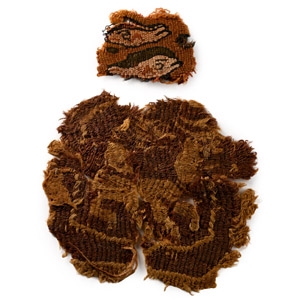
Egyptian Coptic Textile Fragment Group
Circa 5th century A.D.Sold for (Inc. bp): £52
Comprising: fragment of an orbiculus in brown and yellow coarse linen and wool, S torsion, embroidered with a running animal (lion?); fragment of a tablion with representations of fishes, white and green wool on linen. 10 grams total including package, 34-71 mm
Acquired 1970s-1996. Property of a North American collector. London collection, 2016.
Particularly interesting is the presence of fish, which are part of depictions of marine life, in keeping with the classical Graeco-Roman tradition. Stylistically, Hellenistic naturalism is evident in these compositions in the rounded shapes of fish and marine animals, which create an effect of movement. -
.jpg)
Egyptian Alabaster Mirror Handle
New Kingdom, 18th-20th Dynasty, 1550-1070 B.C.Sold for (Inc. bp): £3,900
In the form of a papyrus column, the upper platform pierced through for insertion of a bronze mirror, incised with lotus petals at the top of the shaft and at the base; mounted on a custom-made display stand. 482 grams total, 14.5 cm including stand
with Nicholas Wright, London, UK, 1969. Christie's, London, 14 April 2011, no.128. Accompanied by copies of the relevant Christie's catalogue pages. This lot has been checked against the Interpol Database of stolen works of art and is accompanied by search certificate number no.12941-243535.
The papyrus stalk was used in the hieroglyphic script for the word 'wadj', meaning 'fresh', making it an appropriate talisman for the preservation of the body.
