
Loading, please wait...
_900x900.jpg "Egyptian Silver Bezel for the 'Treasurer of the god, chief keeper (of) the House of Gold'")
_200x200.jpg "Egyptian Silver Bezel for the 'Treasurer of the god, chief keeper (of) the House of Gold'")
.jpg "Egyptian Silver Bezel for the 'Treasurer of the god, chief keeper (of) the House of Gold'")
LOT 0451
Egyptian Silver Bezel for the 'Treasurer of the god, chief keeper (of) the House of Gold'
25TH DYNASTY, 754-656 B.C.
1/2 in. (2.56 grams, 12 mm).
Rectangular with sloping faces on the underside, the upper face with two lines of hieroglyphic inscription reading: ‘Treasurer of the god, chief keeper (of) the House of Gold, great (of) Ra, Pa-di-Ra son of Pa-khered-tawy (or Pa-shery-tawy)’.
Provenancewith Bonhams, London, 27 April 2006.
with Galerie Rhéa, Zurich, Switzerland.
This lot is accompanied by an illustrated lot declaration signed by the Head of the Antiquities Department, Dr Raffaele D'Amato.
The ‘Treasurer of the god’ is a long-attested title known since the Old Kingdom (Jones, D., An Index of Ancient Egyptian Titles, Epithets and Phrases of the Old Kingdom, vol. II, Oxford, 2000, p. 767, no. 2791). The ‘Chief keeper’ title is known from the New Kingdom (for a similar writing of the title, see Al-Ayedi, A.R., Index of Egyptian Administrative, Religious and Military Titles of the New Kingdom, Ismailia, 2006, p. 395, no. 1236). The last part of the title is somewhat curious; the determinative at the end, previously interpreted as ‘Ra’, does not match the determinative for this god in the second line. An alternative tentative interpretation could be ‘Chief keeper, of the gold of the Pharaoh’, treating the pr and ꜤꜢ signs, which are shown side-by-side, as writing ‘Pharaoh’, with the seated figure wearing the Dual Crown symbolising the ruler.
CONDITIONTimeLine Auctions follows a vetting process to ensure the authenticity and legality of all items, reinforcing our commitment to integrity and responsible trading. Each antiquity, antique, and coin lot undergoes thorough examination by a vetting committee of at least ten external specialists, professional trade association members, scientists, and archaeologists: Our Vetting Process
AUCTIONS:
TimeLine is a leading auction house specialising in antiquities, ancient art, collectables, natural history, coins, medals, and books. Our auctions offer museums, collectors, historians, and enthusiasts the opportunity to acquire unique and historically significant pieces.
LOT 0451
Egyptian Silver Bezel for the 'Treasurer of the god, chief keeper (of) the House of Gold'
Sold for (Inc. bp): £2,080
-
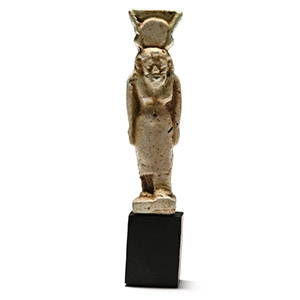
Large Egyptian Faience Isis Amulet
Late Period, 664-332 B.C.Estimate: £250 - 350 (+bp*)
Opening Bid: £125
Pale cream amuletic figure of Isis with crown formed as two horns flanking the sun-disc, and a uraeus at the front, wearing a calf-length robe, with dorsal pillar and rectangular base. 19.21 grams total, 76 mm including stand
Ex P.A. collection, London, UK, 1990s. This lot is accompanied by an illustrated lot declaration signed by the Head of the Antiquities Department, Dr Raffaele D'Amato.
In ancient Egyptian mythology, Isis was the sister-wife of Osiris and the mother of the sky god Horus. She is associated with aspects of fertility and motherhood and is often depicted in various artworks seated in a nursing pose with her son Horus on her lap. -
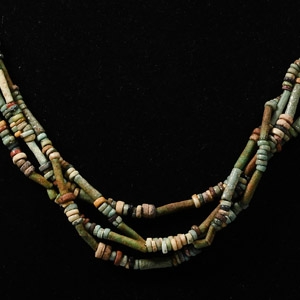
Egyptian Multi-Stranded Mummy Bead Necklace
Late Period, 664-332 B.C.Sold for (Inc. bp): £312
Four-stranded designer necklace composed of beads of mainly annular and tubular types. 21 grams, 67 cm
Acquired before 1979. From the private collection of Mr F.A., South Kensington, London, UK; thence by descent 2014. This lot is accompanied by an illustrated lot declaration signed by the Head of the Antiquities Department, Dr Raffaele D'Amato.
For thousands of years, artisans in Egypt created vibrant ceramics to echo the beauty of rare jewels. These ornaments were created with almost every material, colour, and texture imaginable and they come from across Egypt and beyond: vibrant blue lapis lazuli from Afghanistan, glossy black obsidian from Turkey, and aqua-green turquoise from the Sinai. They were worn in life and, after death, they served as precious ornamentation for mummies. -
.jpg)
Egyptian Gold Uraeus Amulet
Late New Kingdom, 1279-1070 B.C.Estimate: £200 - 300 (+bp*)
Opening Bid: £111
Depicting a rearing cobra sporting a sun disc with its coiled body below resting on the hieroglyphic neb sign. 0.38 grams, 11 mm
From an early 20th century French collection. This lot is accompanied by an illustrated lot declaration signed by the Head of the Antiquities Department, Dr Raffaele D’Amato. This lot is accompanied by an illustrated lot declaration signed by the Head of the Antiquities Department, Dr Raffaele D'Amato.
