
Loading, please wait...
_900x900.jpg "Egyptian Revival Bronze Cross")
_200x200.jpg "Egyptian Revival Bronze Cross")
.jpg "Egyptian Revival Bronze Cross")
LOT 1912
Egyptian Revival Bronze Cross
LATE 19TH-EARLY 20TH CENTURY A.D.
1 5/8 in. (5.6 grams, 43 mm).
Cruciform pendant with integral loop, obverse with impressed cartouche and hieroglyphs, reverse with hatching.
ProvenanceFrom the collection of a gentleman, acquired on the London art market in the 1990s.
This lot is accompanied by an illustrated lot declaration signed by the Head of the Antiquities Department, Dr Raffaele D'Amato.
TimeLine Auctions follows a vetting process to ensure the authenticity and legality of all items, reinforcing our commitment to integrity and responsible trading. Each antiquity, antique, and coin lot undergoes thorough examination by a vetting committee of at least ten external specialists, professional trade association members, scientists, and archaeologists: Our Vetting Process
AUCTIONS:
TimeLine is a leading auction house specialising in antiquities, ancient art, collectables, natural history, coins, medals, and books. Our auctions offer museums, collectors, historians, and enthusiasts the opportunity to acquire unique and historically significant pieces.
LOT 1912
Egyptian Revival Bronze Cross
Estimate £100 - 140€120 - 160 (for guidance only)$140 - 190 (for guidance only)
-
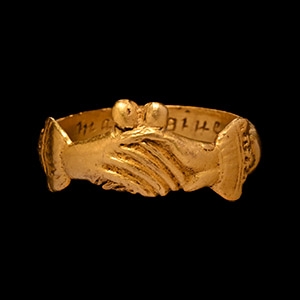
'The Blackmore' Elizabethan Gold 'Can Man Give More' Clasped Hands 'Fede' Posy Ring
Late 16th century A.D.Sold for (Inc. bp): £2,860
Comprising a plano-convex section hoop with bezel formed as two clasped hands, each with a large lace cuff; inscribed to the inner face in an italic hand 'Can man give more' and maker's mark of a heater shield with a gothic style letter 'J'. 2.52 grams, 18.33 mm overall, 16.28 mm internal diameter (approximate size British I 1/2, USA 4 1/2, Europe 8.07, Japan 7)
Found whilst searching with a metal detector near Blackmore, Brentwood, Essex, in 2018, declared as treasure under the Treasure Act with reference no.2018 T849, and subsequently disclaimed by the crown. Accompanied by a copy of a report for Treasure by Laura Smith. Accompanied by a copy of the British Museum’s Portable Antiquities Scheme (PAS) report no.ESS-CACCCD. This lot is accompanied by an illustrated lot declaration signed by the Head of the Antiquities Department, Dr Raffaele D'Amato. -
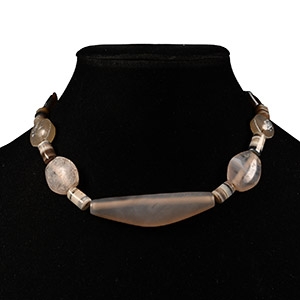
Western Asiatic Style Agate Bead String
20th century A.D.Sold for (Inc. bp): £247
Composed of cylindrical, tabular and conical beads, with a large elbow bead to the centre. 57 grams, 30 cm
From the family collection of a Hampstead gentleman; formerly acquired in the 1980s. This lot is accompanied by an illustrated lot declaration signed by the Head of the Antiquities Department, Dr Raffaele D'Amato. -
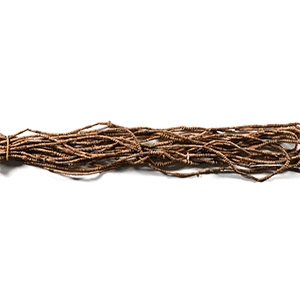
African Terracotta Bead Necklace Group
12th century A.D. or laterSold for (Inc. bp): £7
Ten restrung mainly cream and beige-coloured rondelle, tubular and ribbed beads and other types. 70 grams total, 72-74 cm
Ex property of a UK gallery, early 2000s. This lot is accompanied by an illustrated lot declaration signed by the Head of the Antiquities Department, Dr Raffaele D'Amato.
