
Loading, please wait...
LOT 0017
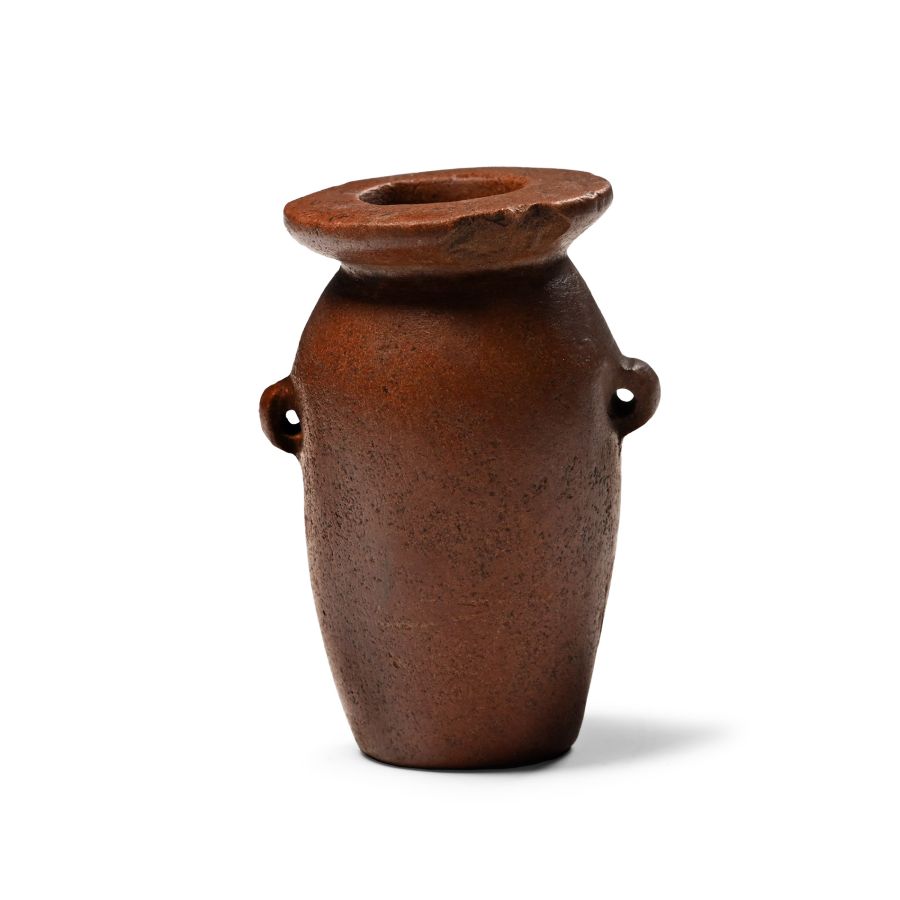
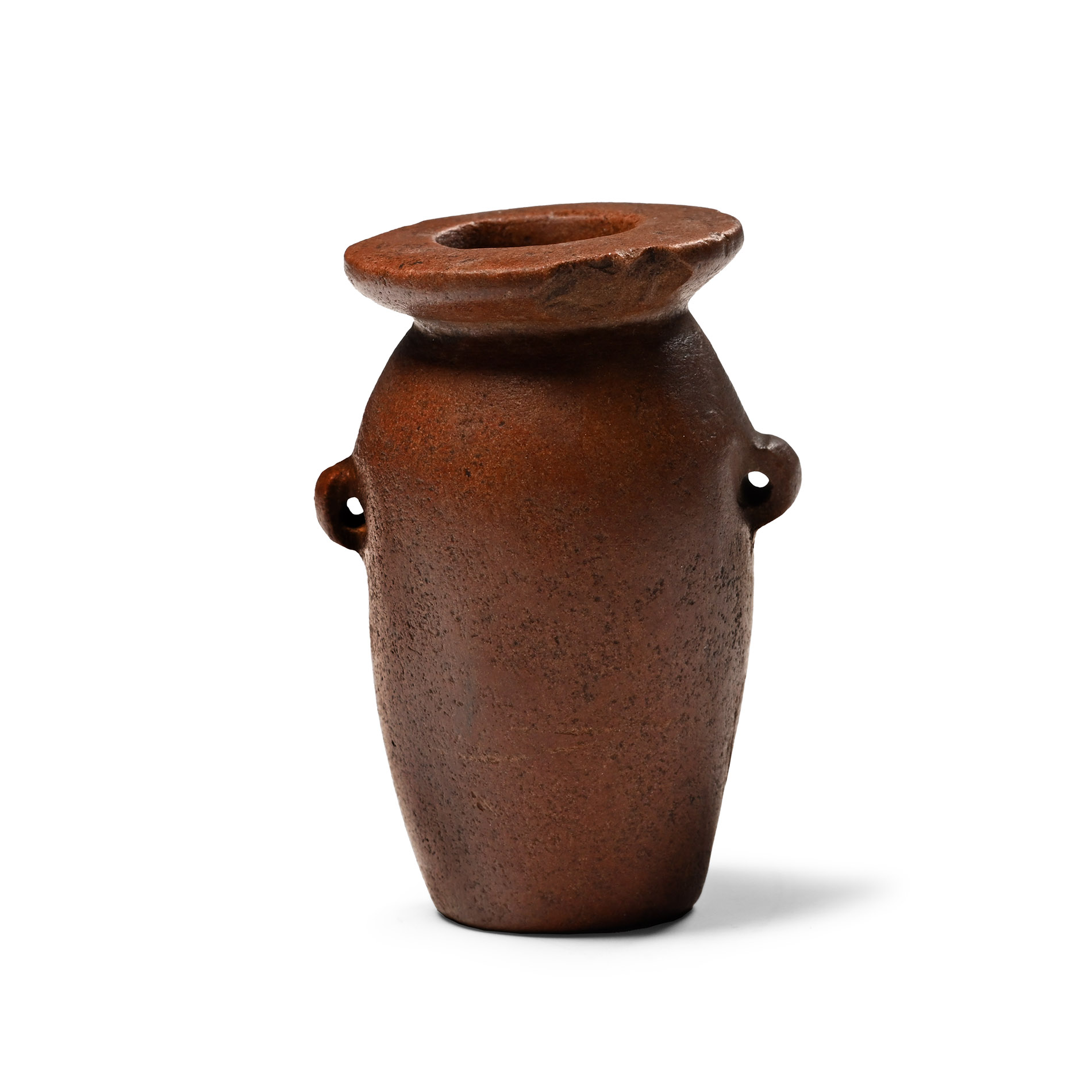
Egyptian Red Limestone Jar
NEW KINGDOM, 1550-1069 B.C.
2 in. (57 grams, 51 mm).
With everted disc rim and flat base, twin lug handles at the shoulder.
ProvenancePino Donati collection, Lugano-Breganzona, formed in the 1960s-early 1970s.
with Arte Classica, Stefano Donati, Lugano.
Private collection, Europe, acquired November 2011 from the above.
with Bonhams, New Bond Street, 28 November 2019, no.163.
Red limestone vessels have a limited chronological range and are particularly characteristic of the Predynastic Period. See Aston, B.G., Ancient Egyptian Stone Vessels: Materials and Forms, SAGA 5, Heidelberg, 1994, p.170, fig. 21, for the chronological range of the stone used for vessels.
CONDITIONTimeLine Auctions follows a vetting process to ensure the authenticity and legality of all items, reinforcing our commitment to integrity and responsible trading. Each antiquity, antique, and coin lot undergoes thorough examination by a vetting committee of at least ten external specialists, professional trade association members, scientists, and archaeologists: Our Vetting Process
AUCTIONS:
TimeLine is a leading auction house specialising in antiquities, ancient art, collectables, natural history, coins, medals, and books. Our auctions offer museums, collectors, historians, and enthusiasts the opportunity to acquire unique and historically significant pieces.
LOT 0017
Egyptian Red Limestone Jar
Estimate £800 - 1,000€930 - 1,160 (for guidance only)$1,080 - 1,350 (for guidance only)
-
Egyptian Amarna Period Beaded Fruit Necklace
18th Dynasty, 1332-1346 B.C.Sold for (Inc. bp): £598
Restrung necklace of annular and tabular beads with fructiform amulets. 13.1 grams, 44 cm
Ex London, UK, collection, 1990s.
Petal-shaped beads of faience and glass were widely used in jewellery during the Amarna Period. During this era, advanced production methods enabled the creation of bi-chrome and polychrome designs, which often included newly developed colours. This resulted in vibrant necklaces that resembled festive collars made of natural floral elements. -
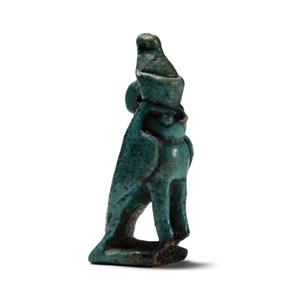
Large Egyptian Blue Glazed Horus Amulet
Late New Kingdom-Third Intermediate Period, circa 1300-700 B.C.Sold for (Inc. bp): £234
Modelled in the round as a perching falcon on a rectangular base and wearing the double-crown; loop to rear of head. 12.5 grams, 54 mm
From an old Suffolk, UK, collection. Acquired in the UK before 1980. From the personal collection of Derek Rogers, Suffolk, UK.
The falcon amulet was a symbol of Horus, the god of the sky, war, and protection. -
.jpg)
Romano-Egyptian Terracotta Votive Figure of Eros
1st-2nd century A.D.Estimate: £4,000 - 6,000 (‡+bp*)
Opening Bid: £2,222
Depicted nude in a dynamic pose with his legs apart and the weight of the body upon his right leg, standing in front of a two storey structure, probably an oven; his left arm raised and right arm extended in front of his torso and resting on the edge of the structure; the oven painted pink at the top and white at the bottom with an offering receptacle at floor level. 232 grams, 15 cm
Ex Dr Daniel Marie Fouquet (1859-1914), Cairo. with Pierre Berge & Associes, Auction, Archaeology 29 November 2014, no.193. Accompanied by a French cultural export permit, no.161028. Accompanied by an academic report by Dr Raffaele D'Amato. Accompanied by a copy of the relevant pages in: Perdrizet, P., Les Terres Cuites Grecques d'Egypt de la Collection Fouquet, Nancy, 1921, where it is published. This lot has been checked against the Interpol Database of stolen works of art and is accompanied by search certificate no.12000-211884.
The image of the ‘Eros Baker’ is part of a wide production of Roman terracotta imitating Greek models, although in somewhat crude way. In the Roman age, designs tended to be commonplace and were often indifferent copies of Greek originals. However, the production of terracotta in Hellenistic Egypt continued without interruption and the most subjects of these votive statuettes (in this case probably a baker invoking the blessing of the god upon his activity) were religious, Eros being one of the favourites.
