
Loading, please wait...
_900x900.jpg "Egyptian PreDynastic Black-Topped Jar")
_200x200.jpg "Egyptian PreDynastic Black-Topped Jar")
.jpg "Egyptian PreDynastic Black-Topped Jar")
LOT 0027
Egyptian PreDynastic Black-Topped Jar
NAQADA I-II, 4000-3200 B.C.
5 1/2 in. (274 grams, 13.5 cm).
Of ovoid form tapering to a narrow flattened base.
ProvenanceFrom the vendor's grandfather's collection, formed in the 1950s; thence by family descent circa 1974.
LiteratureSee Sowada, K.S., Black-Topped Ware in Early Dynastic Contexts, in Journal of Egyptian Archaeology, vol.85, 1999; Adams, B., Predynastic Egypt, Shire Egyptology 7, Princes Risborough, 1988; Petrie, W.M.F., Naqada and Ballas, London, 1895; Petrie, W.M.F., Corpus of Prehistoric Pottery and Palettes, London, 1921; Wodzinska, A., A Manual of Egyptian Pottery. Volume 1: Fayum A – Lower Egyptian Culture, Boston, 2010.
FootnotesThe 'black-topped' ware was the most common funerary pottery during Naqada I and Naqada II periods, with a small volume of production in the Naqada III, Early Dynastic and Old Kingdom periods.
CONDITIONTimeLine Auctions follows a vetting process to ensure the authenticity and legality of all items, reinforcing our commitment to integrity and responsible trading. Each antiquity, antique, and coin lot undergoes thorough examination by a vetting committee of at least ten external specialists, professional trade association members, scientists, and archaeologists: Our Vetting Process
AUCTIONS:
TimeLine is a leading auction house specialising in antiquities, ancient art, collectables, natural history, coins, medals, and books. Our auctions offer museums, collectors, historians, and enthusiasts the opportunity to acquire unique and historically significant pieces.
-
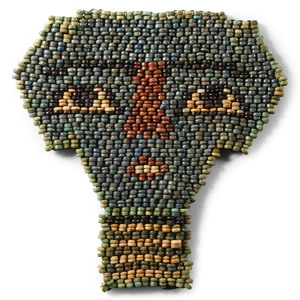
Egyptian Faience Mummy Bead Mask
Ptolemaic Period, 332-30 B.C.Sold for (Inc. bp): £338
Restrung beadwork panel depicting a mummy face mask with false beard. 26.9 grams, 11.2 cm
Previously with Mariaud de Serres, Paris, France. From a Paris gallery. -
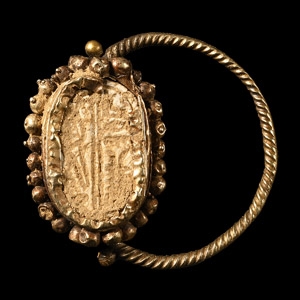
Egyptian Limestone Scarab in Gold Ring
Circa 1750-1550 B.C. and laterSold for (Inc. bp): £572
The scarab carved with simple anatomical detailing with two columns of hieroglyphs to base, including a djed pillar; set in a later gold swivel bezel with beaded edge supported by a tapering, round-section grooved hoop. 2.91 grams, 24.16 mm overall, 21.04 mm internal diameter
Collected from 1970-1999. From the collection of the late Mr S.M., London, UK. Accompanied by a previous catalogue information card.
The djed pillar was associated with the god Ptah, and from the New Kingdom onwards it was associated with the god Osiris, meaning stability, rejuvenation and regeneration. Thus it was used by both the living and the dead, formed of a variety of materials. -
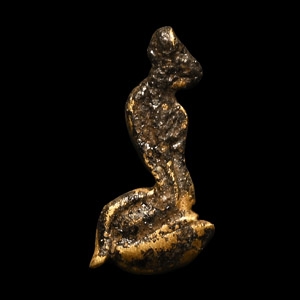
Egyptian Gold Uraeus Amulet
Late New Kingdom, 1070-900 B.C.Sold for (Inc. bp): £338
In rearing cobra pose with body coiled below. 0.38 grams, 11 mm
From an early 20th century French collection.
