
Loading, please wait...
_900x900.jpg "Egyptian Painted Wooden Mummy Mask")
_200x200.jpg "Egyptian Painted Wooden Mummy Mask")
_900x900.jpg "Egyptian Painted Wooden Mummy Mask")
_200x200.jpg "Egyptian Painted Wooden Mummy Mask")
.jpg "Egyptian Painted Wooden Mummy Mask")
.jpg "Egyptian Painted Wooden Mummy Mask")
LOT 0488
Egyptian Painted Wooden Mummy Mask
4TH-3RD CENTURY B.C.
14 in. (677 grams, 36 cm).
Displaying semi-naturalistic detailing in relief, beneath a band of headdress ornament composed of rows of architectural dot-and-dash and zig-zag patterns over a segmental panel, possible hieroglyphs to the top tier; attachment pegs to the sides of the face and through the head; extensive remains of painted black pigmentation and composition fill to the eyes.
ProvenanceFrom a French estate, acquired between 1960 and 1980.
with SAS Cornette de Saint Cyr Auction, Paris, Vente 882, Mobilier et Objets d'art, 2 December 2014, lot 69.
Accompanied by a copy of a French cultural passport no.167062.
Accompanied by an academic report by Dr Alberto Maria Pollastrini.
This lot has been checked against the Interpol Database of stolen works of art and is accompanied by search certificate no.11807-206837.
TimeLine Auctions follows a vetting process to ensure the authenticity and legality of all items, reinforcing our commitment to integrity and responsible trading. Each antiquity, antique, and coin lot undergoes thorough examination by a vetting committee of at least ten external specialists, professional trade association members, scientists, and archaeologists: Our Vetting Process
AUCTIONS:
TimeLine is a leading auction house specialising in antiquities, ancient art, collectables, natural history, coins, medals, and books. Our auctions offer museums, collectors, historians, and enthusiasts the opportunity to acquire unique and historically significant pieces.
LOT 0488
Egyptian Painted Wooden Mummy Mask
Estimate £3,000 - 4,000€3,480 - 4,640 (for guidance only)$4,050 - 5,400 (for guidance only)
-
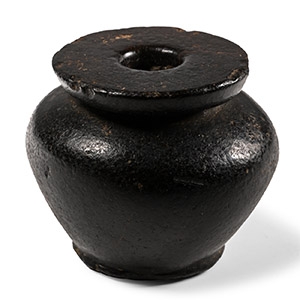
Egyptian Black Stone Kohl Vessel
Middle Kingdom, circa 1991-1665 B.C.Sold for (Inc. bp): £572
Squat in profile with integral discoid base, broad discoid rim to the mouth. 190 grams, 53 mm wide
Swiss collection, acquired in 1998.
Such vessels contained kohl, an eyepaint either green or black. Kohl was used as a cosmetic in daily life, mentioned in funerary texts as necessary make-up in the presentation of the deceased before Osiris, and served as a medical treatment for eye ailments. The small size of kohl jars and their tiny capacity indicate the preciousness and costliness of the contents. -
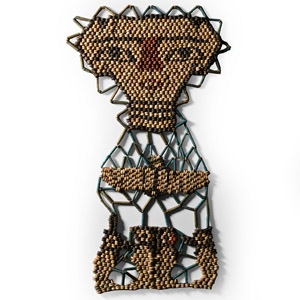
Egyptian Faience Mummy Bead Mask with Four Sons of Horus
Ptolemaic Period, 332-30 B.C.Sold for (Inc. bp): £312
A netted beadwork panel of annular and tubular glazed composition beads in blues, greens, black, cream and red-brown colours, depicting a mummy face mask with a false beard, a scarab with extended wings below, and the 'Four Sons of Horus’ figures beneath the scarab, joined together with areas of open netting of tubular examples; restrung with some later beads. 113 grams, 30 cm
Ex Mariaud des Serres, Paris, France, 1990s.
Winged scarabs were often used as funerary amulets and believed to symbolise the deceased's rebirth and regeneration. The Four Sons of Horus were deities responsible for protecting the deceased's internal organs. Here, on the left, is the erect-eared jackal-headed Duamutef who protects the stomach, followed by the falcon-headed Qebehsenuef, who protects the intestines, then the human-headed Imsety, protector of the liver and, finally, the baboon-headed Hapy on the right, protector of the lungs. The internal organs were often placed in canopic jars with the head of the respective Son of Horus. Amulets depicting these deities were placed within the mummy wrappings. -
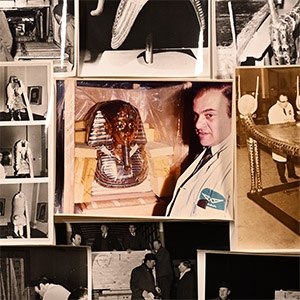
Original Press Photographs of the 1972 Tutankhamun Exhibition
1972 A.D.Sold for (Inc. bp): £39
Comprising monochrome glossy photographs with printed caption to the reverse: 'Tutankhamun's Funerary Couch. The divine cow in the final stages of wrapping, being embraced by Mr. T.G.H. James, Assistant Keeper of the British Museum'; 'The six stages in the packing of the gilded wooden statue of Tutankhamun; one of a pair that stood sentinel at the entrance to the inner chamber'; 'Colin Ashby of Walford Wingate Forwarders Ltd in the course of packing the major item in the Tutankhamun collection at the Cairo Museum. The funerary mask from Tutankhamun's mummy is made of beaten gold and is the finest ever found.' (Colour photo); 'The funerary mask from Tutankhamun's mummy made of beaten gold and the finest ever found. (Please credit the Cairo Museum)'; 'Part of the carefully-packed contents of Tutankhamun's tomb at London Airport on arrival from Cairo. Lt.Col. E.C. Easter MBE, Chairman of Walford Wingate Forwarders Ltd. the company responsible for the entire packing and surface transportation operation, supervises the off-loading of part of the world's most fabulous treasure.' (2 photographs); 'Never has B.O.A.C.'s slogan been more assuring. the innocent looking cargo being unloaded at London Airport is part of a priceless consignment from Cairo for the forthcoming exhibition of the contents of Tutankhamun's tomb to be held at the British Museum. Flown in by the R.A.F. and B.O.A.C. under British Government indemnity, the world's greatest treasure trove was packed and handled by Walford Wingate Forwarders Ltd.'; 'Tutankhamun's Funerary Couch. Preliminary inspection of Tutankhamun's funerary couch by Messrs Ashby and Burnett of Walford Wingate Forwarders Ltd.'; 'Tutankhamun's Funerary Couch. One of the divine cows separated from the couch in the early stages of wrapping'. 102 grams total, 25.2 x 17.7 - 25.3 x 20.4 cm
Property of a Cambridgeshire, UK, gentleman.
