
Loading, please wait...
_900x900.jpg "Egyptian Painted Wooden Model of a Cow Giving Birth, Together with Two Figures")
_200x200.jpg "Egyptian Painted Wooden Model of a Cow Giving Birth, Together with Two Figures")
.jpg "Egyptian Painted Wooden Model of a Cow Giving Birth, Together with Two Figures")
LOT 0428
Egyptian Painted Wooden Model of a Cow Giving Birth, Together with Two Figures
MIDDLE KINGDOM, 11TH-12TH DYNASTY, 2023-1862 B.C.
3 3/4 - 6 1/4 in. (111 grams total, 9.5-16 cm).
Composed of three figures: a standing cow or other quadruped giving birth to its young, its head, neck and forelegs emerging from the mother's rear, both with a black and white speckled coat; a standing male figure with articulated arms and pierced hands, wearing a kilt and cropped wig and with stylised facial detailing; a kneeling figure also with articulated arms, open-palm hands, wearing a kilt and cropped wig, stylised facial features; extensive remains of polychrome pigment.
ProvenanceFrom an early 20th century Home Counties collection.
This lot has been checked against the Interpol Database of stolen works of art and is accompanied by search certificate no.11597-199209.
Cf. Barker, G., Preparing for Eternity: Funerary models and wall scenes from the Egyptian Old and Middle Kingdoms, Oxford, 2022, p.113 figure 4.2, for a near-identical calving cow figure, possibly from Meir (now in the Royal Ontario Museum, Toronto, inv. no. 910.18.16.1-3); cf. The Metropolitan Museum, New York, accession numbers 2021.41.170 and 11.150.5, for similar human and animal figures of this date.
FootnotesSuch models would have been deposited in tombs; the purpose of such a scene was probably to evoke the season of spring, when calves were born, and the floodplain where farmers lived and raised their livestock.
CONDITIONTimeLine Auctions follows a vetting process to ensure the authenticity and legality of all items, reinforcing our commitment to integrity and responsible trading. Each antiquity, antique, and coin lot undergoes thorough examination by a vetting committee of at least ten external specialists, professional trade association members, scientists, and archaeologists: Our Vetting Process
AUCTIONS:
TimeLine is a leading auction house specialising in antiquities, ancient art, collectables, natural history, coins, medals, and books. Our auctions offer museums, collectors, historians, and enthusiasts the opportunity to acquire unique and historically significant pieces.
LOT 0428
Egyptian Painted Wooden Model of a Cow Giving Birth, Together with Two Figures
Estimate £3,500 - 4,500€4,060 - 5,220 (for guidance only)$4,730 - 6,080 (for guidance only)
-
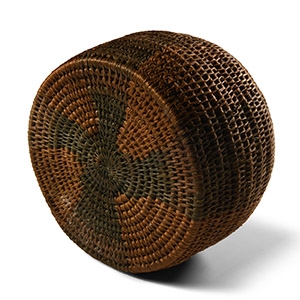
Egyptian Woven Reed Basket
New Kingdom, 1539-1075 B.C.Sold for (Inc. bp): £910
Squat in profile with wide mouth, tinted cross to the underside; old collector's label '1766' inside. 119 grams, 11.3 cm
Ex Bretagne Encheres, Hotel des Ventes de Rennes, France, 2005-2006. Property of a French collector. -
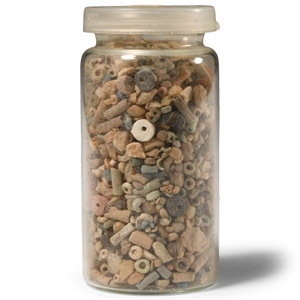
Egyptian Faience Bead Collection
New Kingdom-Late Period, circa 1550-332 B.C.Sold for (Inc. bp): £52
Mainly tubular, annular and oblate types in various colours. 61 grams total, 64 mm
Acquired from Ancient & Oriental, circa 1987. Ian Wilkinson collection, Nottinghamshire, UK, formed since 1985.
The faience of the New Kingdom period is frequently decorated with an expanded palette of red, black, and yellow. This polychrome decoration was often accomplished by inlaying one colour of paste onto another. -
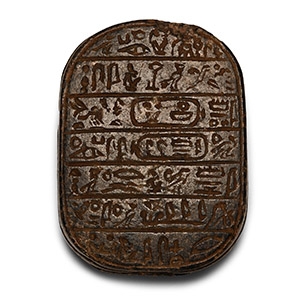
Egyptian Style Heart Scarab with Hieroglyphs
Late 19th-early 20th century A.D.Sold for (Inc. bp): £416
Substantial carved scarab with detailed carapace; underside with seven columns of hieroglyphic text, including two cartouches. 72 grams, 50 mm.
Private collection, UK; acquired prior to 2013.
