
Loading, please wait...
LOT 0459
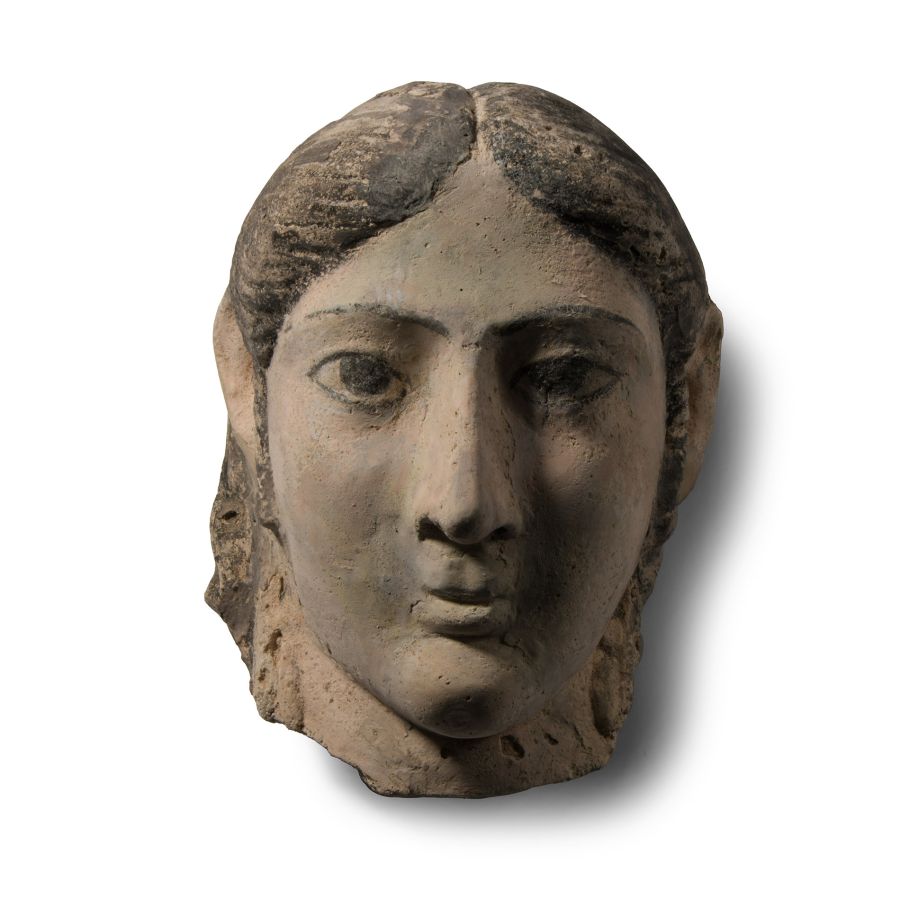
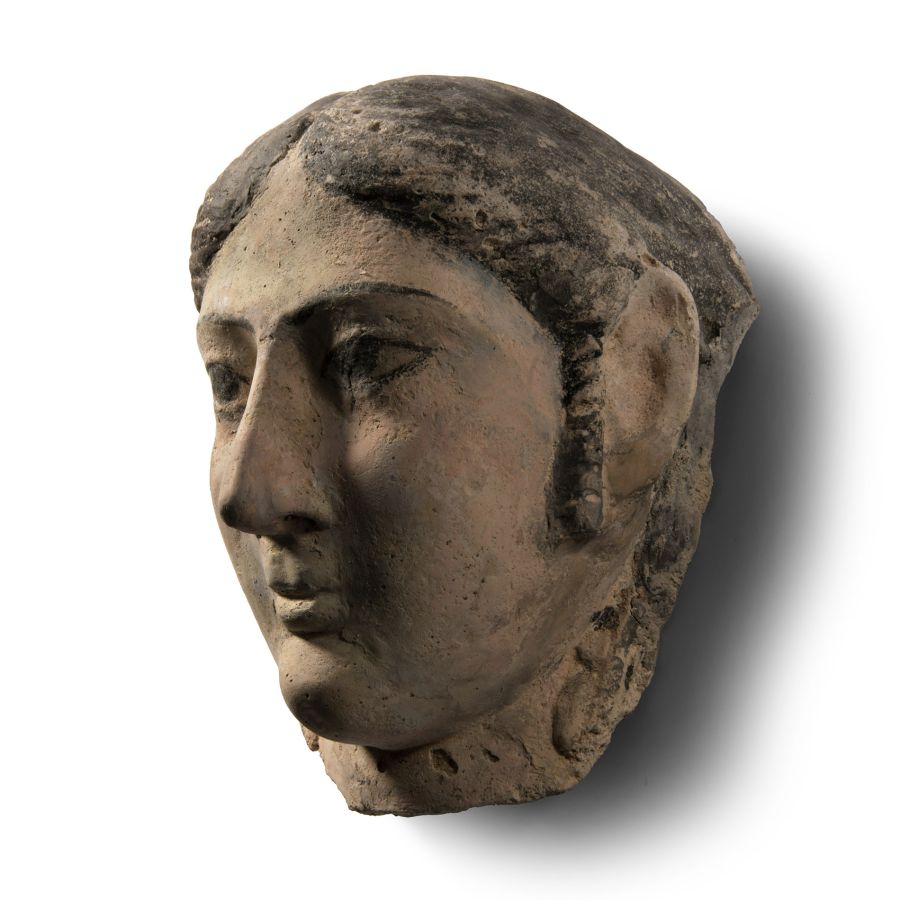
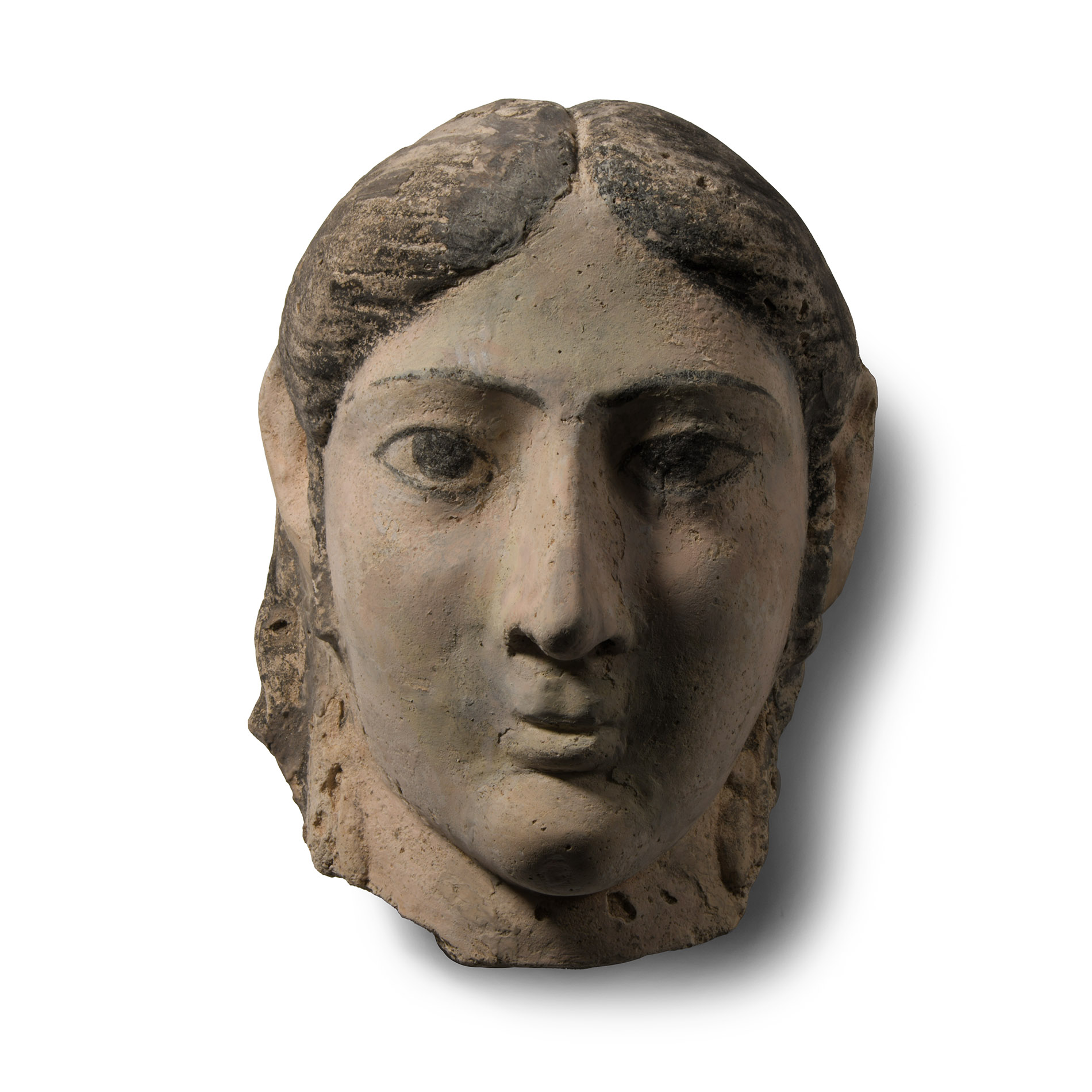
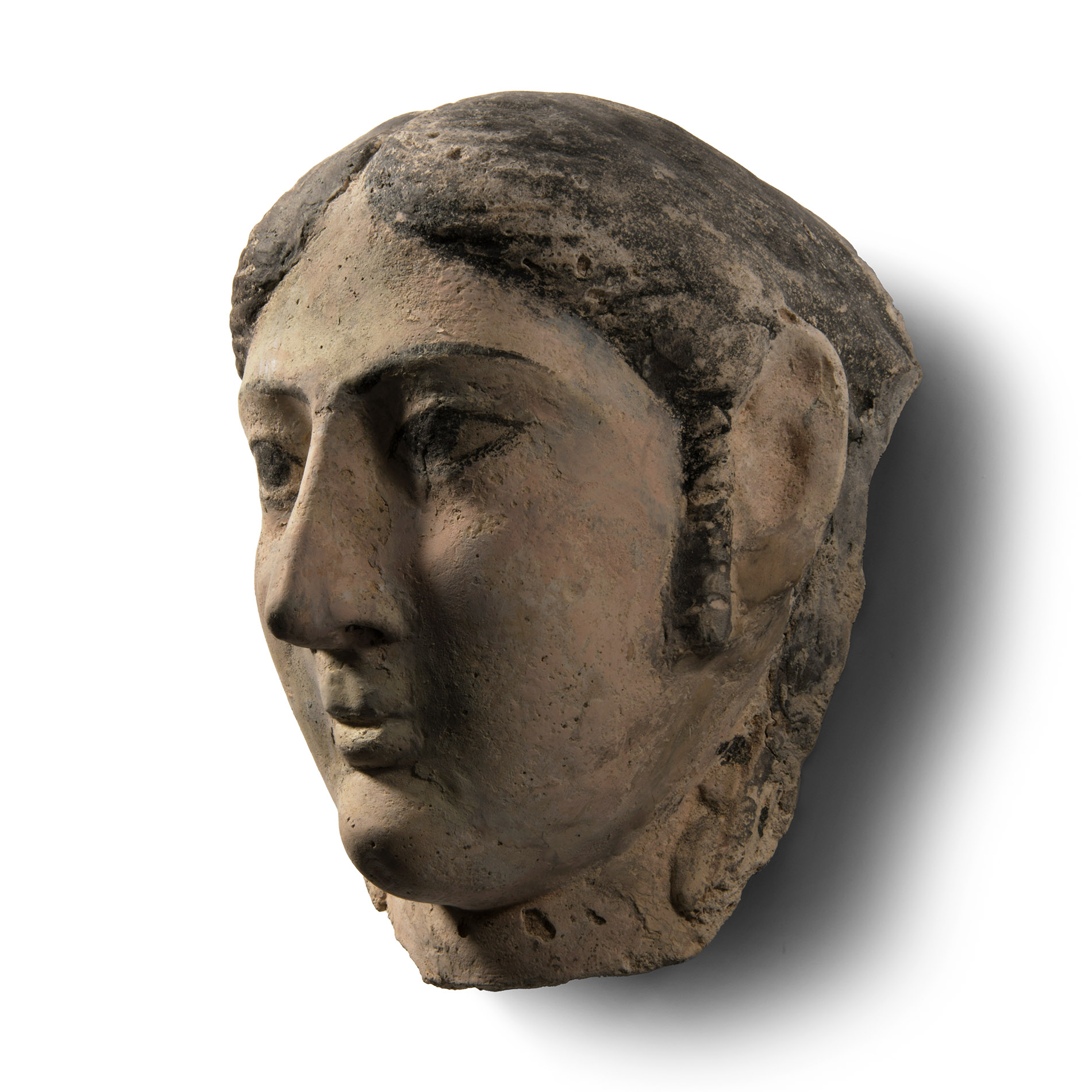
Egyptian Painted Plaster Mummy Mask of a Lady
ROMAN PERIOD, 30 B.C.-323 A.D.
8 in. (777 grams, 20 cm high).
Hollow-formed with finely modelled facial details, dark hair parted in the middle and drawn back to each side with a ringlet before each ear; narrow brow with painted eyebrows, lentoid eyes with dark irises; narrow nose and small pursed lips; impressions of bandaging on the rear where attached to mummy.
ProvenanceFrom a London, UK, collection.
Formerly with a central London auction house.
Cf. Manley, B., and Dodson, A., Life Everlasting. National Museum of Scotland Collection of Ancient Egyptian Coffins, Edinburgh, 2010, pp.136-137, nos.58-59, for two examples of such plaster masks; see also Toynbee, J.M.C. Roman Historical Portraits, London, 1978, for discussion.
CONDITIONTimeLine Auctions follows a vetting process to ensure the authenticity and legality of all items, reinforcing our commitment to integrity and responsible trading. Each antiquity, antique, and coin lot undergoes thorough examination by a vetting committee of at least ten external specialists, professional trade association members, scientists, and archaeologists: Our Vetting Process
AUCTIONS:
TimeLine is a leading auction house specialising in antiquities, ancient art, collectables, natural history, coins, medals, and books. Our auctions offer museums, collectors, historians, and enthusiasts the opportunity to acquire unique and historically significant pieces.
-
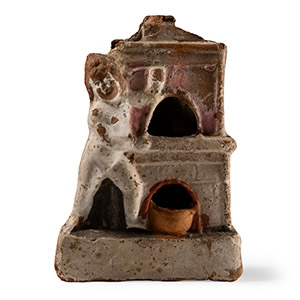
Romano-Egyptian Terracotta Figure of Eros
1st-2nd century A.D.Sold for (Inc. bp): £5,850
Depicted nude in a dynamic pose with his legs apart and the weight of the body upon his right leg, standing in front of a two storey structure, probably an oven; his left arm raised and right arm extended in front of his torso and resting on the edge of the structure; the oven painted pink at the top and white at the bottom with an offering receptacle at floor level. 232 grams, 15 cm
Ex Dr Daniel Marie Fouquet (1859-1914), Cairo. with Pierre Berge & Associes, Auction, Archaeology 29 November 2014, no.193. Accompanied by a French cultural export permit, no.161028. Accompanied by an academic report by Dr Raffaele D'Amato. Accompanied by a copy of the relevant pages in: Perdrizet, P., Les Terres Cuites Grecques d'Egypt de la Collection Fouquet, Nancy, 1921, where it is published. This lot has been checked against the Interpol Database of stolen works of art and is accompanied by search certificate no.12000-211884.
The image of the ‘Eros Baker’ is part of a wide production of Roman terracotta imitating Greek models, although in somewhat crude way. In the Roman age, designs tended to be commonplace and were often indifferent copies of Greek originals. However, the production of terracotta in Hellenistic Egypt continued without interruption and the most subjects of these votive statuettes (in this case probably a baker invoking the blessing of the god upon his activity) were religious, Eros being one of the favourites. -
.jpg)
Egyptian Faience Beaded Mummy Mask with Sons of Horus
Ptolemaic Period, 332-31 B.C.Sold for (Inc. bp): £445
Restrung netted beadwork panel of annular and tubular glazed composition beads in blues, greens, black, cream and red-brown colours, depicting a mummy face mask with false beard, a scarab with extended wings below, the 'Four Sons of Horus’ beneath the scarab, joined together with areas of open netting of tubular beads; mounted in a glazed frame with papyrus backing. 127 grams, 28 cm
Previously with Mariaud de Serres, Paris, France. From a Paris gallery.
The Four Sons of Horus were deities responsible for protecting the internal organs of the deceased. The human-headed Imsety protected the liver, the baboon-headed Hapy protected the lungs, the jackal-headed Duamutef protected the stomach, and the falcon-headed Qebehsenuef protected the intestines. -
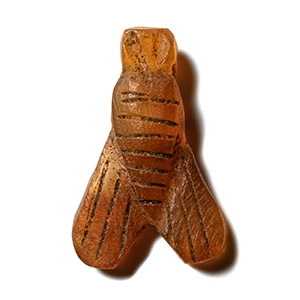
Egyptian Hardstone Fly Amulet
Late Period, 664-332 B.C.Sold for (Inc. bp): £143
With linear detailing to body and wings, pierced at the neck. 0.34 grams, 13 mm
From an early 20th century UK collection.
