
Loading, please wait...
LOT 0009
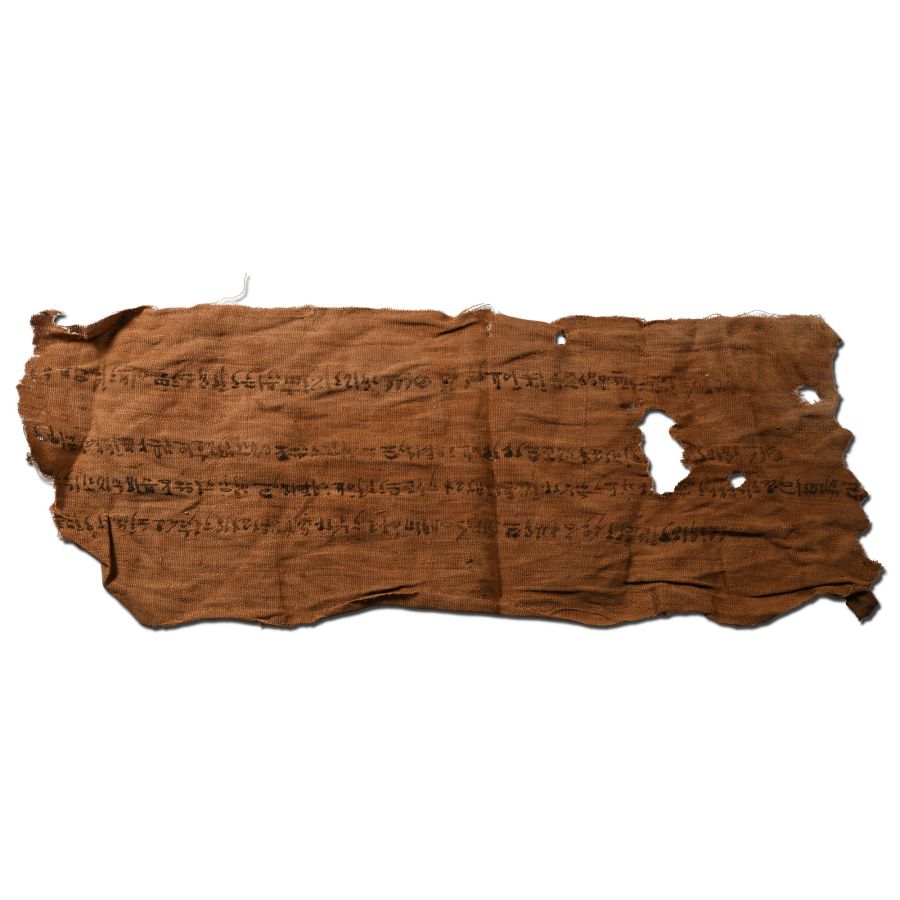
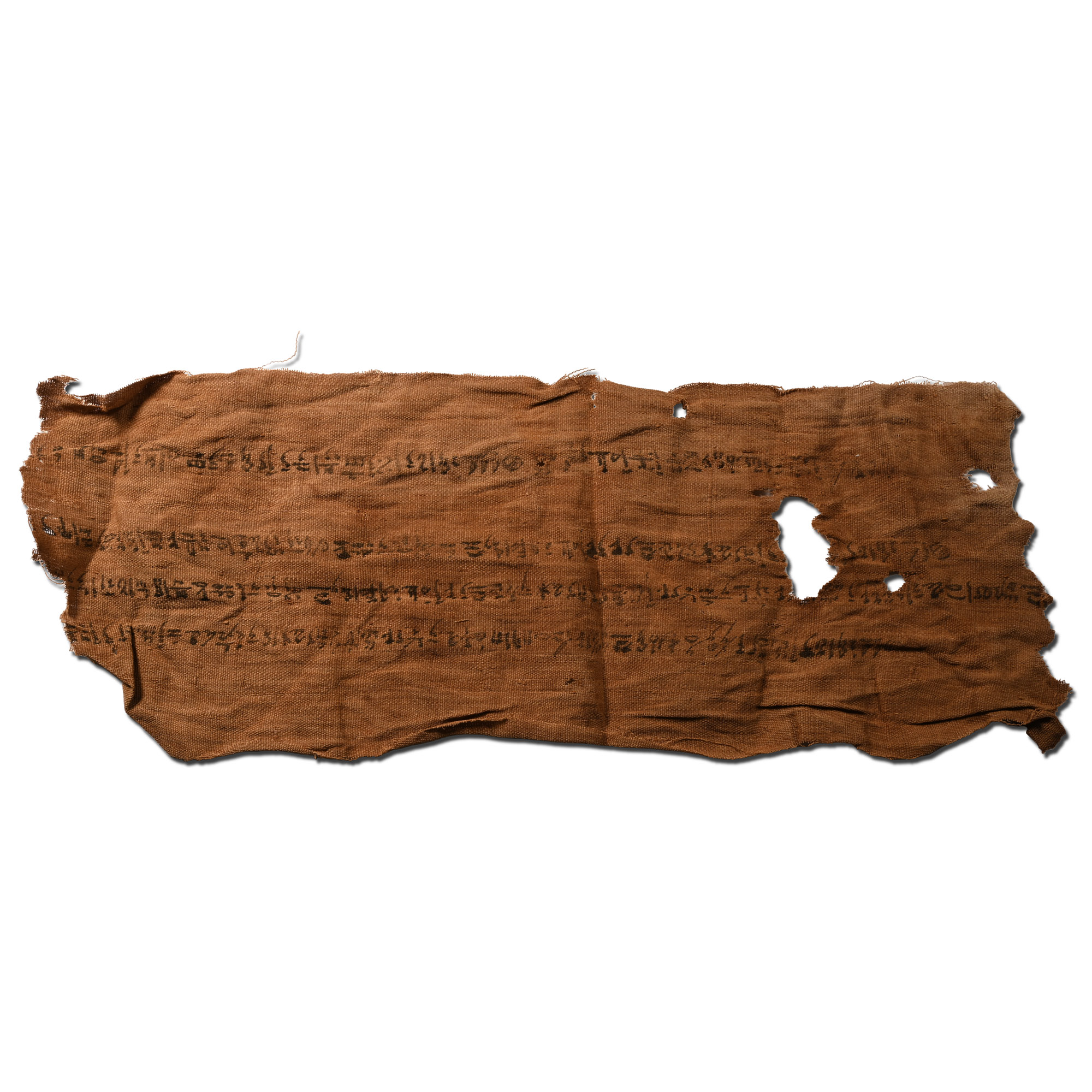
Egyptian Mummy Shroud Section with Hieratic Text
LATE-PTOLEMAIC PERIOD, CIRCA 480-30 B.C.
12 5/8 in. (8 grams, 32 cm).
A rectangular section of woven linen textile featuring four lines of neat hieratic text in black.
ProvenanceFrom the collection of a gentleman, acquired on the London art market in the 1990s.
This lot is accompanied by an illustrated lot declaration signed by the Head of the Antiquities Department, Dr Raffaele D'Amato.
Cf. A. De Caluwe, A., Un "Livre des Morts" sur bandelette de momie, Brussels, 1991, for a discussion of the longest known mummy bandage.
FootnotesFrom the fifth century B.C., mummy wrappings for the affluent frequently display lines of hieratic script—a cursive variant of Egyptian hieroglyphs used for both daily and religious writings. These often include excerpts from funerary texts like the Book of the Dead, along with prayers and invocations designed to safeguard and guide the deceased in the afterlife. These texts, sometimes accompanied by vignettes, were inscribed directly on the linen strips before or during the mummification process. Some of these bandages could be remarkably long; one example from Brussels, measuring only 6.2 cm in width, spans an incredible 26 metres.
CONDITIONTimeLine Auctions follows a vetting process to ensure the authenticity and legality of all items, reinforcing our commitment to integrity and responsible trading. Each antiquity, antique, and coin lot undergoes thorough examination by a vetting committee of at least ten external specialists, professional trade association members, scientists, and archaeologists: Our Vetting Process
AUCTIONS:
TimeLine is a leading auction house specialising in antiquities, ancient art, collectables, natural history, coins, medals, and books. Our auctions offer museums, collectors, historians, and enthusiasts the opportunity to acquire unique and historically significant pieces.
-
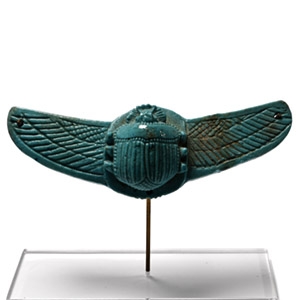
Egyptian Blue Faience Scarab
Late Period, 7th-6th century B.C.Sold for (Inc. bp): £4,550
Comprising a crescentic plaque with central scarab modelled in the half-round, and lateral wings with hatched texturing; scarab with ribbing and other detailing; pierced in four places for attachment; accompanied by a custom-made stand. 22.3 grams, 10 cm wide (44 grams total, 10 cm wide including stand)
Acquired in the 1950-1990s. Mr C., Geneva, Switzerland. Private collection, Europe. This lot has been checked against the Interpol Database of stolen works of art and is accompanied by a search certificate number no.12592-232170. This lot has been cleared against the Art Loss Register database, and is accompanied by an illustrated lot declaration signed by the Head of the Antiquities Department, Dr Raffaele D'Amato.
Winged scarabs were thought to ensure the rebirth and regeneration of the deceased, making them popular funerary amulets. This is a particularly fine example of a rarer one-piece amulet, as they are usually made from three separate elements. -
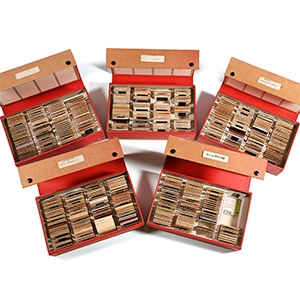
Historic Collection of 561 Slides of Archaeological Objects From Egypt
1960s-1980s A.D.Sold for (Inc. bp): £702
Housed in five linen-covered boxes, covering objects from the Old Kingdom, royal sculpture, general sculpture, and amulets, etc. 3.78 kg total, 26.5 x 16.5 x 6.5 cm each box
Property of archaeologist Stephanie Gee, N.W. London, UK, 1960s-1980s. This lot is accompanied by an illustrated lot declaration signed by the Head of the Antiquities Department, Dr Raffaele D'Amato.
Stephanie Gee was a prominent archaeologist who took part in several expeditions in Egypt. She was a trusted assistant to the British-Australian archaeologist Veronica Seton-Williams, who excavated in Egypt, Britain, and the Near East. Stephanie also took part in the Tell El-Farâ'în expeditions of 1965-1968, and assisted Seton-Williams with preparing the 1966 expedition report. Their collaboration continued and Stephanie helped with the manuscript of Seton-Williams’ book ‘The Road to El-Aguzein’, a narrative account of her life that was first published in 1988. -
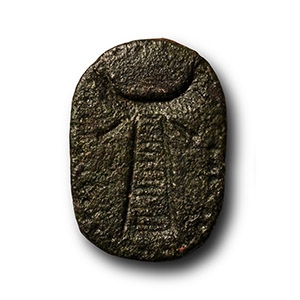
Phoenicio-Egyptian Dark Green Stone Scarab
Circa 9th-8th century B.C.Estimate: £200 - 280 (+bp*)
Opening Bid: £111
With textured carapace, bull-horned column to the reverse, possibly a symbol of Tanit. 3.94 grams, 15 mm
From the property of the late Mr SM, London, UK, 1969-1999. This lot is accompanied by an illustrated lot declaration signed by the Head of the Antiquities Department, Dr Raffaele D'Amato.
The widespread adoption of the scarab, both as a symbol linked to the concept of rebirth, and in its function as a seal, exemplifies the extent of Egyptian influence on Phoenician culture, from its origins in the Levant to its spread across the Mediterranean.
