
Loading, please wait...
LOT 0478
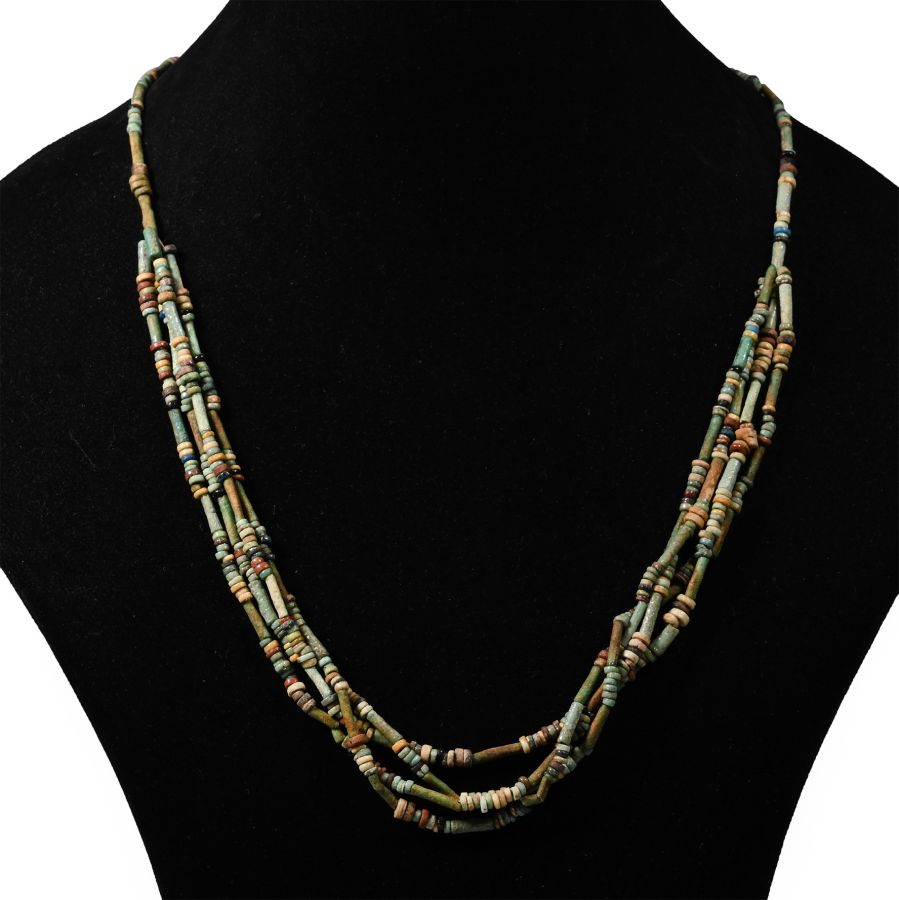
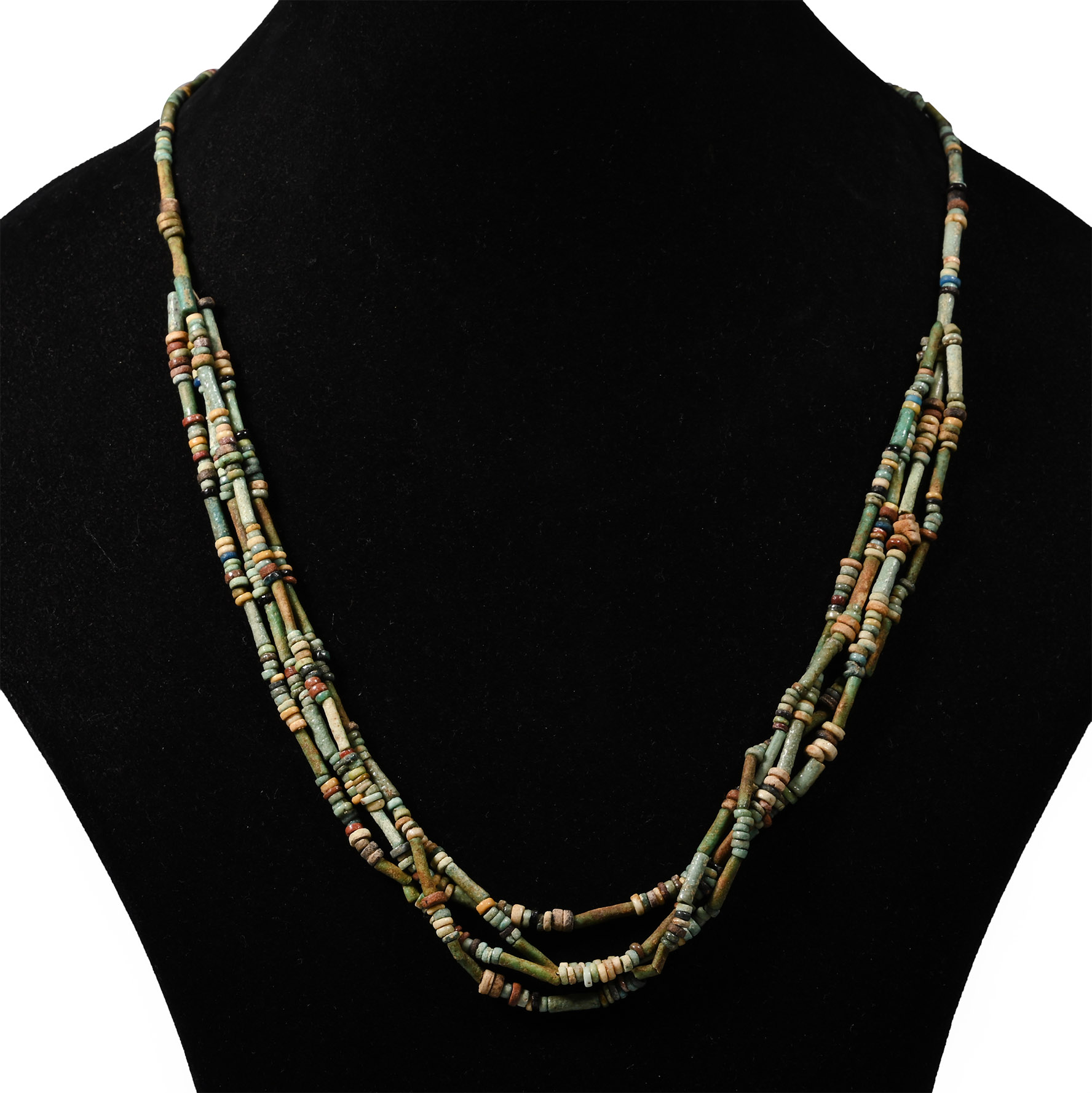
Egyptian Multi-Stranded Mummy Bead Necklace
LATE PERIOD, 664-332 B.C.
26 3/8 in. (21 grams, 67 cm).
Four-stranded designer necklace composed of beads of mainly annular and tubular types. [No Reserve]
ProvenanceAcquired before 1979.
From the private collection of Mr F.A., South Kensington, London, UK; thence by descent 2014.
This lot is accompanied by an illustrated lot declaration signed by the Head of the Antiquities Department, Dr Raffaele D'Amato.
Cf. similar specimens in faience at the Worcester Art Museum, inventory no.1925.539.
FootnotesFor thousands of years, artisans in Egypt created vibrant ceramics to echo the beauty of rare jewels. These ornaments were created with almost every material, colour, and texture imaginable and they come from across Egypt and beyond: vibrant blue lapis lazuli from Afghanistan, glossy black obsidian from Turkey, and aqua-green turquoise from the Sinai. They were worn in life and, after death, they served as precious ornamentation for mummies.
CONDITIONTimeLine Auctions follows a vetting process to ensure the authenticity and legality of all items, reinforcing our commitment to integrity and responsible trading. Each antiquity, antique, and coin lot undergoes thorough examination by a vetting committee of at least ten external specialists, professional trade association members, scientists, and archaeologists: Our Vetting Process
AUCTIONS:
TimeLine is a leading auction house specialising in antiquities, ancient art, collectables, natural history, coins, medals, and books. Our auctions offer museums, collectors, historians, and enthusiasts the opportunity to acquire unique and historically significant pieces.
-
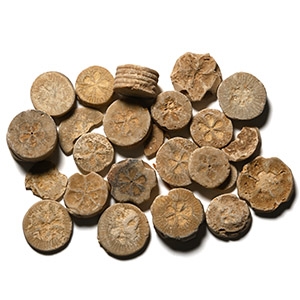
Egyptian Limestone Floral Inlay Group
Roman Period, 30 B.C.-323 A.D. or earlierSold for (Inc. bp): £104
Group of cylindrical and discoid inlay plaques or gaming counters, crinoids with cinquefoil motif. 48.8 grams total, 12-20 mm
From a central London ADA dealership, 1980-1990. This lot is accompanied by an illustrated lot declaration signed by the Head of the Antiquities Department, Dr Raffaele D'Amato.
Flowers were symbolic of rebirth due to the daily reopening of their petals after nightfall. As a result, they were widely used in domestic settings, religious and funerary contexts, and as adornments. Similar rosette discs, like those recovered from the Ramesside Period palace at Qantir, were used as decorative elements in royal palaces. -
.jpg)
Egyptian Gold Uraeus Amulet
Late New Kingdom, 1279-1070 B.C.Estimate: £200 - 300 (+bp*)
Opening Bid: £111
Depicting a rearing cobra sporting a sun disc with its coiled body below resting on the hieroglyphic neb sign. 0.38 grams, 11 mm
From an early 20th century French collection. This lot is accompanied by an illustrated lot declaration signed by the Head of the Antiquities Department, Dr Raffaele D’Amato. This lot is accompanied by an illustrated lot declaration signed by the Head of the Antiquities Department, Dr Raffaele D'Amato. -
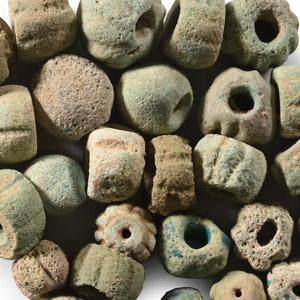
Romano-Egyptian Faience Melon Bead Collection
2nd-1st century B.C.Sold for (Inc. bp): £33
Comprising thirty green and blue beads in various sizes. 42 grams total, 8-18 mm
Ex H. Norry collection, Milton Keynes, UK, 1980s-1990s. This lot is accompanied by an illustrated lot declaration signed by the Head of the Antiquities Department, Dr Raffaele D'Amato.
