
Loading, please wait...
LOT 0510
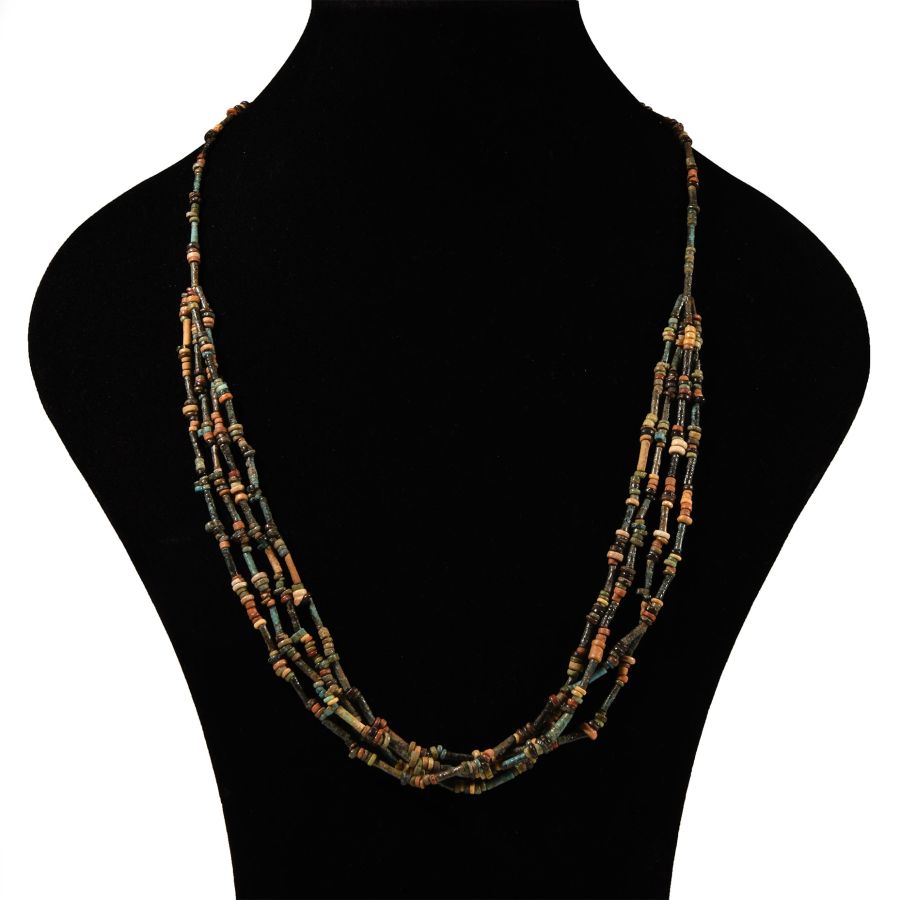
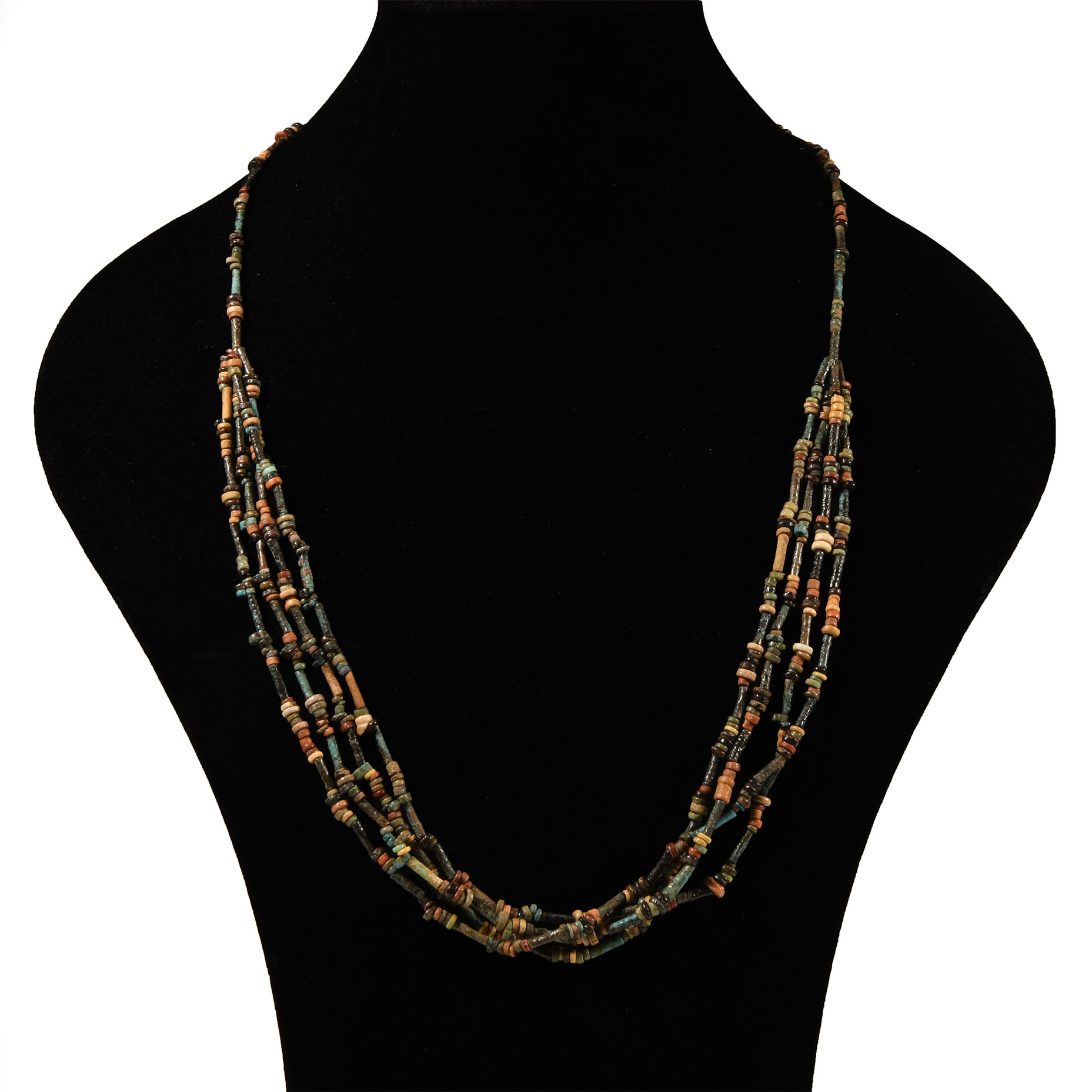
Egyptian Multi-Stranded Mummy Bead Necklace
LATE PERIOD, 664-332 B.C.
29 1/8 in. (21 grams, 74 cm).
Multi-stranded designer necklace composed of beads of mainly annular and tubular types. [No Reserve]
ProvenanceAcquired before 1979.
From the private collection of Mr F. A., South Kensington, London, UK; thence by descent 2014.
Cf. similar specimens in faience at the Worcester Art Museum, inventory no.1925.539.
FootnotesFor thousands of years, artisans in Egypt created vibrant ceramics to echo the beauty of rare jewels. These ornaments were created with almost every material, colour, and texture imaginable and they come from across Egypt and beyond: vibrant blue lapis lazuli from Afghanistan, glossy black obsidian from Turkey, and aqua-green turquoise from the Sinai. They were worn in life and, after death, they served as precious ornamentation for mummies.
CONDITIONTimeLine Auctions follows a vetting process to ensure the authenticity and legality of all items, reinforcing our commitment to integrity and responsible trading. Each antiquity, antique, and coin lot undergoes thorough examination by a vetting committee of at least ten external specialists, professional trade association members, scientists, and archaeologists: Our Vetting Process
AUCTIONS:
TimeLine is a leading auction house specialising in antiquities, ancient art, collectables, natural history, coins, medals, and books. Our auctions offer museums, collectors, historians, and enthusiasts the opportunity to acquire unique and historically significant pieces.
-
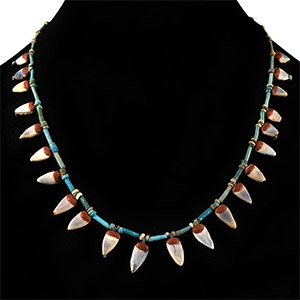
Egyptian Amarna Period Beaded Fruit Necklace
18th Dynasty, 1332-1346 B.C.Sold for (Inc. bp): £598
Restrung necklace of annular and tabular beads with fructiform amulets. 13.1 grams, 44 cm
Ex London, UK, collection, 1990s.
Petal-shaped beads of faience and glass were widely used in jewellery during the Amarna Period. During this era, advanced production methods enabled the creation of bi-chrome and polychrome designs, which often included newly developed colours. This resulted in vibrant necklaces that resembled festive collars made of natural floral elements. -
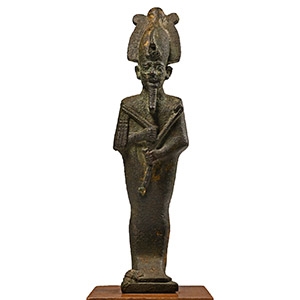
Egyptian Bronze Figure of Osiris
Late Period, 664-332 B.C.Sold for (Inc. bp): £5,980
Solid cast mummiform figure standing on an integral plinth; the god cloaked in a tight-fitting shroud, sporting the ostrich-plumed atef crown with uraeus, divine beard, and holding the characteristic crook and flail regalia; traces of gilding remain; mounted on a custom-made display stand. 811 grams total, 21 cm including stand
Private collection, 19th century, thence by descent. Private collection, Neuchâtel. This lot has been checked against the Interpol Database of stolen works of art and is accompanied by search certificate number no.12195-222135.
Osiris is a deity who represents death and fertility and is commonly regarded as the quintessential god of rebirth. Though he was once a mortal ruler, as a deceased entity, his domain was the Underworld. Abydos was the primary centre of Osiris’s cult, where a renowned yearly celebration of the god was held. -
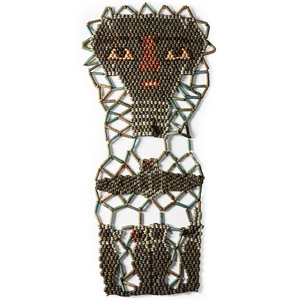
Egyptian Faience Mummy Bead Mask with Scarab and Four Sons of Horus
Ptolemaic Period, 332-30 B.C.Sold for (Inc. bp): £316
A netted beadwork panel of annular and tubular glazed composition beads in blues, greens, black, cream and red-brown colours, depicting a mummy face mask with false beard, a scarab with extended wings below, the 'Four Sons of Horus’ beneath the scarab, joined together with areas of open netting of tubular beads; restrung with some later beads. 58 grams, 25.5 cm
Ex Mariaud de Serres, Paris, France, 1980-1990s. From a London, UK, collection.
Winged scarabs were often used as funerary amulets and believed to symbolise the deceased's rebirth and regeneration. The Four Sons of Horus were deities responsible for protecting the deceased's internal organs. Here, on the left, is the baboon-headed Hapy, protector of the lungs, then the human-headed Imsety, protector of the liver, followed by the falcon-headed Qebehsenuef, who protects the intestines and, finally, the jackal-headed Duamutef on the right (note his erect ears are indicated), who protected the stomach. These internal organs were often placed in canopic jars with the head of the respective Son of Horus. Amulets depicting these deities were placed within the mummy wrappings.
