
Loading, please wait...
LOT 0413
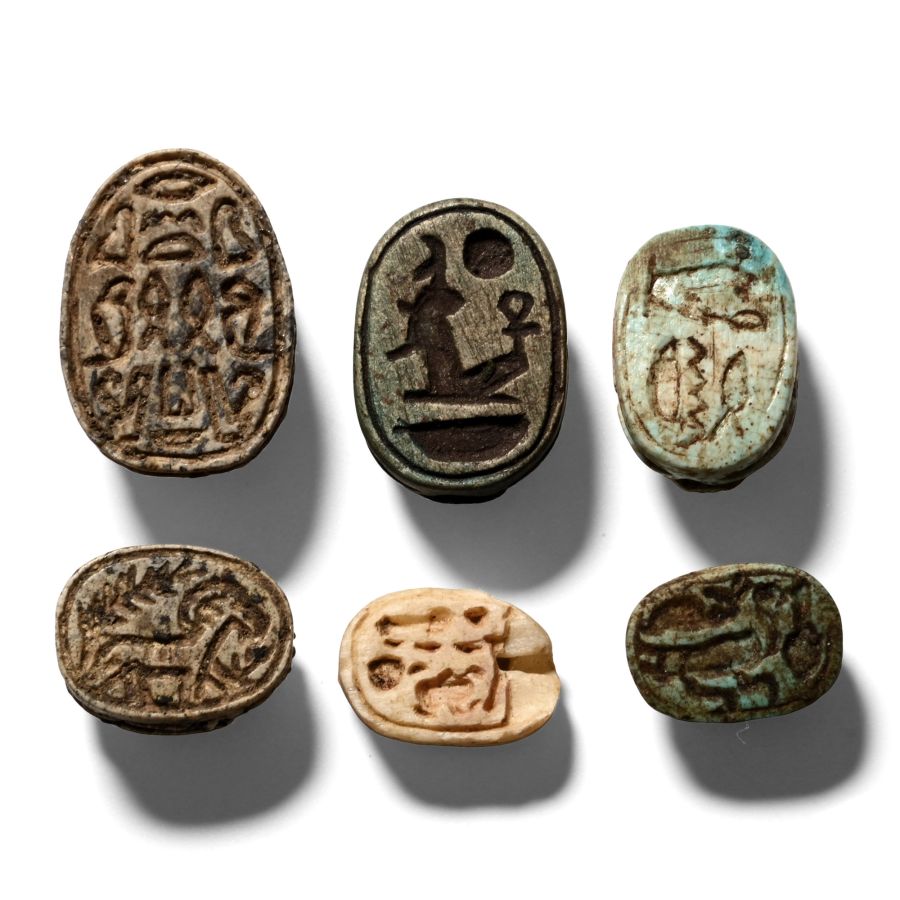
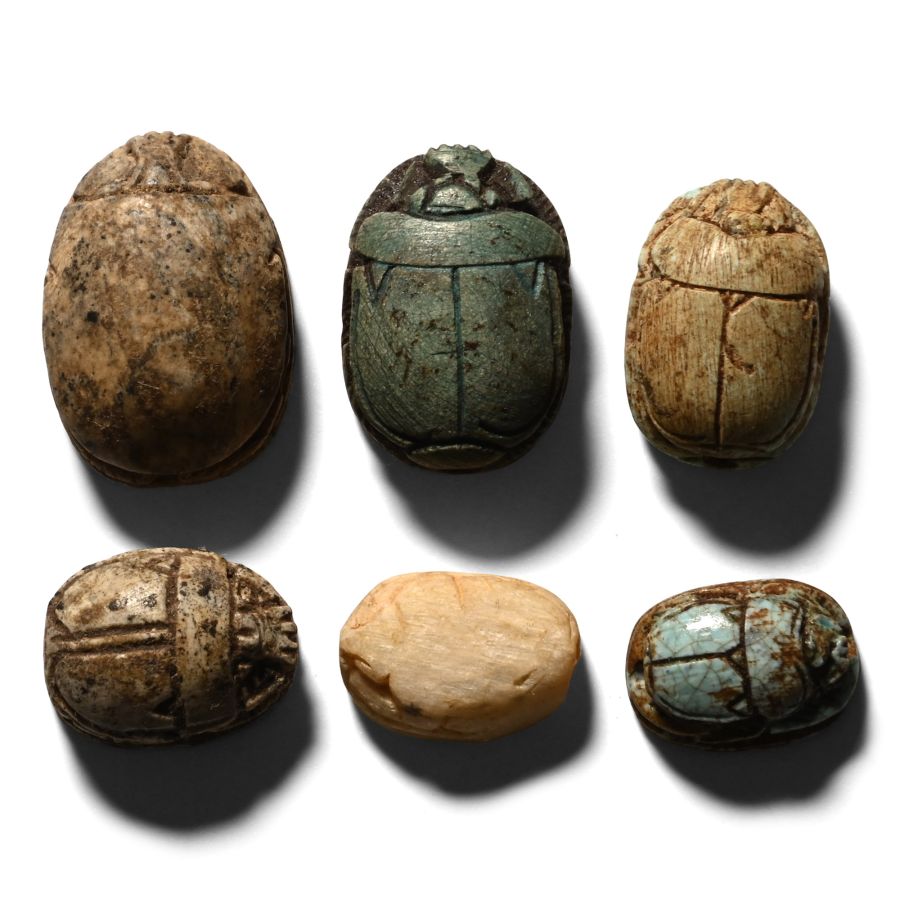
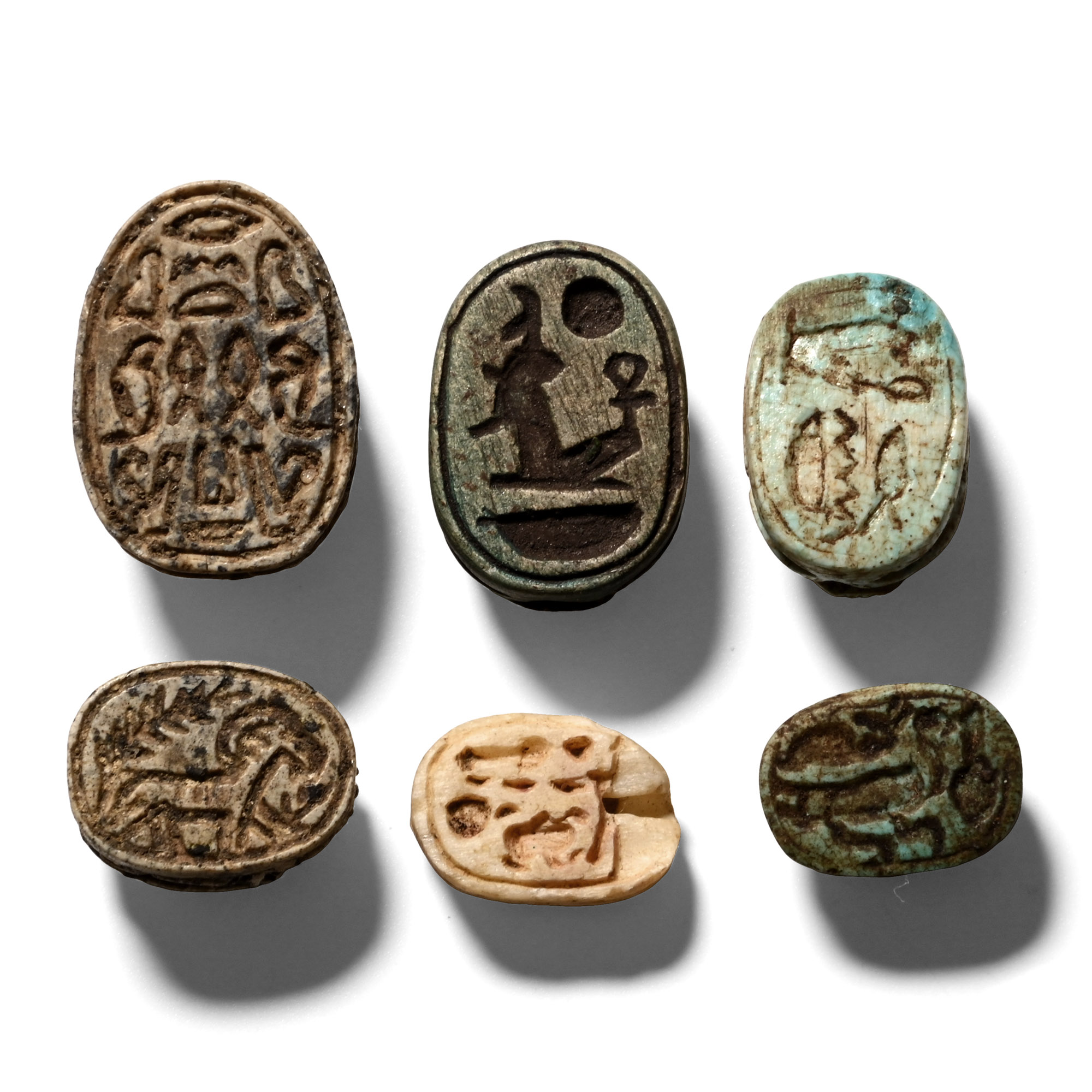
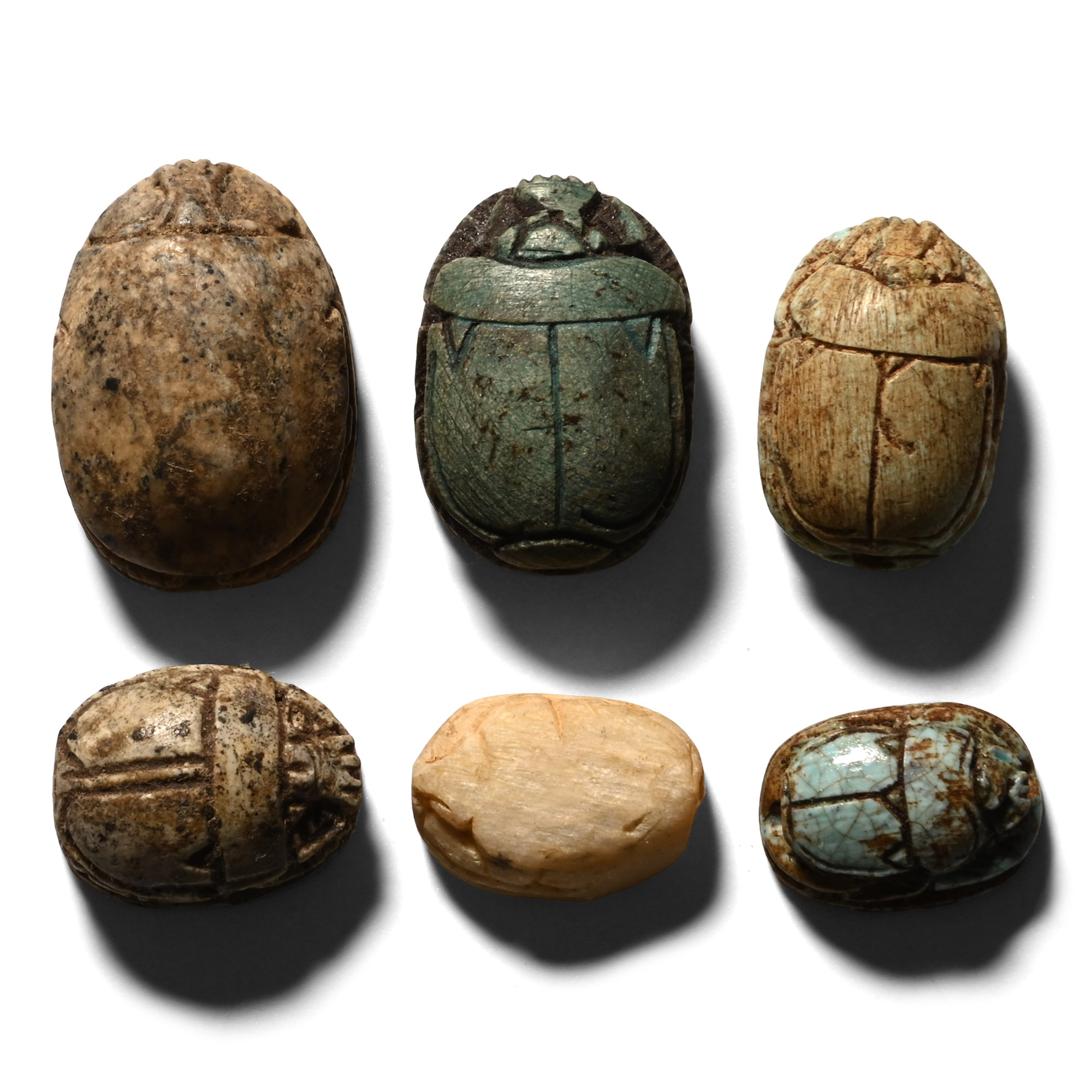
Egyptian Mixed Scarab Collection
2ND-1ST MILLENNIUM B.C.
1/2 - 7/8 in. (19.5 grams total, 14-23 mm).
Comprising (from left to right and top to bottom): 1) a scarab with an oval border containing, on either side, a maat feather, rearing cobra, and Dual Crown flanking a central column composed of ‘r’–‘n’–‘r’- sa (x2)-ka-neb signs; 2) a scarab with an oval border containing the throne name of pharaoh Amenhotep III (Neb-Maat-Re); 3) a scarab with an oval border containing a seated deity holding an ankh sign, facing sa, water, and neb signs; 4) a scarab with an oval border containing a running ibex surrounded by foliage; 5) a scarab with partially preserved design that gives the throne name of pharaoh Akhenaten (Nefer-kheperu-Re); 6) a scarab with an oval border containing a viper, duck and nefer signs. [7]
ProvenanceFrom the collection of a gentleman, acquired on the London art market in the 1990s.
This lot is accompanied by an illustrated lot declaration signed by the Head of the Antiquities Department, Dr Raffaele D'Amato.
Cf. 1) Ben-Tor, D., Scarabs, Chronology, and Interconnections: Egypt and Palestine in the Second Intermediate Period, Fribourg/Göttingen, 2007, pl. 56, no. 44, for a design incorporating the same three-sign border motif and a central sign group column; 2) Petrie, W.M.F., Scarabs and Cylinders with Names, London, 1917, pl. XXXIV, nos. 87-88, for the same design; 3) Newberry, P.E., Catalogue général des antiquités égyptiennes du Musée du Caire N° 36001-37521, Scarab-shaped Seals, Cairo, 1907, pl. XIV, no. 36571, for a motif using a horizontal sa sign; 4) Matouk, F.S., Corpus du scarabée égyptien. Vol. 2: Analyse thématique, Beirut, 1976, p. 387, no. 711, for a similar motif; 5) Petrie, W.M.F., Scarabs and Cylinders with Names, London, 1917, pl. XXXVI, no. 25, for comparable arrangement of signs making the name; 6) Newberry, P.E., Catalogue général des antiquités égyptiennes du Musée du Caire N° 36001-37521, Scarab-shaped Seals, Cairo, 1907, pl. VIII, no. 36426, for a similar design theme.
CONDITIONTimeLine Auctions follows a vetting process to ensure the authenticity and legality of all items, reinforcing our commitment to integrity and responsible trading. Each antiquity, antique, and coin lot undergoes thorough examination by a vetting committee of at least ten external specialists, professional trade association members, scientists, and archaeologists: Our Vetting Process
AUCTIONS:
TimeLine is a leading auction house specialising in antiquities, ancient art, collectables, natural history, coins, medals, and books. Our auctions offer museums, collectors, historians, and enthusiasts the opportunity to acquire unique and historically significant pieces.
-
Egyptian Scarab and Amulet Group
Late Period, 664-332 B.C.Sold for (Inc. bp): £59
Comprising: a scarab with anatomical detailing to the carapace, underside with a crocodile and two quadrupeds; a rectangular Eye of Horus amulet with domed upper face. 3.04 grams total, 14-16 mm
Norfolk family collection, 1940s-1960s; thence by descent. This lot is accompanied by an illustrated lot declaration signed by the Head of the Antiquities Department, Dr Raffaele D'Amato. -
Egyptian Faience Crocodile Amulet
Late-Ptolemaic Period, 664-30 B.C.Sold for (Inc. bp): £2,600
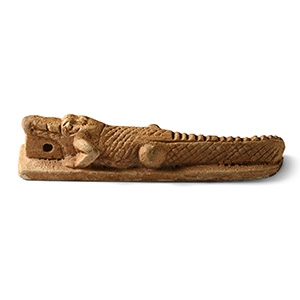
Representing the god Sobek; detailed face and scales; standing on a rectangular plinth; pierced to the front for suspension. 13.4 grams, 74 mm
From the estate of the late Professor Dr E. Bernardo Streiff, Geneva; a distinguished collection of antiquities formed during the 1950s-1970s. with Galerie Rhéa, Zurich, Switzerland. This lot has been checked against the Interpol Database of stolen works of art and is accompanied by a search certificate number no.12629-236404. This lot has been cleared against the Art Loss Register database, and is accompanied by an illustrated lot declaration signed by the Head of the Antiquities Department, Dr Raffaele D'Amato.
Sobek is one of the most ancient and fascinating deities in the Egyptian pantheon. He is typically depicted as a crocodile or a man with the head of a crocodile, embodying various attributes related to the natural world, power, and protection. Sobek was mainly associated with water, fertility, and the Nile, along with strength and military prowess. His worship extends throughout much of ancient Egyptian history, and he was venerated not only as a force of nature but also as a god of healing, protection, and royal authority. His principal cult centres were situated in the Faiyum region, particularly the city of Crocodilopolis, and also at Kom Ombo in Upper Egypt. -
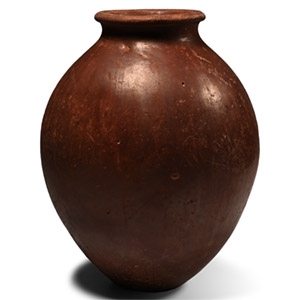
Egyptian Predynastic Globular Flask
Naqada II, 3500-3150 B.C.Sold for (Inc. bp): £1,040
A globular-shaped body with a disc base, short neck, and everted rim at the mouth; featuring a burnished red wash surface. 925 grams, 21 cm
Private collection. with Bonhams, London, 22 September 1998, no.130. European private collection. This lot is accompanied by an illustrated lot declaration signed by the Head of the Antiquities Department, Dr Raffaele D'Amato.
