
Loading, please wait...
LOT 0483
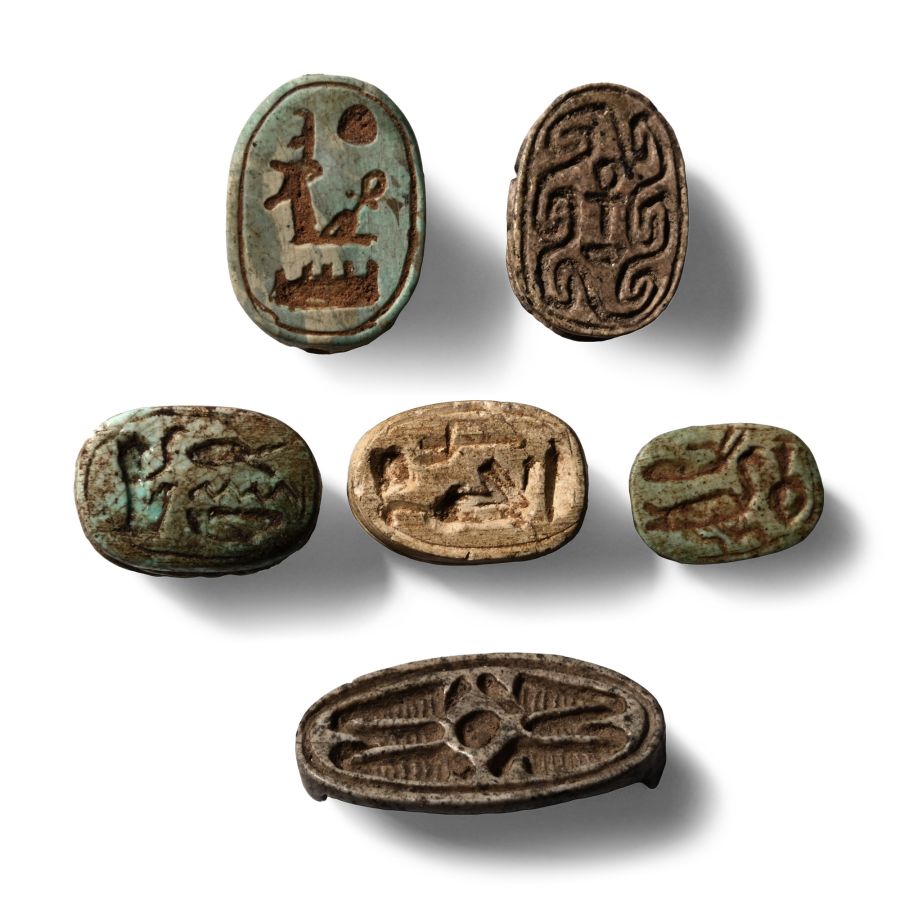
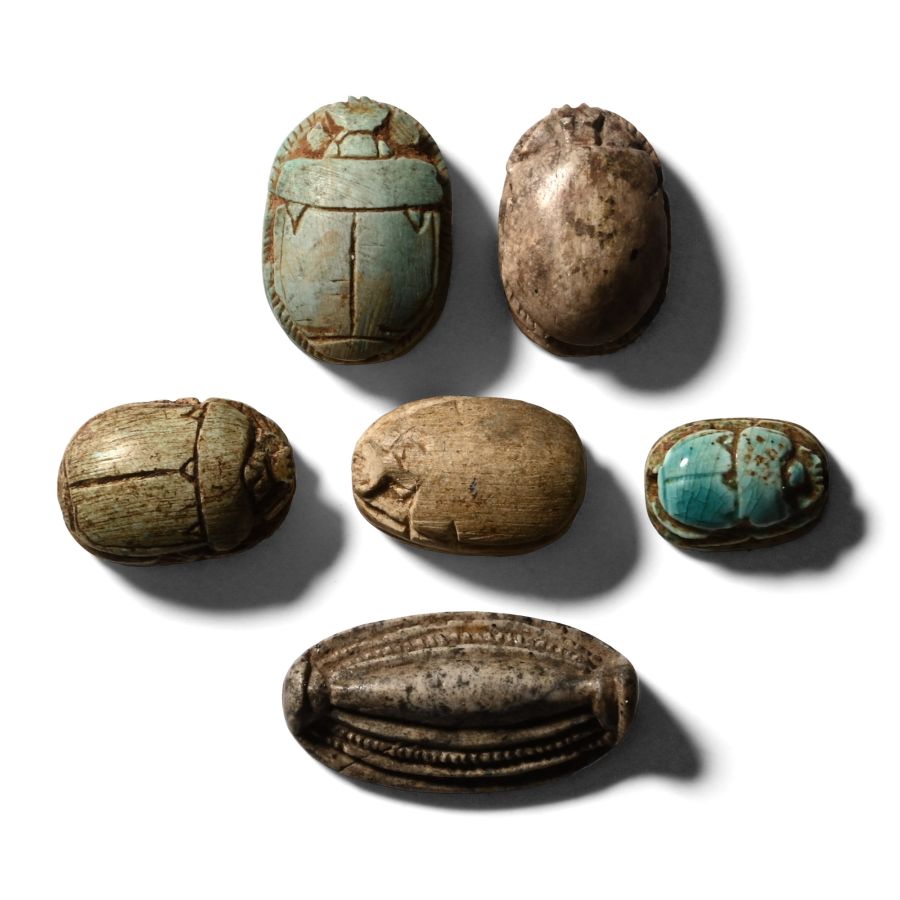
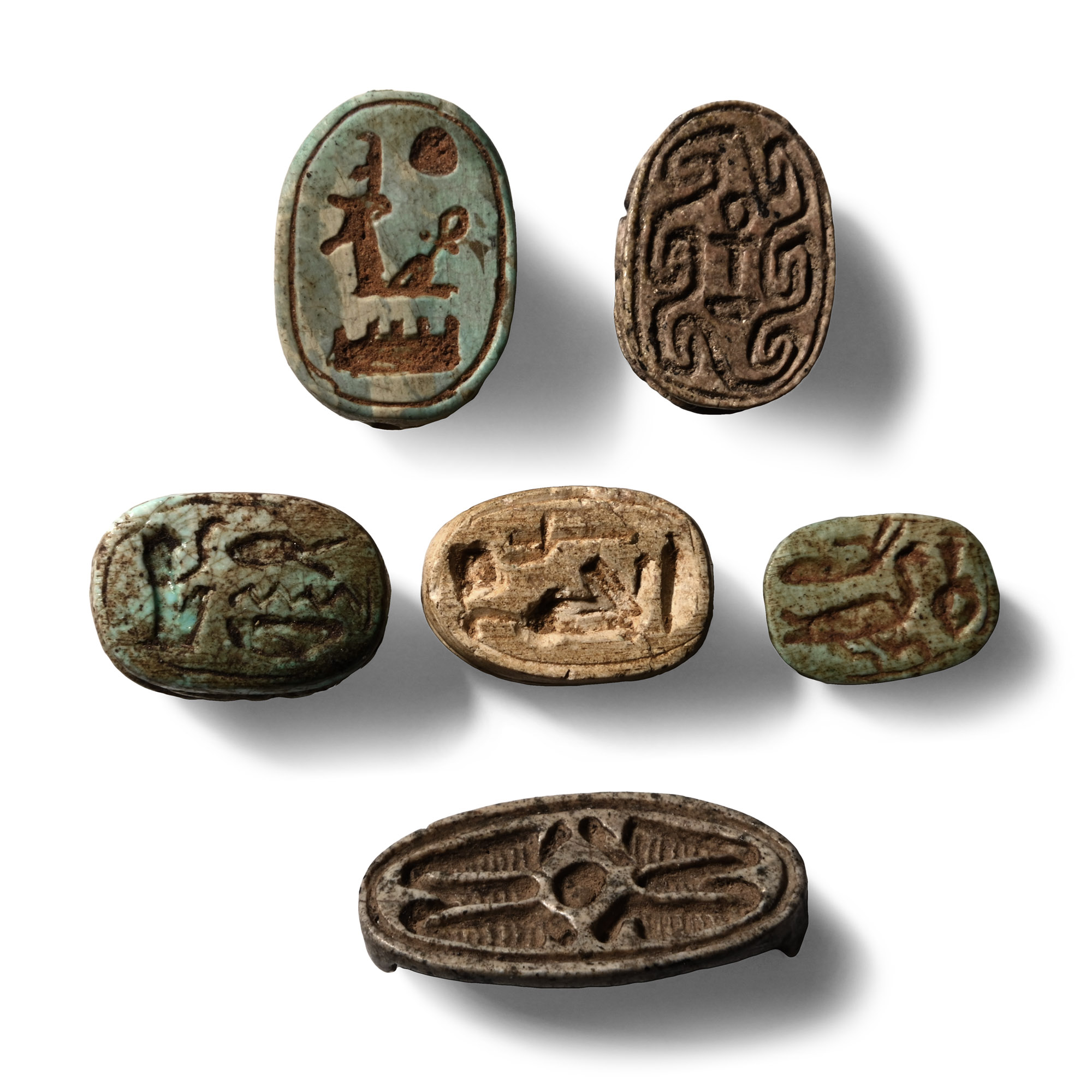
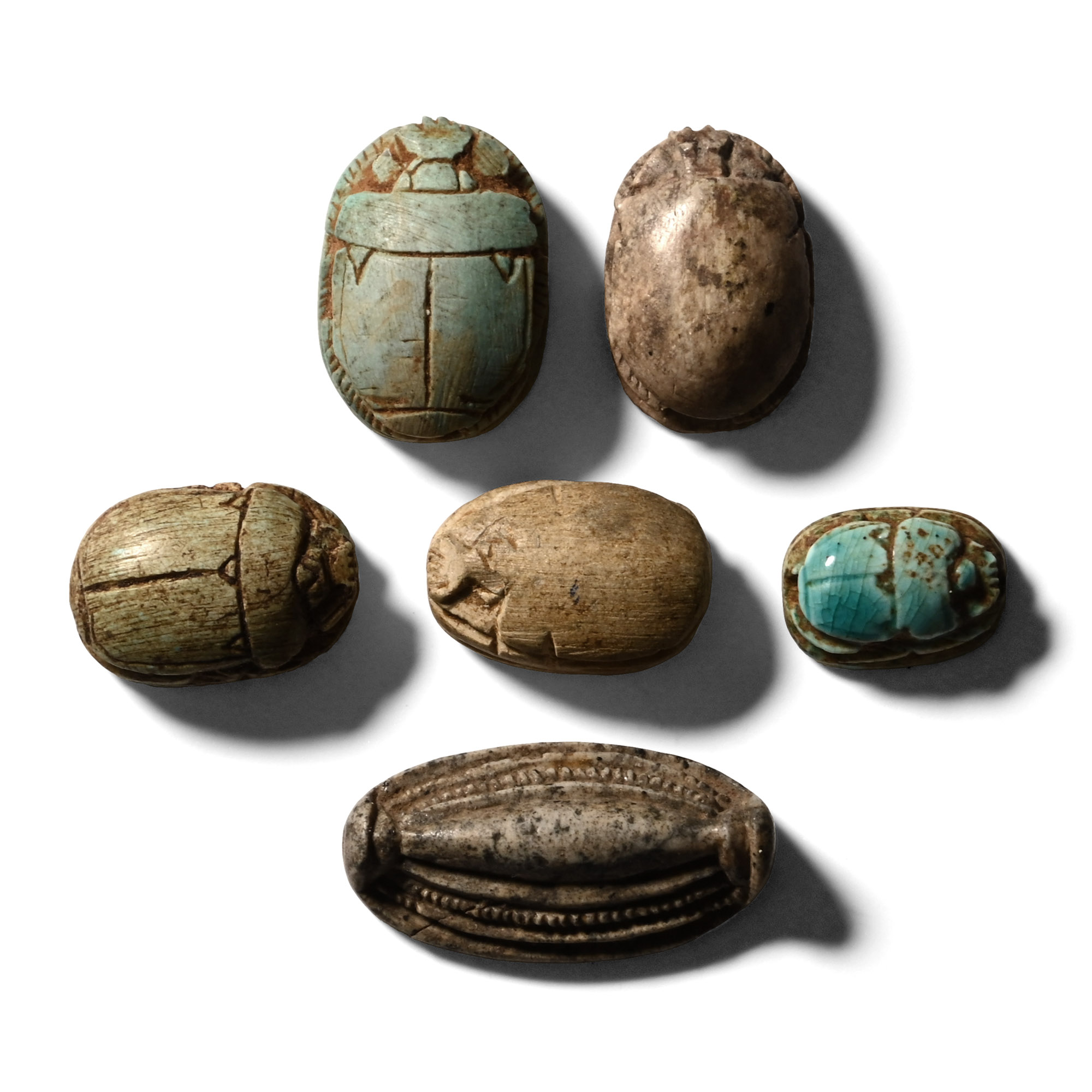
Egyptian Mixed Scarab Collection
2ND-1ST MILLENNIUM B.C.
1/2 - 1 in. (18.64 grams total, 14-27 mm).
Comprising (from left to right, top to bottom): 1) a scarab with an oval border containing the throne name of the 19th Dynasty pharaoh, Seti I (Men-Maat-Re); 2) a scarab with an oval outer border containing a continuous oblong scroll border framing a neb and ankh symbol; 3) a scarab with an oval border containing a seated adorant before a sa, water, and neb symbol; 4) a scarab with an oval border containing the throne name of the 19th Dynasty pharaoh, Ramesses II (User-Maat-Re), atop a neb sign; 5) a scarab with two signs, possibly representing the word for ‘bread’ above a goose, with a beer jar in front; 6) and a scaraboid with a stretched oval border containing mirrored pairs of rearing cobras surrounding a central sun disc. [6]
ProvenanceFrom the collection of a gentleman, acquired on the London art market in the 1990s.
This lot is accompanied by an illustrated lot declaration signed by the Head of the Antiquities Department, Dr Raffaele D'Amato.
Cf. 1) Petrie, W.M.F., Scarabs and Cylinders with Names, London, 1917, pl. XXXIX, no.24, for similar; 2) Ben-Tor, D., Scarabs, Chronology, and Interconnections: Egypt and Palestine in the Second Intermediate Period, Fribourg/Göttingen, 2007, pl. 15, Design class 7A2, for this late Middle Kingdom type; 3) Newberry, P.E., Catalogue général des antiquités égyptiennes du Musée du Caire N° 36001-37521, Scarab-shaped Seals, Cairo, 1907, pl. XIV, no. 36571, for a motif using a horizontal sa sign; 4) Petrie, W.M.F., Scarabs and Cylinders with Names, London, 1917, pl. XLI, no. 98, for similar; 5) Matouk, F.S., Corpus du scarabée égyptien. Vol. 2: Analyse thématique, Beirut, 1976, p. 393, nos. 1029-1039, for examples of scarab motifs incorporating a duck and other symbols; 6) Petrie, W.M.F., Button and Design Scarabs, London, 1925, pl. XXX, no. 67, for a similar mirrored cobra motif.
CONDITIONTimeLine Auctions follows a vetting process to ensure the authenticity and legality of all items, reinforcing our commitment to integrity and responsible trading. Each antiquity, antique, and coin lot undergoes thorough examination by a vetting committee of at least ten external specialists, professional trade association members, scientists, and archaeologists: Our Vetting Process
AUCTIONS:
TimeLine is a leading auction house specialising in antiquities, ancient art, collectables, natural history, coins, medals, and books. Our auctions offer museums, collectors, historians, and enthusiasts the opportunity to acquire unique and historically significant pieces.
-
Egyptian Mummy Shroud Section with Hieratic Text
Late-Ptolemaic Period, circa 480-30 B.C.Sold for (Inc. bp): £715
A narrow strip of woven linen textile featuring two lines of neatly written hieratic text in black. 3.74 grams, 40 cm
From the collection of a gentleman, acquired on the London art market in the 1990s. This lot is accompanied by an illustrated lot declaration signed by the Head of the Antiquities Department, Dr Raffaele D'Amato.
From the fifth century B.C., mummy wrappings often feature hieratic script—a cursive form of Egyptian hieroglyphs used for daily and religious texts. These include excerpts from funerary works like the Book of the Dead, alongside prayers meant to protect the deceased in the afterlife. Often with vignettes, these texts were inscribed directly on linen strips during the mummification. Some bandages were notably long; one from Brussels, 6.2 cm wide, measures an incredible 26 metres. -
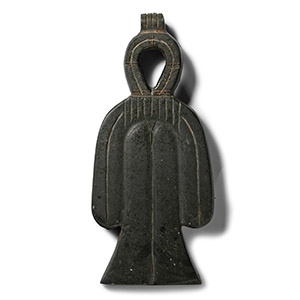
Egyptian Stone Tyet Amulet
Third Intermediate Period-Late Period, circa 743-332 B.C.Sold for (Inc. bp): £1,300
Finely carved tyet amulet with incised internal detailing and ribbed suspension loop at the top. 38.9 grams, 81 mm
Acquired in the mid 1980s-1990s. Private collection, Switzerland, thence by descent. Private collection, since the late 1990s. This lot is accompanied by an illustrated lot declaration signed by the Head of the Antiquities Department, Dr Raffaele D'Amato.
The tyet amulet was associated with the goddess Isis and was often referred to as the 'knot' or 'girdle' of Isis. Some believe that it represents a bandage used to absorb menstrual blood. It was commonly placed within the mummy wrappings on the upper torso of the deceased, with the belief that it would invoke Isis' protection and safeguard the body, thus ensuring their rebirth in the afterlife. -
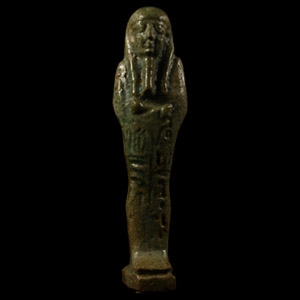
Egyptian Faience Shabti for Hor-sa-Iset
Late Period, circa 4th century B.C.Sold for (Inc. bp): £975
Of mummiform type, wearing a tripartite wig and long plaited divine beard; holding a pick in the left hand, a hoe in the right, and the cord of a seed bag hanging over his left shoulder; standing on an integral plinth, a plain back pillar terminating at the base of the wig; two vertical panels of hieroglyphic inscription to the front, including dedication: sḥḏ wsỉr ḥr sꜢ Ꜣst, ‘The illuminated, the Osiris, Hor-sa-Iset’; mounted on a custom-made display stand. 124 grams, 15.2 cm
Jacques René Fiechter, Switzerland (1920-1950). with Auction Martin, Egyptian collection of André Bircher, 1949. with Cahn Auktionen AG, Basel, 5 November 2011, no.20. Private collection, Europe. Accompanied by copies of the relevant Cahn catalogue pages. This lot is accompanied by an illustrated lot declaration signed by the Head of the Antiquities Department, Dr Raffaele D'Amato.
