
Loading, please wait...
_900x900.jpg "Egyptian Mixed Bead Group")
_200x200.jpg "Egyptian Mixed Bead Group")
.jpg "Egyptian Mixed Bead Group")
LOT 0485
Egyptian Mixed Bead Group
CIRCA 2ND MILLENNIUM B.C. AND LATER
1/8 - 1 1/4 in. (248 grams total, 4-33 mm).
Comprising various types, composition, sizes and colours, including: glass; calcite; steatite; shell; obsidian; peridot; carnelian; pink limestone; faience and rock crystal; some examples taking zoomorphic and axe forms; some held in perspex collector boxes with inked inventory numbers; accompanied by a handwritten collector's label reading 'glass beads from the tombs near Joppa. 1897' and a more recent note handwritten in the lid of one presentation box: '4 glass beads from 'the tombs near Joppa' now in Tel Aviv-Yafo in Israel, collected in 1897 when part of Ottoman Empire. Gift from Miss C. Rawdin 1982'; also a faience baboon amulet. [29, No Reserve]
ProvenanceFound Joppa, 1897.
The property of Mr and Mrs P. R. of East Sussex.
Thence by descent to family members.
With an old dated label.
TimeLine Auctions follows a vetting process to ensure the authenticity and legality of all items, reinforcing our commitment to integrity and responsible trading. Each antiquity, antique, and coin lot undergoes thorough examination by a vetting committee of at least ten external specialists, professional trade association members, scientists, and archaeologists: Our Vetting Process
AUCTIONS:
TimeLine is a leading auction house specialising in antiquities, ancient art, collectables, natural history, coins, medals, and books. Our auctions offer museums, collectors, historians, and enthusiasts the opportunity to acquire unique and historically significant pieces.
-
.jpg)
Romano-Egyptian Glass Millefiori Face Bead
Circa 1st century A.D.Estimate: £500 - 700 (+bp*)
Opening Bid: £278
Spherical in form with an opaque yellow body with three face-cane slices and three chequerboard slices. 5.35 grams, 16 mm
Acquired 1969-1999. From the private collection of the late Mr S.M., London, UK, thence by descent. -
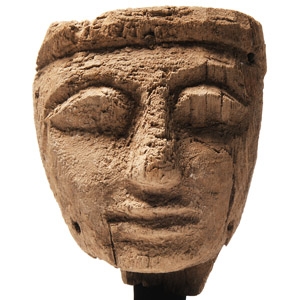
Egyptian Wooden Mask
Late Dynastic Period, after 500 B.C.Sold for (Inc. bp): £1,300
Wooden face from a coffin lid, D-shaped in plan with large almond-shaped eyes, holes for mounting pegs; accompanied by the original dealer's ticket from Phocion J. Tano of Cairo with handwritten description and signature 'Small masque of wood of the end of the Saïtic Period some four hundred years B.C. It is found close to the pyramid of Meïdun and it is genuine guaranteed and nothing ticked. It is as is found. Cairo the 14/4/65.'; mounted on a custom-made stand. 357 grams total, 20.8 cm high including stand
Ex Phocion J. Tano, Cairo, Egypt, 1965. Phocion Jean Tano (1898-1972) belonged to a family dynasty who founded and ran one of the oldest antiquities shops in Egypt, located in front of the old Shepheard's Hotel in Cairo. From a private UK family collection. Accompanied by an original handwritten and signed card receipt dated 14 April 1965 from Phocion J. Tano Antiquities Gallery, Cairo, Egypt. -
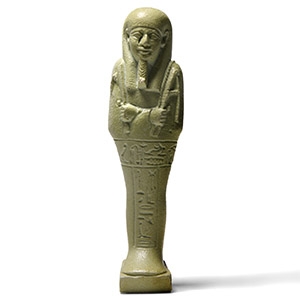
Egyptian Glazed Composition Shabti for Ka-Nefer
30th Dynasty, 380-343 B.C.Sold for (Inc. bp): £975
Modelled mummiform, hands crossed in front of chest holding pick and hoe, seed bag over shoulder, wearing tripartite wig and false beard, T-shaped arrangement of hieroglyphic inscription to the midriff and lower body; plinth base and plain back pillar to reverse. 78 grams, 12.2 cm high
Private collection, New York, USA, early 1980s.
The inscription informs us that Ka-nefer was a wener- priest and scribe of Ptah. His mother's name was Isit-reshuty. He was buried at Saqqara.
