
Loading, please wait...
_900x900.jpg "Egyptian Marble Head of a Queen")
_200x200.jpg "Egyptian Marble Head of a Queen")
.jpg "Egyptian Marble Head of a Queen")
LOT 0006
Egyptian Marble Head of a Queen
PTOLEMAIC PERIOD, 323-30 B.C.
4 in. (5 5/8 in.) (313 grams total, 10 cm high (14.3 cm high including stand)).
Modelled in the half-round in Hellenistic style with a stephane and centre-parted hair, serene facial features including hooded eyes and pert lips; mounted on a custom-made wooden display stand.
ProvenanceEx Hanna Saba collection, Ambassador to Egypt-USA-France (1909-1992).
Private European collection.
Accompanied by an academic report by Dr Raffaele D'Amato.
This lot has been checked against the Interpol Database of stolen works of art and is accompanied by a search certificate number no.12083-218194.
This lot has been cleared against the Art Loss Register database, and is accompanied by an illustrated lot declaration signed by the Head of the Antiquities Department, Dr Raffaele D'Amato.
See Walker S., Higgs, P., Cleopatra Regina d’Egitto, Milano, 2000; Walker, S., Higgs, P., Cleopatra of Egypt, from History to the Myth, London, 2001; for discussion see Berman, L.M., The Cleveland Museum of Art Catalogue of Egyptian Art, New York, 1999; Andrews, C., van Dijk, J., Objects for Eternity: Egyptian Antiquities from the W. Arnold Meijer Collection, Mainz am Rhein, 2006.
FootnotesThe head is similar to various portraits of Ptolemaic queens, some of them identified as belonging to the famous Berenice II (246-222 B.C.), some others to Cleopatra VII Philopator (69-30 BC), the lover of Julius Caesar, the spouse of Mark Anthony and the last Queen of Egypt. The analogies with Berenike II’s portrait are noteworthy, especially with the portrait in the Cairo Museum (inv.JE 39517): the diadem and its position on the top of the head, similar physical features, and similar roundness of the cheeks.
CONDITIONTimeLine Auctions follows a vetting process to ensure the authenticity and legality of all items, reinforcing our commitment to integrity and responsible trading. Each antiquity, antique, and coin lot undergoes thorough examination by a vetting committee of at least ten external specialists, professional trade association members, scientists, and archaeologists: Our Vetting Process
AUCTIONS:
TimeLine is a leading auction house specialising in antiquities, ancient art, collectables, natural history, coins, medals, and books. Our auctions offer museums, collectors, historians, and enthusiasts the opportunity to acquire unique and historically significant pieces.
LOT 0006
Egyptian Marble Head of a Queen
Estimate £1,800 - 2,400€2,090 - 2,780 (for guidance only)$2,430 - 3,240 (for guidance only)
-
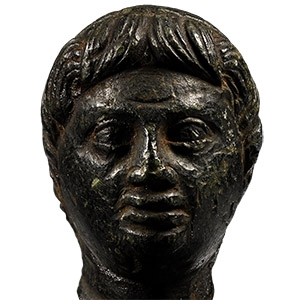
Egyptian Steatite Portrait of a Ptolemaic Prince
2nd-1st century B.C.Estimate: £3,000 - 4,000 (‡+bp*)
Opening Bid: £1,500
With a round face featuring large eyes, a narrow nose that broadens at the end, and full lips downturned at the corners, the forehead has a distinctive deep furrow above the brow; a narrow, twisted diadem encircling his wavy hair; mounted on a custom-made display stand. 84 grams total, 10 cm including stand
Private collection, Bern, Switzerland. with Galerie Rhéa, Zurich, Switzerland. This lot has been checked against the Interpol Database of stolen works of art and is accompanied by a search certificate number no.12631-236408. This lot has been cleared against the Art Loss Register database, and is accompanied by an illustrated lot declaration signed by the Head of the Antiquities Department, Dr Raffaele D'Amato.
The Greek hairstyle is a characteristic feature of Ptolemaic royal portraiture, as is the twisted diadem - a Greek interpretation of the Egyptian headband (the sšd) - which appears on several portrait heads of Ptolemaic boy-kings and princes. The distinctive furrow is intriguing, as it contrasts with the typically blemish-free physiognomy of most Ptolemaic royal sculpture. However, a similar furrow can be seen on the portrait head of a provincial governor from Dendera, dated to the 2nd century B.C. (Bothmer, B.V., Egyptian Sculpture of the Late Period 700 B.C. to A.D. 100, New York, 1960, pp. 144-143, pl. 112, nos. 301-302), which may indicate an artistic trend employed in high-status sculpture at that time. It has been suggested that small royal portrait heads, such as this example, may have served as votives. The lack of an Egyptian-style back pillar on this and similar pieces supports the possibility that they were inserted into statues made of different materials (Ashton, S.-A., Ptolemaic Royal Sculpture from Egypt, BAR International Series 923, Oxford, 2001, p.12). -
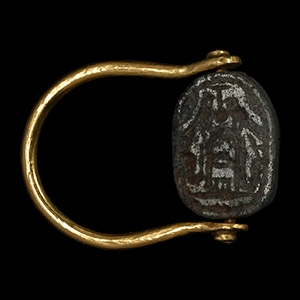
Phoenician Scarab in Gold Swivel Ring
6th-4th century B.C. and laterEstimate: £1,500 - 2,000 (‡+bp*)
Opening Bid: £675
The scarab with lightly incised anatomical detailing, the underside with a central cartouche flanked by two rearing crowned uraei, a pair of falcons standing above the cartouche facing a smꜣ hieroglyph symbolising union (of the two lands, Upper and Lower Egypt); set into a later gold swivel ring. 4.34 grams, 26.44 mm overall, 15.68 mm internal diameter (approximate size British J 1/2, USA 5, Europe 9.32, Japan 9)
with Bonhams, London, UK, 21 October 1999, no.36. Private collection, Europe. This lot has been checked against the Interpol Database of stolen works of art and is accompanied by a search certificate number no.12370-226696. This lot has been cleared against the Art Loss Register database, and is accompanied by an illustrated lot declaration signed by the Head of the Antiquities Department, Dr Raffaele D'Amato. -
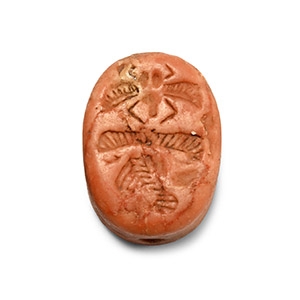
Phoenicio-Egyptian Orange Stone Scaraboid
1st millennium B.C.Estimate: £600 - 800 (+bp*)
Opening Bid: £300
Ellipsoid in plan with frieze comprising a large Maat feather, a winged sun disc, and a winged Khepri beetle. 13 grams, 27 mm
Ex collection of the late Mr S. M., London, UK, 1970-1990s. This lot is accompanied by an illustrated lot declaration signed by the Head of the Antiquities Department, Dr Raffaele D'Amato.
