
Loading, please wait...
_900x900.jpg "Egyptian Lower Legs from an Unfinished Limestone Figure")
_200x200.jpg "Egyptian Lower Legs from an Unfinished Limestone Figure")
.jpg "Egyptian Lower Legs from an Unfinished Limestone Figure")
LOT 0506
Egyptian Lower Legs from an Unfinished Limestone Figure
POSSIBLY FIRST INTERMEDIATE PERIOD, 2181-2055 B.C. OR LATER
4 in. (560 grams, 10.2 cm).
Showing the shins and two feet from a larger figure, rectangular section back and base. [No Reserve]
ProvenanceAcquired in the 1970s.
Property of a London gentleman.
TimeLine Auctions follows a vetting process to ensure the authenticity and legality of all items, reinforcing our commitment to integrity and responsible trading. Each antiquity, antique, and coin lot undergoes thorough examination by a vetting committee of at least ten external specialists, professional trade association members, scientists, and archaeologists: Our Vetting Process
AUCTIONS:
TimeLine is a leading auction house specialising in antiquities, ancient art, collectables, natural history, coins, medals, and books. Our auctions offer museums, collectors, historians, and enthusiasts the opportunity to acquire unique and historically significant pieces.
LOT 0506
Egyptian Lower Legs from an Unfinished Limestone Figure
Sold for (Inc. bp): £143
-
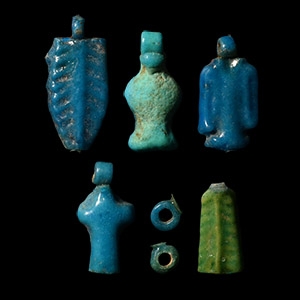
Egyptian Faience Amulet Group
New Kingdom, Amarna Period, 1353-1336 B.C.Sold for (Inc. bp): £169
Composed of polychrome amulets of various types, with suspension loops, including fruits and a feathered plume. 0.78 grams total, 3-13 mm
From an early 20th century collection, Surrey, UK. -
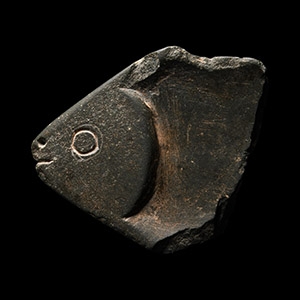
Egyptian Greywacke Cosmetic Fish Spoon Section
New Kingdom, 1569-1081 B.C.Estimate: £250 - 350 (+bp*)
Opening Bid: £125
A fragment of a greywacke cosmetic spoon, shaped as a fish with finely worked features and incised eye, scales, gill, and fin detailing; the underside is recessed to create the spoon bowl; accompanied by a custom-made display stand. 27 grams, 58 mm wide (50 grams total, 85 mm high including stand)
Fine condition.
Acquired in the 1980s. From a French collection. -
.jpg)
Romano-Egyptian Glass Millefiori Face Bead
Circa 1st century A.D.Estimate: £500 - 700 (+bp*)
Opening Bid: £278
Spherical in form with an opaque yellow body with three face-cane slices and three chequerboard slices. 5.35 grams, 16 mm
Acquired 1969-1999. From the private collection of the late Mr S.M., London, UK, thence by descent.
