
Loading, please wait...
LOT 0520
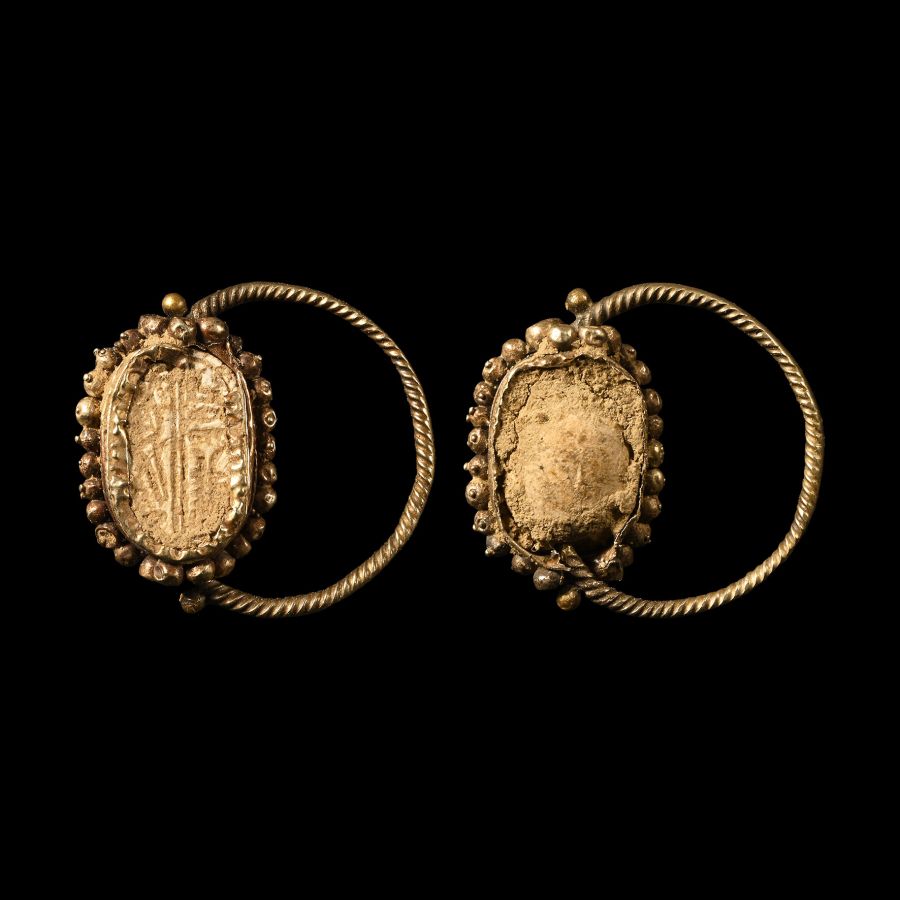
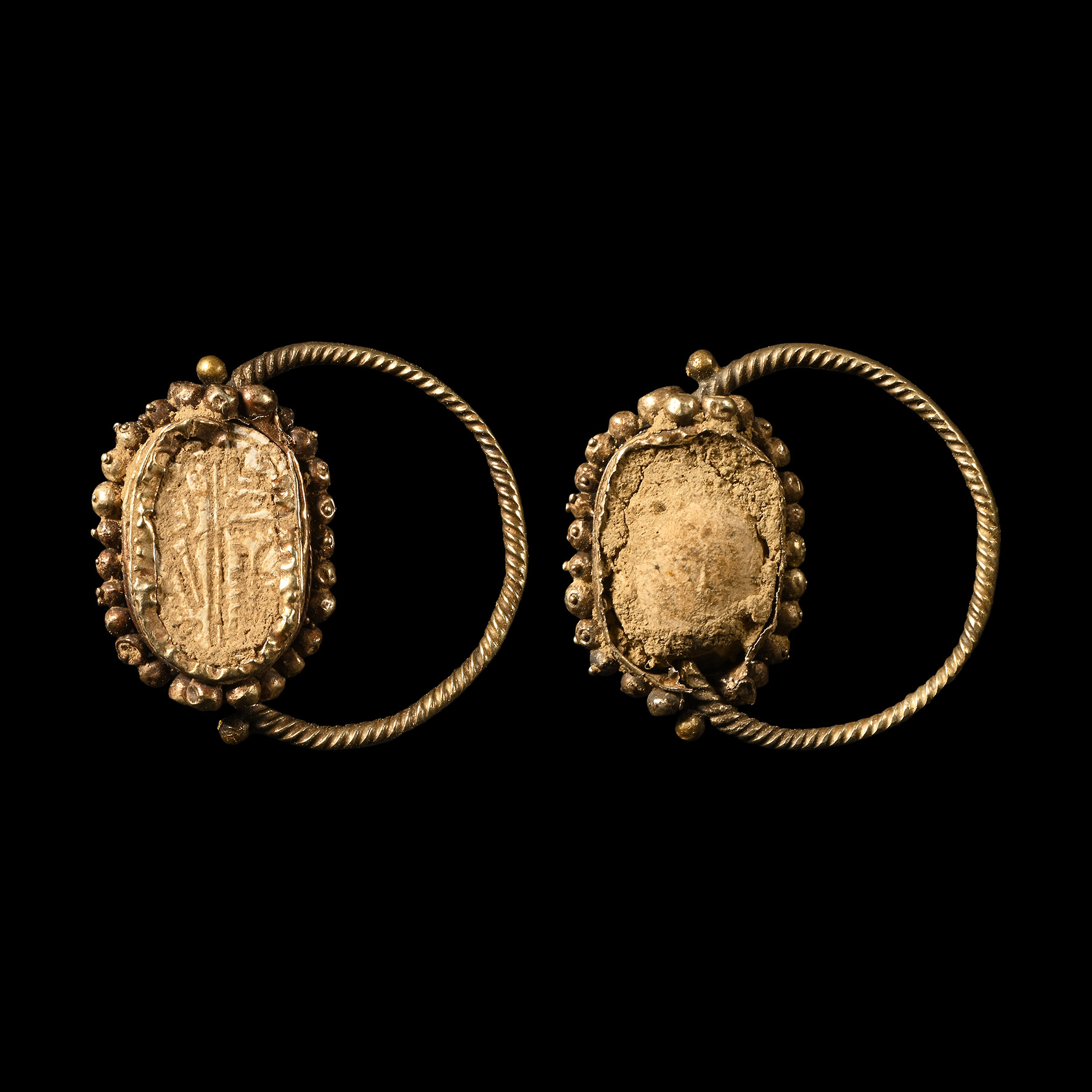
Egyptian Limestone Scarab in Gold Ring
CIRCA 1750-1550 B.C. AND LATER
1 in. (2.91 grams, 24.16 mm overall, 21.04 mm internal diameter).
The scarab carved with simple anatomical detailing with two columns of hieroglyphs to base, including a djed pillar; set in a later gold swivel bezel with beaded edge supported by a tapering, round-section grooved hoop.
ProvenanceCollected from 1970-1999.
From the collection of the late Mr S.M., London, UK.
Accompanied by a previous catalogue information card.
Cf. Chadour, A.B., Rings. The Alice and Louis Koch Collection, volume I, Leeds, 1994, items 39-42, for type.
FootnotesThe djed pillar was associated with the god Ptah, and from the New Kingdom onwards it was associated with the god Osiris, meaning stability, rejuvenation and regeneration. Thus it was used by both the living and the dead, formed of a variety of materials.
CONDITIONTimeLine Auctions follows a vetting process to ensure the authenticity and legality of all items, reinforcing our commitment to integrity and responsible trading. Each antiquity, antique, and coin lot undergoes thorough examination by a vetting committee of at least ten external specialists, professional trade association members, scientists, and archaeologists: Our Vetting Process
AUCTIONS:
TimeLine is a leading auction house specialising in antiquities, ancient art, collectables, natural history, coins, medals, and books. Our auctions offer museums, collectors, historians, and enthusiasts the opportunity to acquire unique and historically significant pieces.
-
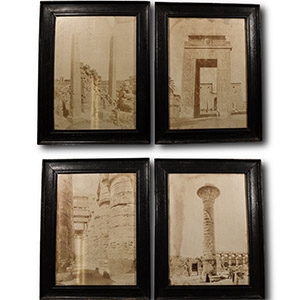
Original Framed Photographs of Egyptian Monuments
1922 A.D.Sold for (Inc. bp): £156
Group of four original photographs, each in a glazed wooden frame: (1) Karnak: Gateway of Ptolemy III Euergetes and Ptolemy IV Philopator at the Precinct of Montu (2) Obelisks at Karnak, on the right erected by Thutmose I (reign c. 1520 - 1492 BCE) and on the left by Hatshepsut (1479-1458 BCE) (3) Column of Taharqa, Karnak Temple (4) Karnak temple columns with hieroglyphs. 4.6 kg total, 46 x 35.5 cm each
Property of a North Lincolnshire, UK, gentleman. -
.jpg)
Egyptian Limestone Head of a Priest
Ptolemaic Period, 332-31 B.C. or laterSold for (Inc. bp): £2,340
With shaven head, finely modelled facial features, lined forehead; mounted on a custom-made stand. 1.8 kg total, 20 cm including stand
with J.J. Klejman, Madison Avenue, New York, USA, 1960s. UK collection, acquired from the above, 1960s.
The heads of priests in Egypt were customarily shaven for reasons of ritual purity. -
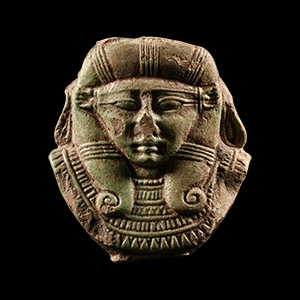
Egyptian Faience Sistrum Fragment with Hathor Head
Late Period, 664-332 B.C.Sold for (Inc. bp): £1,170
Pale blue-green bifacial bust of Hathor with D-shaped face, characteristic banded hair with curled ends, cow's ears, broad collar of radiating segments; circular attachment point beneath for handle. 44.4 grams, 50 mm
Acquired in the 1970s. European private collection.
This fragment is the central element of a highly decorative sistrum. The sistrum was a rattle-like instrument played exclusively by women in religious ceremonies. The sound produced by the sistrum was believed to drive away evil and soothe a god's anger. Hathor is the daughter of the sun god Re, and in her role as a mother goddess is often depicted as a cow or with bovine characteristics as here. Hathor is also associated with love, music and dancing, and the sistrum is one of her sacred symbols.
