
Loading, please wait...
LOT 0479
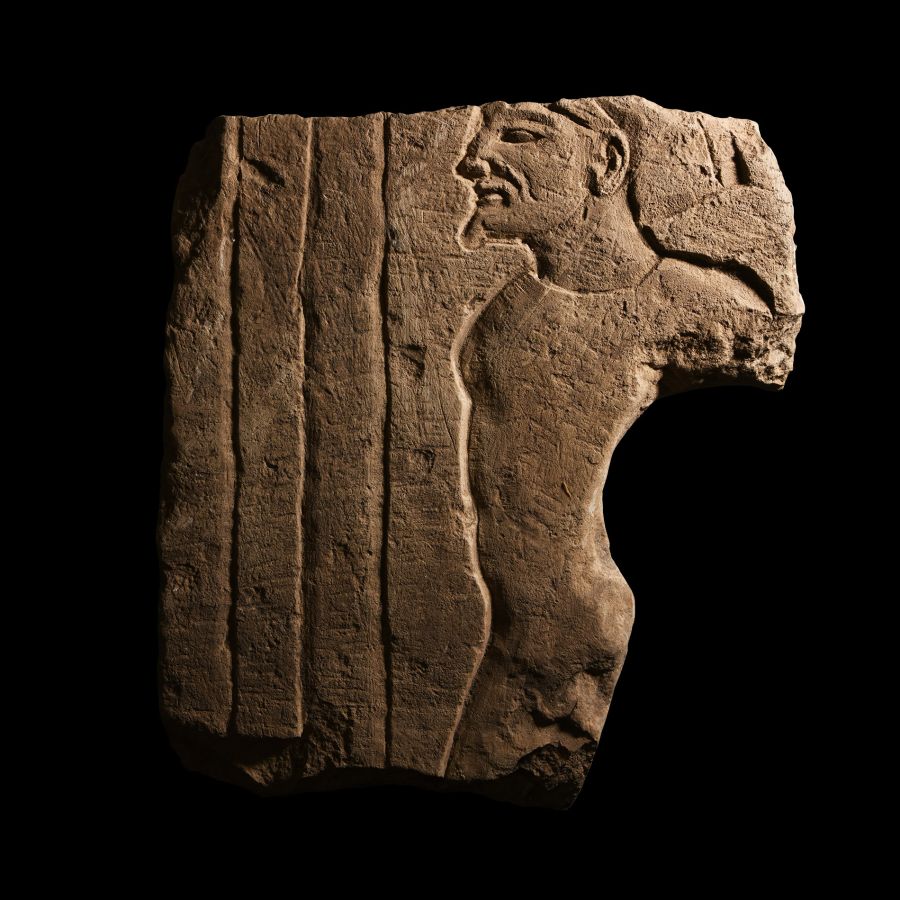
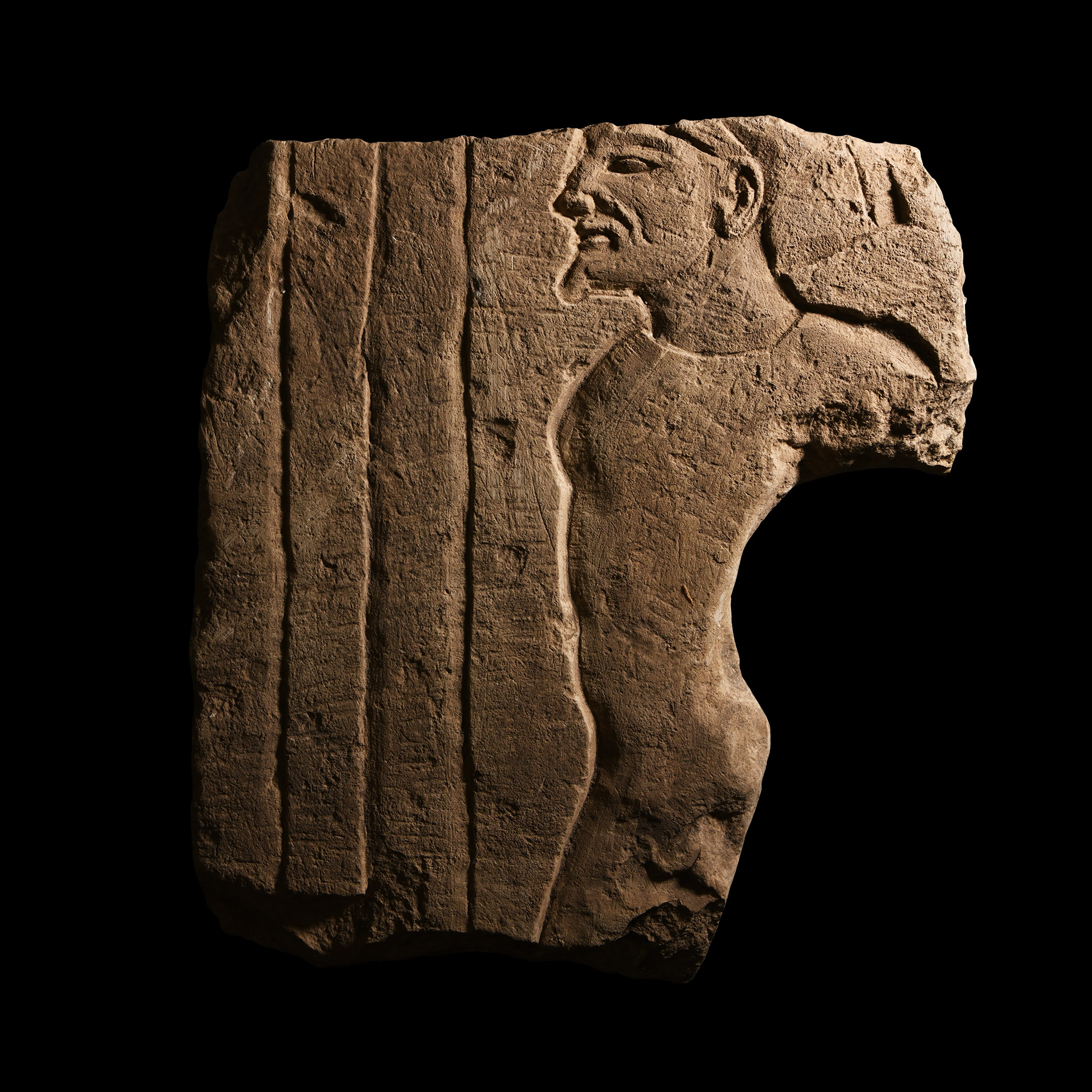
Egyptian Limestone Relief with Bound Asiatic Captive
NEW KINGDOM, 19TH DYNASTY, CIRCA 1250 B.C.
14 3/4 in. (14.5 kg, 37.5 cm high).
Sub-rectangular with keyhole-shaped aperture to the lower right edge; low-relief figure in profile wearing a tunic with circular neckline, bobbed hair swept behind the ears, sharp facial features with short goatee beard; bands of vertical fluting.
ProvenanceAcquired 1970s-1996.
Property of a North American collector.
London collection, 2016.
This lot has been checked against the Interpol Database of stolen works of art and is accompanied by search certificate number no. 11830-207550.
See Spalinger, A.J., Historical Observations on the Military Reliefs of Abu Simbel and Other Ramesside Temples in Nubia, in The Journal of Egyptian Archaeology Vol. 66, 1980; see also a similar image of a Syrian prisoner from the temple of Ramesses III at Tell el Yahudiyeh, in Caubet, A., Egyptian & Near Eastern Faience at the Louvre, in Minerva, September/October 2005, pp.8-10, fig.7.
FootnotesThe features and hairstyle of the figure resemble closely those of Asiatic captives shown on the outer wall of the temple of Ramesses II at Abu Simbel, Egypt. It is likely that the Egyptian artists from the time of Thutmose III onwards had frequent opportunities to observe the foreigners who came, or were brought into Egypt. It is likely that the Egyptian artists were interested in differentiating the various peoples encountered by the armies on their campaigns northward during the New Kingdom.
The remains of a circular aperture behind the figure probably indicates that the slab was re-used as a grindstone or a door pivot in ancient times.
TimeLine Auctions follows a vetting process to ensure the authenticity and legality of all items, reinforcing our commitment to integrity and responsible trading. Each antiquity, antique, and coin lot undergoes thorough examination by a vetting committee of at least ten external specialists, professional trade association members, scientists, and archaeologists: Our Vetting Process
AUCTIONS:
TimeLine is a leading auction house specialising in antiquities, ancient art, collectables, natural history, coins, medals, and books. Our auctions offer museums, collectors, historians, and enthusiasts the opportunity to acquire unique and historically significant pieces.
-
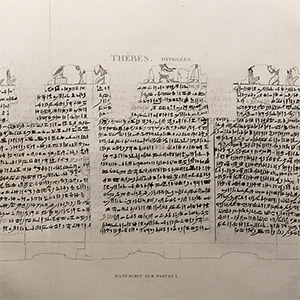
Large Egyptian Expedition Lithograph Print of Hieroglyphs
1820 A.D.Estimate: £150 - 200 (‡+bp*)
Opening Bid: £50
Leclerc - Thèbes - Hypogées - Manuscrit sur papyrus - Proof etching on laid paper of plate 69 from La Description de l’Égypte: Antiquités, Volume II: Commission des sciences et arts d’Égypte with later backing sheet. 350 grams, 132 x 65 cm
From the collection of a North American priest. Acquired between 1981-1996. Property of a North American collector.
Produced between February 1802 and 1830 on the orders of Napoleon Bonaparte; published between 1809 and 1828. Just 1,000 copies were distributed to various institutions, printed on on laid paper with an 'Égypte ancienne et moderne' watermark. The book is subtitled Recueil des observations et des recherches qui ont été faites en Égypte pendant l’expédition de l’Armée française, publié par les ordres de Sa Majesté l’Empereur Napoléon le Grand (Gathering of observations and discoveries which were made in Egypt during the expedition of the French army, published on the orders of His Majesty the Emperor Napoleon the Great). It was the world's first encyclopedia devoted exclusively to the remains of ancient Egypt. The plates of this book are the first to present the archaeological sites of Thebes (Luxor). The papyrus manuscript was recovered from the underground chambers (hypogea). The papyrus is now in the Bibliothèque Nationale, Paris. -
.jpg)
Egyptian Painted Wooden Mummy Mask
4th-3rd century B.C.Estimate: £4,000 - 6,000 (‡+bp*)
Opening Bid: £2,000
Displaying semi-naturalistic detailing in relief, beneath a band of headdress ornament composed of rows of architectural dot-and-dash and zig-zag patterns over a segmental panel, possible hieroglyphs to the top tier; attachment pegs to the sides of the face and through the head; extensive remains of painted black pigmentation and composition fill to the eyes. 677 grams, 36 cm
From a French estate, acquired between 1960 and 1980. with SAS Cornette de Saint Cyr Auction, Paris, Vente 882, Mobilier et Objets d'art, 2 December 2014, lot 69. Accompanied by a copy of a French cultural passport no.167062. Accompanied by an academic report by Dr Alberto Maria Pollastrini. This lot has been checked against the Interpol Database of stolen works of art and is accompanied by search certificate no.11807-206837. -
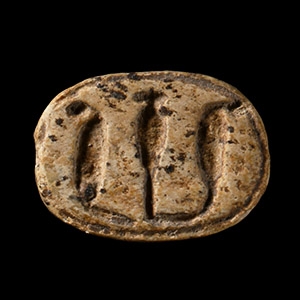
Egyptian Steatite Scaraboid Amulet with Royal Uraei and Vessel
Late Period, 664-332 B.C.Sold for (Inc. bp): £78
Ellipsoid scaraboid bead with base inscribed with a central hes-vase flanked by two uraei. 1.16 grams, 14 mm
Ex ArtAncient Ltd, London, SW6, in 2013, with stock no.15989. From the private collection of Mr A Hills, Kent, UK. Accompanied by a copy of an ArtAncient certificate of authenticity.
