
Loading, please wait...

LOT 0004
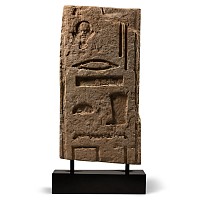
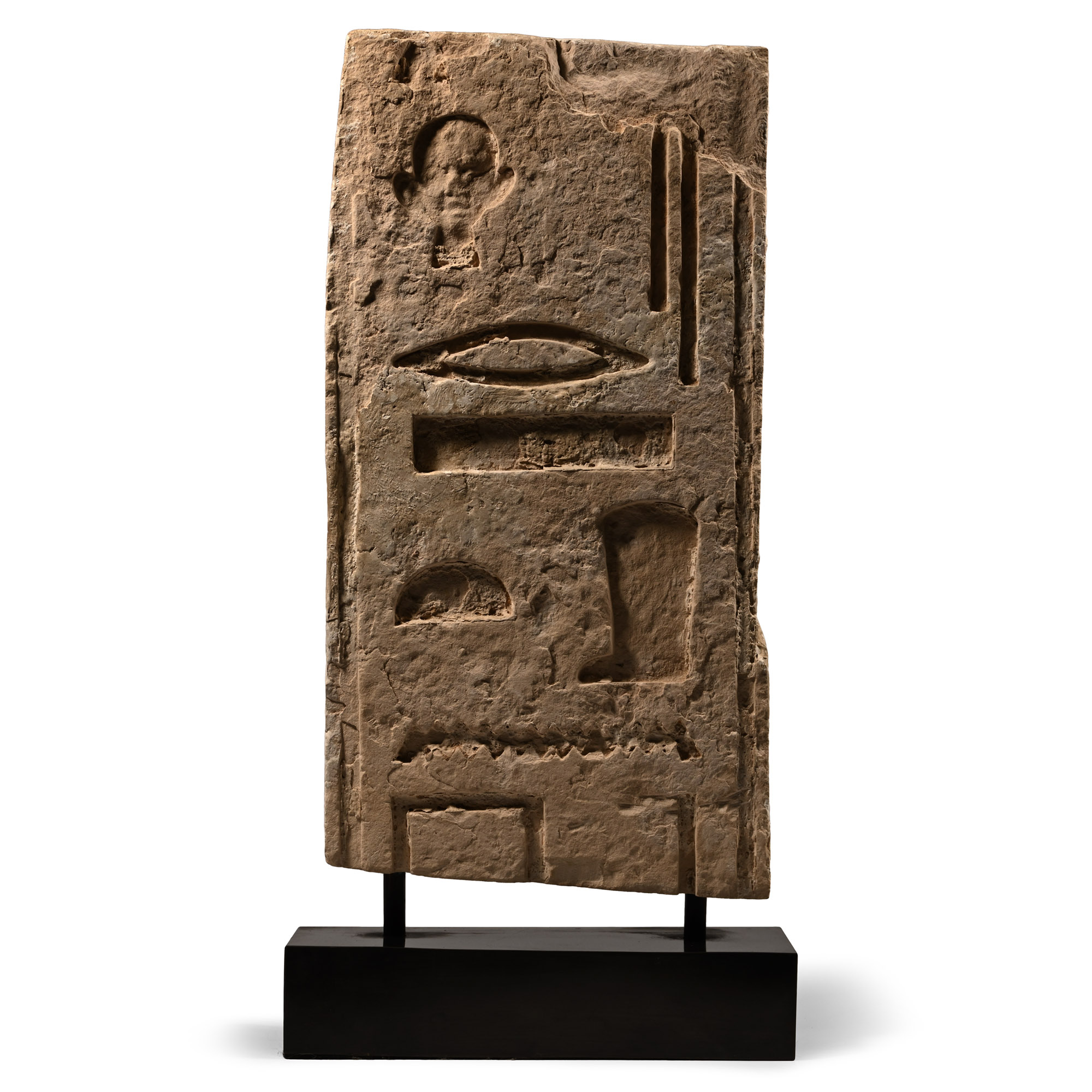
Egyptian Limestone Relief Fragment
OLD KINGDOM, 2686-2181 B.C.
19 7/8 in. (6.79 kg total, 50.5 cm high including stand).
Rectangular panel carved in sunk relief with vertical borders framing a portion of hieroglyphic inscription ...ḥry sštꜢ n..., '...keeper of secrets of...'.
ProvenanceReputedly acquired by a private collector in 1936.
Ex Ian Colverson Collection, UK (1940-2022).
This lot has been checked against the Interpol Database of stolen works of art and is accompanied by search certificate number no.12196-222436.
Cf. Simpson, W.K., The Offering Chapel of Kayemnofret in the Museum of Fine Arts, Boston, Boston, 1992, Figure B, for a complete false door.
FootnotesThe relief is most likely a fragment of a vertical inscription from a false door of an Old Kingdom tomb chapel. The complete inscription was probably an offering formula followed by a list of the tomb owner's titles. The 'keeper of secrets' is a priestly title indicating that one of his roles was as an embalmer.
CONDITIONTimeLine Auctions follows a vetting process to ensure the authenticity and legality of all items, reinforcing our commitment to integrity and responsible trading. Each antiquity, antique, and coin lot undergoes thorough examination by a vetting committee of at least ten external specialists, professional trade association members, scientists, and archaeologists: Our Vetting Process
AUCTIONS:
TimeLine is a leading auction house specialising in antiquities, ancient art, collectables, natural history, coins, medals, and books. Our auctions offer museums, collectors, historians, and enthusiasts the opportunity to acquire unique and historically significant pieces.
-
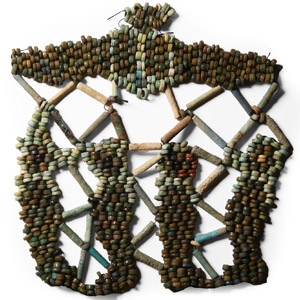
Egyptian Faience Beaded Sons of Horus Panel
Ptolemaic Period, 332-30 B.C.Sold for (Inc. bp): £130
Openwork restrung panel depicting Imsety, Hapy, Duamutef, and Qebehsenuef, the Four Sons of Horus with a winged scarab above; restrung. 21.4 grams, 12 cm
Ex Mariaud de Serres, Paris, France, 1990s. From a London, UK, collection.
Winged scarabs were often used as funerary amulets and believed to symbolise the deceased's rebirth and regeneration. The Four Sons of Horus were deities responsible for protecting the deceased's internal organs. Here, on the left, is the erect-eared jackal-headed Duamutef, who protects the stomach. Next is the falcon-headed Qebehsenuef, who protects the intestines. Then comes the human-headed Imsety, protector of the liver, and finally, the baboon-headed Hapy on the right, protector of the lungs. -
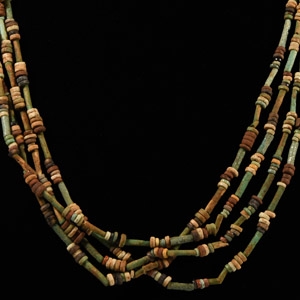
Egyptian Multi-Stranded Mummy Bead Necklace
Late Period, 664-525 B.C.Sold for (Inc. bp): £85
Multi-stranded restrung composition necklace composed of beads of mainly annular and tubular types. 27 grams, 66 cm
Acquired before 1979. From the private collection of Mr F. A., South Kensington, London, UK; thence by descent 2014.
For thousands of years, artisans in Egypt created vibrant ceramics to echo the beauty of rare jewels. These ornaments were created with almost every material, colour, and texture imaginable and they come from across Egypt and beyond: vibrant blue lapis lazuli from Afghanistan, glossy black obsidian from Turkey, and aqua-green turquoise from the Sinai. They were worn in life and, after death, they served as precious ornamentation for mummies. -
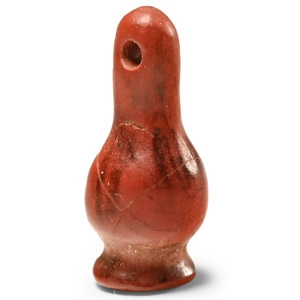
Egyptian Jasper Poppy Head Amulet
New Kingdom, 18th-19th Dynasty, circa 1550-1213 B.C.Sold for (Inc. bp): £104
Polished and with integral pierced suspension loop. 0.78 grams, 15 mm
From an early 20th century collection.
Amulets in the form of poppies were used to heal, alleviate pain, and ward off death. This type of amulet was also associated with Osiris, the Egyptian deity of agriculture, death, and the afterlife.
