
Loading, please wait...
_900x900.jpg "Egyptian Limestone Painted Shabti Inscribed for Ir-Nu")
_200x200.jpg "Egyptian Limestone Painted Shabti Inscribed for Ir-Nu")
_900x900.jpg "Egyptian Limestone Painted Shabti Inscribed for Ir-Nu")
_200x200.jpg "Egyptian Limestone Painted Shabti Inscribed for Ir-Nu")
_900x900.jpg "Egyptian Limestone Painted Shabti Inscribed for Ir-Nu")
_200x200.jpg "Egyptian Limestone Painted Shabti Inscribed for Ir-Nu")
.jpg "Egyptian Limestone Painted Shabti Inscribed for Ir-Nu")
.jpg "Egyptian Limestone Painted Shabti Inscribed for Ir-Nu")
.jpg "Egyptian Limestone Painted Shabti Inscribed for Ir-Nu")
LOT 0023
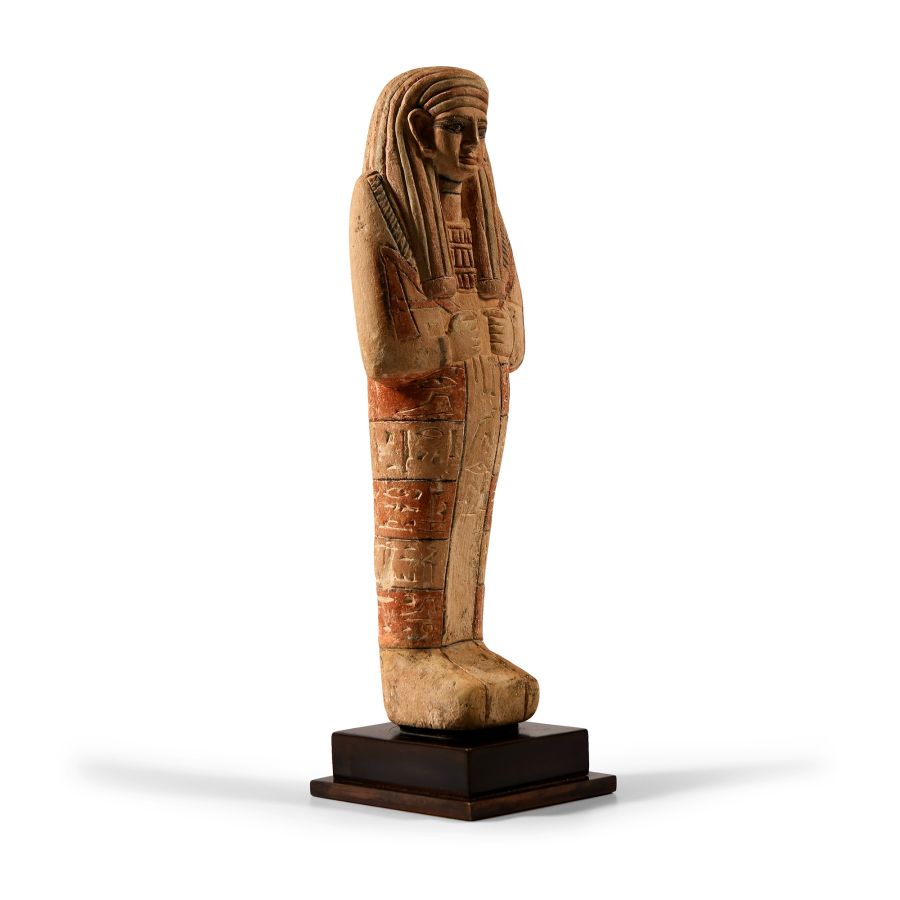
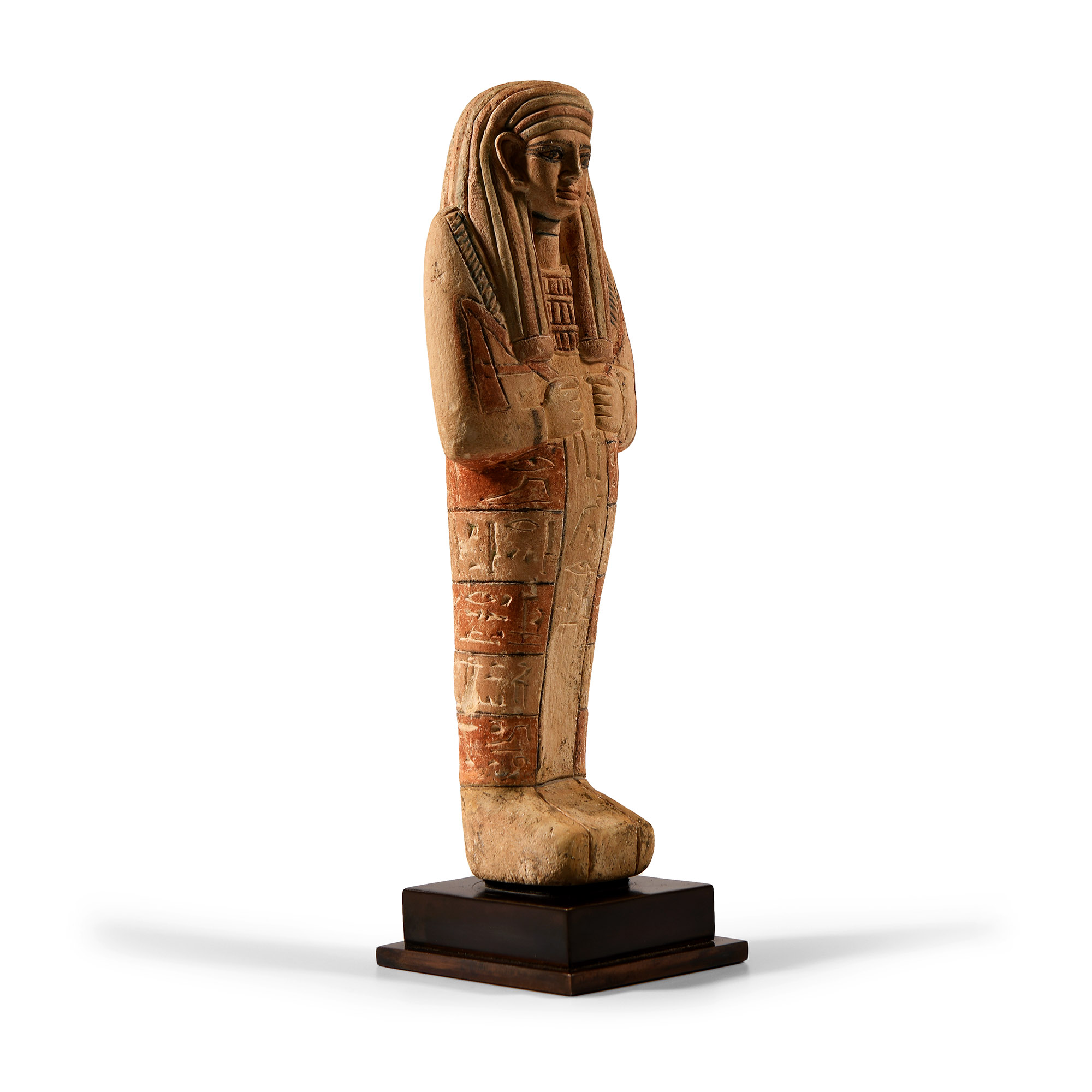
Egyptian Limestone Painted Shabti Inscribed for Ir-Nu
NEW KINGDOM, 19TH-20TH DYNASTY, 1295-1077 B.C.
11 1/8 in. (1.4 kg total, 28.4 cm high including stand).
Inscribed for Ir-nu; with carefully modelled face, large eyes and unnaturally large ears, wearing a neck-strap, a long tripartite wig with incised striations and a broad three-band collar; holding a pick in his left hand, a hoe in the right and a seed bag hanging over the left shoulder; the unusual position of the hands opposed on the chest; the text beginning in the vertical column running down the front of the figure, continuing in five horizontal bands with pale red-ochre pigment colouring to the top, middle and bottom bands; the same pigment used to colour the implements and also alternates with blue striations of the wig, the neck strap and details of the collar also in blue; the inscription from the Book of the Dead Chapter 6, reading: (Vertical column:) 'The illuminated one, the Osiris' (Horizontal rows:) 1) Ir-nu, true of voice, he says: O, this shabti 2) if one is counted, if one is reckoned to do the work 3) [to do all that is to be done in] the god’s land, to cultivate the riparian lands, transport by boat 4) [sand of] the west to the east, to act 5) at any time, to serve there (you) shall say true of voice(?).
ProvenanceCarieau family collection, Belgium, acquired in 1952.
Ex Maspero collection, Paris, 1963.
Acquired from a private European collection, in 1978.
Accompanied by a copy of a technical report by Edmund S. Meltzer Ph.D.
Accompanied by an academic report by Egyptologist Paul Whelan.
This lot has been checked against the Interpol Database of stolen works of art and is accompanied by a search certificate number no.12080-217053.
Exhibited: The European Fine Art Foundation (TEFAF) 2016, Booth 430, Maastricht Exhibition & Congress Centre, Maastricht, Netherlands.
LiteratureCf. Newberry, P., Funerary Statuettes and Model Sarcophagi, Catalogue général des Antiquités égyptiennes du musée du Caire, Nos.46530-48575, Cairo 1930-1957, pp.378-379 (CG 48497), pl. XXI; see Donald, B., Funerary Figurines in Oxford Encyclopaedia of Ancient Egypt, vol 1, New York, 2000, pp.568-569; see also Schneider, H.D., Shabtis. An Introduction to the History of Ancient Egyptian Funerary Statuettes with a Catalogue of the Collection of Shabtis in the National Museum of Antiquities at Leiden, 3 vols., Leiden 1977, V.2, p.73, (3.2.1.55), pl.100; V.3 p.26.
CONDITIONTimeLine Auctions follows a vetting process to ensure the authenticity and legality of all items, reinforcing our commitment to integrity and responsible trading. Each antiquity, antique, and coin lot undergoes thorough examination by a vetting committee of at least ten external specialists, professional trade association members, scientists, and archaeologists: Our Vetting Process
AUCTIONS:
TimeLine is a leading auction house specialising in antiquities, ancient art, collectables, natural history, coins, medals, and books. Our auctions offer museums, collectors, historians, and enthusiasts the opportunity to acquire unique and historically significant pieces.
LOT 0023
Egyptian Limestone Painted Shabti Inscribed for Ir-Nu
Sold for (Inc. bp): £18,200
-
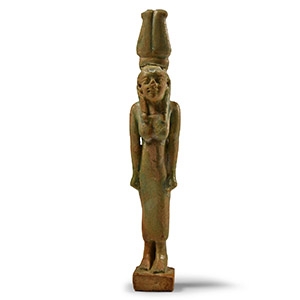
Egyptian Silver Neith Amulet
Late Period, 664-332 B.C.Sold for (Inc. bp): £46
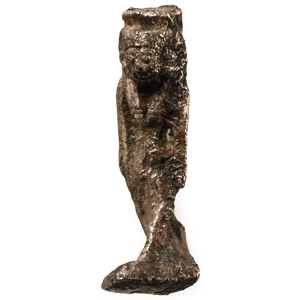
Modelled in the round with hands to her sides, dished panel above the head. 4.03 grams, 24 mm
Acquired from a London, UK, collection in 1980. From the personal collection of a West London, UK, gentleman. -
Large Egyptian Faience Amulet of the Goddess Isis
Late Period-Ptolemaic Period, 664-30 B.C.Estimate: £1,200 - 1,700 (‡+bp*)
Opening Bid: £600
The goddess dressed in a long tight-fitting tunic to her ankles, standing with her left leg forward, her straight arms descending to her thighs; vulture headgear surmounted two long feathers; dorsal pillar with hieroglyphic text; repaired. 50 grams, 14 cm
Private collection Mr E. Saad, Cairo, Egypt-Montreux, Switzerland, 1970s. Ex private collection of Mr S.A., acquired from Mr Saad in 1997.
In ancient Egyptian mythology, Isis was the sister-wife of Osiris and the mother of the sky god Horus. She is associated with aspects of fertility and motherhood. This amulet unusually depicts her with a two-plumed crown, which may associate her with the goddess Sothis. -
.jpg)
'Egyptian Blue' Counter Weight Menat Amulet
Late Period, 664-525 B.C.Estimate: £800 - 1,000 (+bp*)
Opening Bid: £400
Amuletic pendant with broad bale, keyhole-shaped plaque with gusset to the rim. 14 grams, 67 mm
Acquired on the German art market, 1989-1995. with The Museum Gallery, 19 Bury Place, London, WC1A 2JB, 1998-2003. Property of a London based academic, 2003-present.
The menat necklace was a sacred item of great importance to female Egyptian goddesses, particularly Hathor. Priestesses of Hathor and other powerful goddesses used the necklace as a rattle, holding it in their hand by the counterpoise and evoking protection from the sound of the shaken beads. The amuletic menat counterweight symbolised the whole elaborate necklace. The menat was considered a powerful magical amulet throughout Egyptian history, offering good luck and protection against evil spirits. It was often buried with the dead for protection in the afterlife and was believed to promote fertility and good health for women while signifying virility for men.
