
Loading, please wait...
LOT 0496
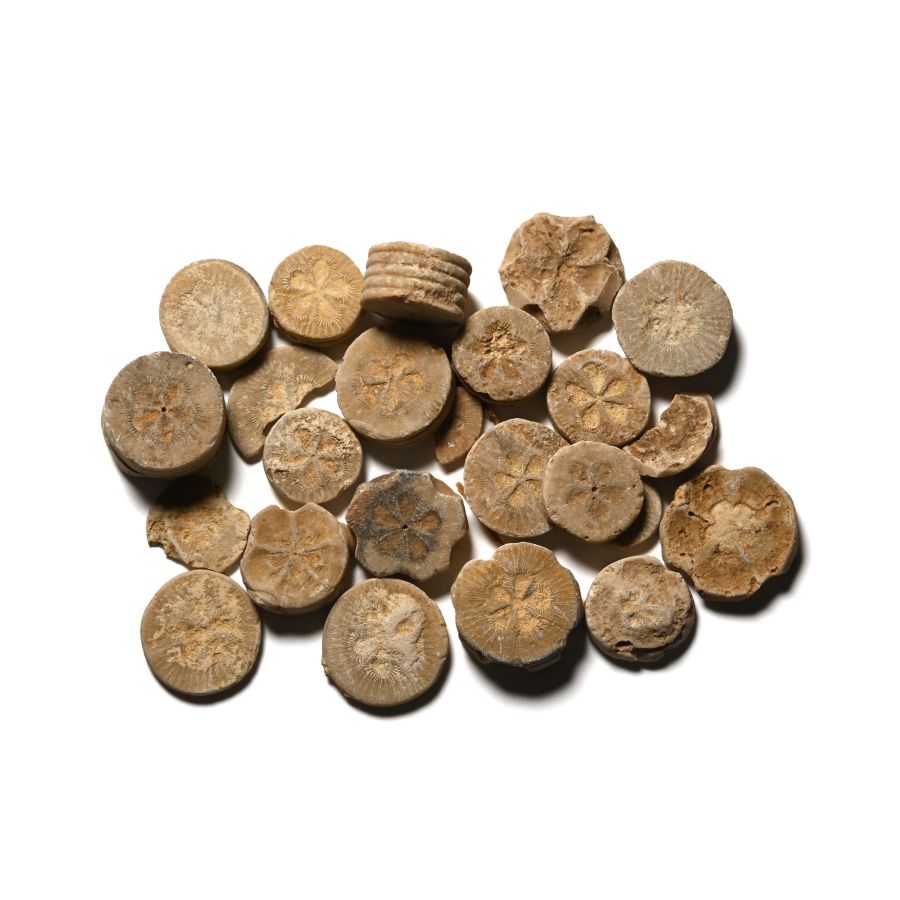
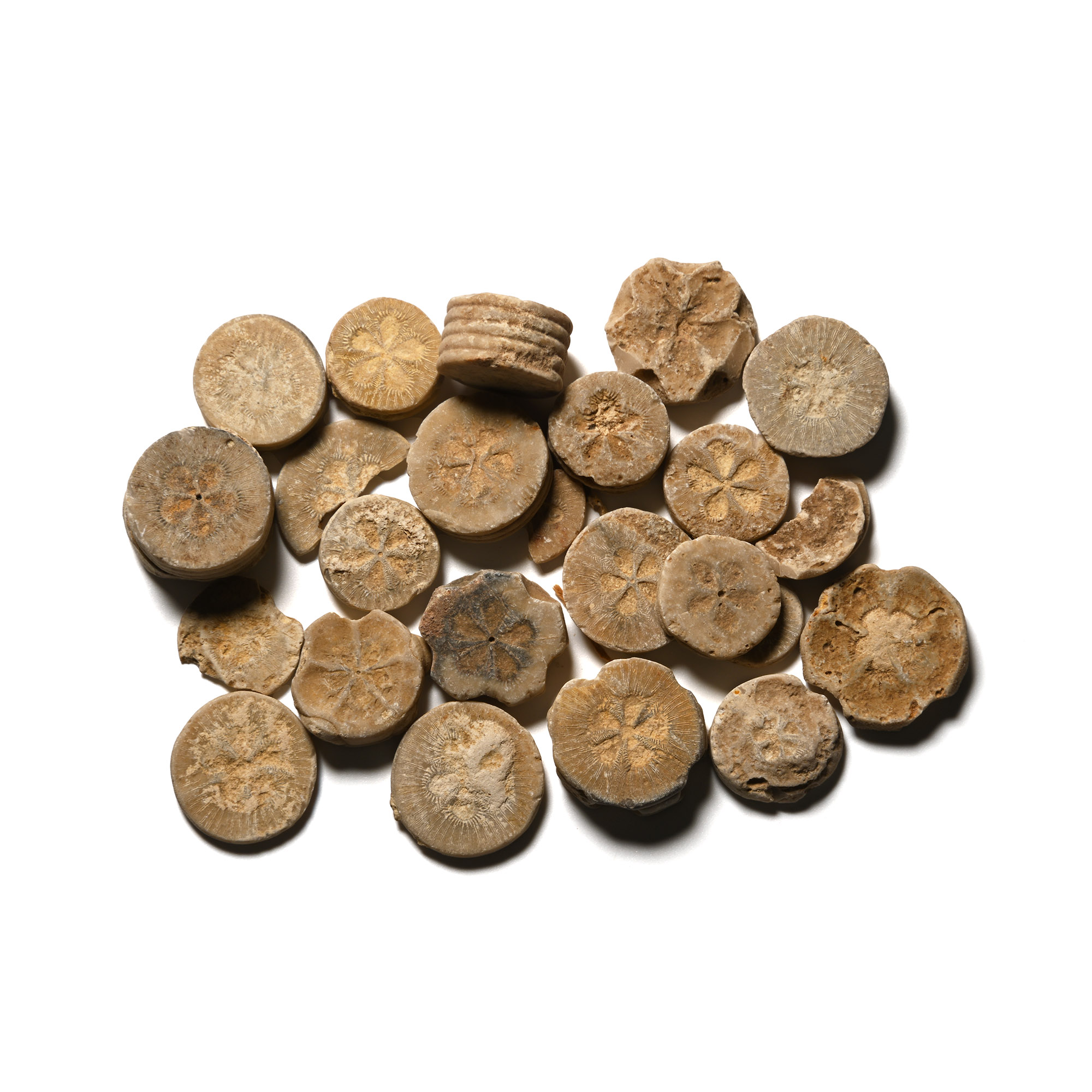
Egyptian Limestone Floral Inlay Group
ROMAN PERIOD, 30 B.C.-323 A.D. OR EARLIER
1/2 - 3/4 in. (48.8 grams total, 12-20 mm).
Group of cylindrical and discoid inlay plaques or gaming counters, crinoids with cinquefoil motif. [21, No Reserve]
ProvenanceFrom a central London ADA dealership, 1980-1990.
This lot is accompanied by an illustrated lot declaration signed by the Head of the Antiquities Department, Dr Raffaele D'Amato.
Flowers were symbolic of rebirth due to the daily reopening of their petals after nightfall. As a result, they were widely used in domestic settings, religious and funerary contexts, and as adornments. Similar rosette discs, like those recovered from the Ramesside Period palace at Qantir, were used as decorative elements in royal palaces.
CONDITIONTimeLine Auctions follows a vetting process to ensure the authenticity and legality of all items, reinforcing our commitment to integrity and responsible trading. Each antiquity, antique, and coin lot undergoes thorough examination by a vetting committee of at least ten external specialists, professional trade association members, scientists, and archaeologists: Our Vetting Process
AUCTIONS:
TimeLine is a leading auction house specialising in antiquities, ancient art, collectables, natural history, coins, medals, and books. Our auctions offer museums, collectors, historians, and enthusiasts the opportunity to acquire unique and historically significant pieces.
-
.jpg)
Egyptian Silver Bezel for the 'Treasurer of the god, chief keeper (of) the House of Gold'
25th Dynasty, 754-656 B.C.Sold for (Inc. bp): £2,080
Rectangular with sloping faces on the underside, the upper face with two lines of hieroglyphic inscription reading: ‘Treasurer of the god, chief keeper (of) the House of Gold, great (of) Ra, Pa-di-Ra son of Pa-khered-tawy (or Pa-shery-tawy)’. 2.56 grams, 12 mm
with Bonhams, London, 27 April 2006. with Galerie Rhéa, Zurich, Switzerland. This lot is accompanied by an illustrated lot declaration signed by the Head of the Antiquities Department, Dr Raffaele D'Amato.
The ‘Treasurer of the god’ is a long-attested title known since the Old Kingdom (Jones, D., An Index of Ancient Egyptian Titles, Epithets and Phrases of the Old Kingdom, vol. II, Oxford, 2000, p. 767, no. 2791). The ‘Chief keeper’ title is known from the New Kingdom (for a similar writing of the title, see Al-Ayedi, A.R., Index of Egyptian Administrative, Religious and Military Titles of the New Kingdom, Ismailia, 2006, p. 395, no. 1236). The last part of the title is somewhat curious; the determinative at the end, previously interpreted as ‘Ra’, does not match the determinative for this god in the second line. An alternative tentative interpretation could be ‘Chief keeper, of the gold of the Pharaoh’, treating the pr and ꜤꜢ signs, which are shown side-by-side, as writing ‘Pharaoh’, with the seated figure wearing the Dual Crown symbolising the ruler. -
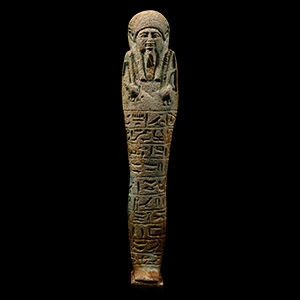
Egyptian Blue Glazed Hieroglyphic Shabti for Ta-Amun
Saite Period, 26th Dynasty, 664-525 B.C. or laterEstimate: £1,200 - 1,700 (+bp*)
Opening Bid: £600
Slender columnar shabti featuring a dorsal pillar, with ten rows of hieroglyphic text on the lower body beginning with the dedication 'The illuminated one, the Osiris priest Ta-Amun born of Ta-seh-nebty' ( sḥḏ wsỉr ḥm nṯr TꜢ-I͗mn ms (n) TꜢ-sḥ-nbty); the features of the small face are finely modelled, including a long, plaited false beard and a heavy lappet wig; the arms are crossed, with hands holding a pick and a hoe, along with a cord for a seed bag. 137 grams, 17.8 cm
Acquired on the German art market, 1989-1995. with The Museum Gallery, 19 Bury Place, London, WC1, UK, 1998-2003. Property of a London based academic, 2003-present. This lot is accompanied by an illustrated lot declaration signed by the Head of the Antiquities Department, Dr Raffaele D'Amato. -
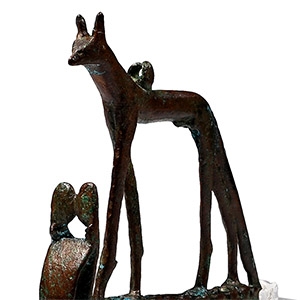
Large Egyptian Bronze Wepwawet Amulet
Third Intermediate-Late Period, 1069-332 B.C.Estimate: £4,000 - 6,000 (‡+bp*)
Opening Bid: £2,000
Showing the jackal deity Wepwawet standing with ears pricked on a sledge, the slender body modelled with long legs and a tail, suspension loop on the back; two rearing cobras before the jackal; mounted on a custom-made display stand. 54 grams, 91 mm (162 grams total, 11.7 cm including stand )
Ex Dr R. and Mrs L.B., Zumikon, Switzerland. with Galerie Rhéa, Zurich, Switzerland. This lot has been checked against the Interpol Database of stolen works of art and is accompanied by a search certificate number no.12627-236406. This lot has been cleared against the Art Loss Register database, and is accompanied by an illustrated lot declaration signed by the Head of the Antiquities Department, Dr Raffaele D'Amato.
Wepwawet, meaning "Opener of the Ways," was an ancient Egyptian god associated primarily with warfare, protection, and funerary practices. Depicted as a jackal or a man with a jackal's head—often mistaken for Anubis—Wepwawet was believed to guide souls through the afterlife and open paths both in battle and in the spiritual realm. He originated in Asyut (ancient Lycopolis) in Upper Egypt and was one of the oldest deities in the Egyptian pantheon, with worship dating back to at least the First Dynasty (c. 3100–2900 BCE). Over time, Wepwawet became closely linked to Anubis, and the two were sometimes conflated, though Wepwawet retained his distinct identity as a god who preceded and cleared the way. In military contexts, Wepwawet was invoked to "open the way" for pharaohs and armies, ensuring victory and safe passage. In funerary texts, he was described as clearing the path to the afterlife, acting as a scout or guide for the deceased.
